
In the modern data-driven world, Data Processing has become the backbone of analytics, machine learning, and decision-making systems. Whether you’re analyzing customer behavior, financial trends, or scientific experiments, understanding how to standardize and interpret data is essential.
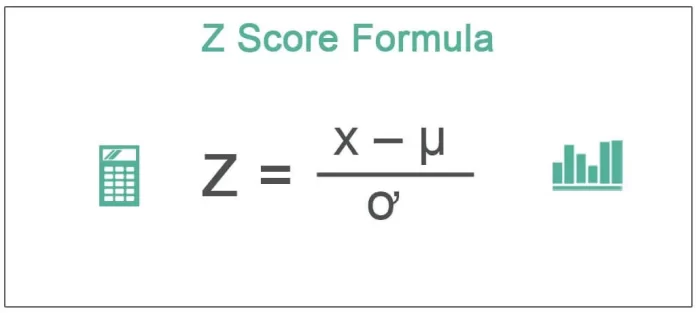
One of the most powerful statistical tools used in Data Processing is the Z Score Formula, a concept rooted in Standard Score. It helps transform raw data into a standardized format, making comparisons easier across datasets.
What is a Z Score?
A Z Score (also called a standard score) measures how many standard deviations a data point is from the mean of a dataset.
- Positive Z Score → Value is above the mean
- Negative Z Score → Value is below the mean
- Zero Z Score → Value equals the mean
In Data Processing, Z Scores are essential for:
- Detecting outliers
- Normalizing data
- Comparing values across different scales
Why Z Score Matters in Data Processing
Data rarely comes in a clean, comparable format. Different datasets may have:
- Different units
- Different ranges
- Different distributions
This is where Data Processing techniques like Z Score normalization become crucial.
Beyond basic normalization, the Z Score Formula plays a deeper and more strategic role in Data Processing, especially when dealing with large-scale, real-world datasets. Modern data systems often integrate information from multiple sources—different regions, formats, and measurement units. Without standardization, comparing such data becomes unreliable. Z Score eliminates this inconsistency by transforming all values into a common statistical scale, making cross-dataset analysis far more meaningful.
Another important reason Z Score matters in Data Processing is its role in decision intelligence. Businesses rely on data to make critical decisions—such as identifying high-performing products, detecting unusual customer behavior, or optimizing operations. By converting raw values into standardized scores, Z Score enables analysts to quickly spot deviations from the norm. This is particularly useful in industries like finance and e-commerce, where even small anomalies can have significant implications.
Key Benefits:
- Converts data into a standard scale
- Enables fair comparison
- Improves machine learning model performance
- Helps identify anomalies
Z Score Formula Explained
The Z Score Formula is the mathematical representation used to standardize values:
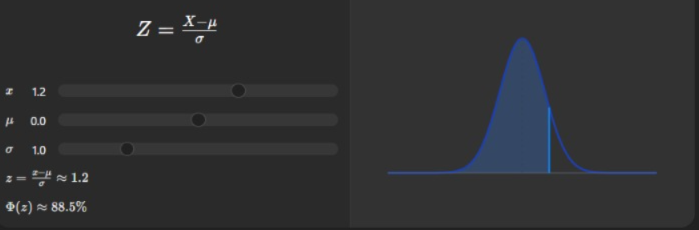
Where:
- Z = Z Score
- X = Data point
- μ (mu) = Mean of the dataset
- σ (sigma) = Standard deviation
Components of the Z Score Formula
Understanding each component is essential for effective Data Processing:
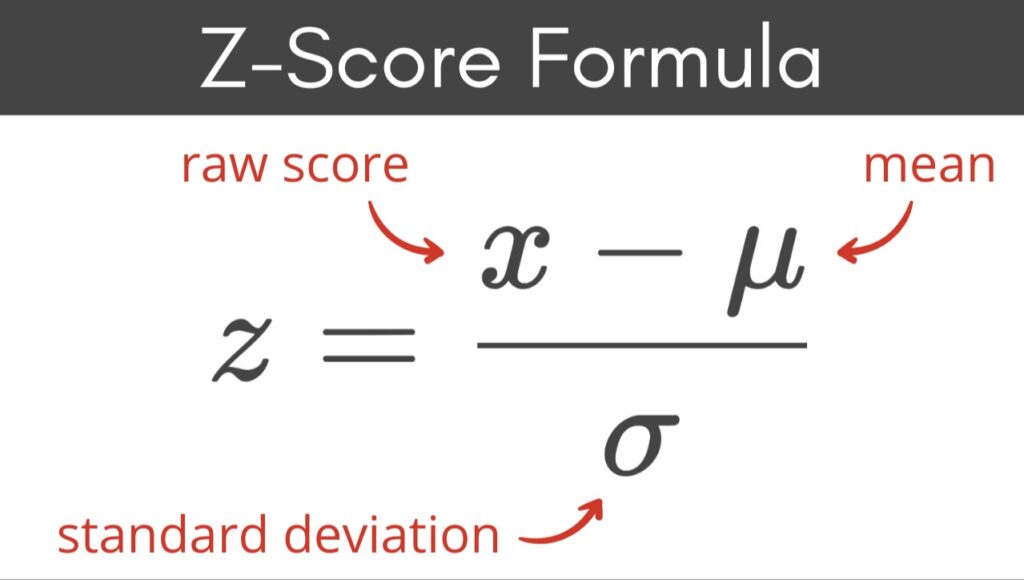
The components of the Z Score Formula are fundamental to understanding how standardization works in Data Processing. The formula is based on three key elements: the data point (X), the mean (μ), and the standard deviation (σ). The data point (X) represents the individual value you want to evaluate within a dataset. The mean (μ) is the average of all values and serves as the central reference point in the distribution. The standard deviation (σ) measures how spread out the data is around the mean, indicating the variability within the dataset. Together, these components help determine how far a specific value deviates from the average. In Data Processing, this deviation is crucial for identifying patterns and anomalies. A higher standard deviation means data points are widely spread, while a lower value indicates they are closely clustered. The mean ensures that all comparisons are anchored to a consistent baseline. The data point allows for individual-level analysis within the dataset. By combining these three elements, the Z Score provides a standardized measure that makes different datasets comparable and more meaningful for analysis.
1. Mean (μ)
The average value of the dataset.
2. Standard Deviation (σ)
Measures how spread out the data is.
3. Data Point (X)
The individual value you want to evaluate.
Step-by-Step Calculation with Examples
Let’s walk through a real-world example used in Data Processing.
Example: Student Exam Scores
Dataset: 60, 70, 80, 90, 100
- Mean (μ) = 80
- Standard Deviation (σ) = 14.14 (approx)
- Data Point (X) = 90
Calculation:
Z = (90 − 80) / 14.14
Z ≈ 0.71
Interpretation:
The score 90 is 0.71 standard deviations above the mean.
Real-Time Example: Salary Analysis
In a company:
- Average salary = ₹50,000
- Standard deviation = ₹10,000
- Employee salary = ₹70,000
Z = (70,000 − 50,000) / 10,000 = 2
This employee earns significantly above average.
Real-World Applications in Data Processing
Z Score plays a critical role in various domains:
1. Outlier Detection
One of the most important applications of Z Score in Data Processing is identifying outliers. In large datasets, unusual values can significantly distort analysis and lead to incorrect conclusions. By calculating the Z Score for each data point, analysts can easily identify values that fall far from the mean. For instance, in an e-commerce dataset, if most product prices range between ₹500 and ₹2000 but one product is listed at ₹50,000, the Z Score will flag it as an anomaly. This helps data professionals clean the dataset by removing or correcting such values, ensuring more accurate analysis and model performance.
- Detect fraud in banking
- Identify anomalies in sensor data
2. Machine Learning
Z Score normalization is a critical step in machine learning pipelines, which rely heavily on efficient Data Processing. Many algorithms, such as linear regression and clustering techniques, perform better when input features are standardized. For example, consider a dataset with features like age (ranging from 18 to 60) and income (ranging from ₹10,000 to ₹1,00,000). Without normalization, the model may give more importance to income due to its larger scale. Z Score ensures that all features are on the same scale, improving model accuracy and reducing bias.
- Feature scaling
- Model optimization
3. Finance
In the financial sector, Z Score is widely used in Data Processing to detect fraudulent activities. Banks and payment systems analyze transaction data in real time to identify unusual behavior. For example, if a customer typically spends ₹2,000 per transaction but suddenly makes a purchase worth ₹1,00,000, the Z Score for that transaction will be significantly high. This deviation alerts the system to flag the transaction for further verification. Such real-time anomaly detection helps prevent fraud and enhances the security of financial systems.
- Risk analysis
- Stock volatility comparison
4. Healthcare
In healthcare, Z Score is widely used in Data Processing to interpret medical test results. Doctors often compare patient data against population averages to detect abnormalities. For example, in growth charts for children, Z Scores help determine whether a child’s height or weight is within a normal range. If the Z Score is too high or too low, it may indicate a potential health issue. This standardized approach allows healthcare professionals to make accurate diagnoses and provide better treatment plans.
- Identify abnormal test results
5. Stock Market and Risk Analysis
In stock market analysis, Z Score is used to evaluate how far a stock’s return deviates from its average performance. This is an essential part of Data Processing in financial analytics. Traders and analysts use Z Scores to identify overvalued or undervalued stocks. For instance, if a stock has a very high positive Z Score, it may indicate that the stock is overbought and could soon correct itself. Similarly, a very low Z Score might signal a buying opportunity. This helps investors make more informed decisions based on statistical evidence.
6. Quality Control in Manufacturing
Manufacturing industries rely on Z Score as part of their Data Processing systems to maintain product quality. During production, measurements such as weight, size, or temperature are continuously monitored. If a product’s measurement deviates significantly from the standard value, its Z Score will indicate an anomaly. This allows manufacturers to quickly identify defects and take corrective action, reducing waste and ensuring consistent product quality.
7. Recommendation Systems and User Behavior Analysis
Online platforms like e-commerce websites and streaming services use Z Score in Data Processing to analyze user behavior. By standardizing user activity data—such as time spent, clicks, or purchases—systems can identify patterns and preferences. For example, if a user’s activity level is significantly higher than average, their Z Score will reflect this, helping platforms personalize recommendations. This improves user experience and increases engagement.
8. IoT and Sensor Data Monitoring
In Internet of Things (IoT) systems, sensors generate massive amounts of real-time data. Z Score plays a key role in Data Processing by detecting anomalies in this data stream. For instance, in a smart factory, sensors monitor machine temperature and vibration levels. If a machine starts behaving abnormally, its Z Score will spike, indicating a potential failure. This enables predictive maintenance, reducing downtime and saving costs.
9. Education and Performance Analysis
Educational institutions use Z Score in Data Processing to evaluate student performance. Instead of relying solely on raw scores, Z Scores provide a standardized way to compare students across different exams or subjects. For example, if one exam is more difficult than another, raw scores may not be directly comparable. Z Score adjusts for this difference, allowing fair assessment and ranking of students.
10. Marketing and Customer Segmentation
In marketing analytics, Z Score is used in Data Processing to segment customers based on behavior and preferences. By analyzing metrics such as purchase frequency, spending habits, and engagement levels, businesses can identify high-value customers. For instance, customers with high Z Scores in spending behavior may be targeted for premium offers, while those with lower scores may receive promotional discounts. This data-driven approach improves marketing effectiveness and ROI.
Z Score vs Other Standardization Techniques
| Technique | Description | Use Case |
| Z Score | Mean-based normalization | General Data Processing |
| Min-Max Scaling | Scales between 0 and 1 | Neural networks |
| Robust Scaling | Uses median & IQR | Outlier-heavy data |
In Data Processing, the Z Score method stands out because it standardizes data based on the mean and standard deviation, making it ideal for datasets that follow a normal distribution. Unlike Min-Max Scaling, which transforms data into a fixed range (usually 0 to 1), Z Score preserves the underlying distribution and highlights how far each value deviates from the average. This makes it particularly useful for statistical analysis, anomaly detection, and algorithms that assume normally distributed input data.
On the other hand, techniques like Robust Scaling and Min-Max Scaling serve different purposes in Data Processing workflows. Robust Scaling uses median and interquartile range, making it more effective when dealing with datasets that contain extreme outliers. Min-Max Scaling is preferred in scenarios like neural networks where bounded values improve performance. However, these methods do not provide the same level of interpretability as Z Score, which clearly indicates deviation from the mean, making it a more insightful choice for analytical and decision-making tasks.
Advantages of Using Z Score in Data Processing
- Easy to calculate
- Works well with normally distributed data
- Useful for statistical analysis
- Standardizes different datasets
Limitations of Z Score
- Sensitive to outliers
- Assumes normal distribution
- Not ideal for skewed data
Z Score in Machine Learning and AI
In Data Processing pipelines, Z Score normalization is widely used before feeding data into algorithms.
In machine learning and AI, the Z Score Formula plays a critical role in preparing data through effective Data Processing. Before training any model, raw data must be standardized so that all features contribute equally to the learning process. Z Score normalization transforms features to have a mean of zero and a standard deviation of one, which prevents models from being biased toward variables with larger numerical ranges. This is especially important in algorithms like gradient descent-based models, where uneven feature scales can slow down convergence or lead to suboptimal results.
Another important aspect of Z Score in AI-driven Data Processing is its contribution to improving model stability and generalization. When data is standardized, models become less sensitive to variations in input values, leading to more consistent predictions across different datasets. Z Score is also widely used in clustering algorithms like K-Means, where distance calculations are crucial, and in anomaly detection systems where unusual patterns need to be identified quickly. Additionally, in deep learning pipelines, standardized inputs help maintain numerical stability during training, reducing issues like exploding or vanishing gradients. Overall, Z Score is a foundational step that enhances both the efficiency and reliability of machine learning and AI systems.
Why it matters:
- Improves convergence speed
- Prevents bias toward large values
- Enhances model accuracy
Example:
Algorithms like:
- Linear Regression
- Logistic Regression
- K-Means Clustering
perform better when features are standardized.
Common Mistakes to Avoid
- Using Z Score on non-normal data
- Ignoring outliers before calculation
- Misinterpreting negative values
- Forgetting to standardize test data
Internal Linking Strategy
You can connect this blog with:
- Pandas Overview Guide
- Python Data Analysis Tutorials
- Machine Learning Basics
This strengthens your Data Processing content ecosystem.
External Resources (DoFollow)
For deeper understanding, explore:
- Statistics concepts from Khan Academy
- Data science tutorials on Coursera
These platforms provide practical insights into Data Processing techniques.
Key Takeaways
- Z Score is a fundamental concept in Data Processing
- It standardizes data for better comparison
- Widely used in analytics, finance, and machine learning
- Helps detect anomalies and improve insights
Conclusion
Understanding the Z Score Formula is essential for anyone working in Data Processing, data science, or analytics. It transforms raw data into meaningful insights by standardizing values and enabling accurate comparisons.
From detecting fraud in financial systems to optimizing machine learning models, the Z Score remains one of the most powerful tools in statistical analysis.
If you want to build a strong foundation in data analytics, mastering Z Score is not optional—it’s essential.
Final Thought
In the evolving landscape of Data Processing, those who understand how to interpret and normalize data will always stay ahead. The Z Score Formula is your gateway to making smarter, data-driven decisions.
FAQ’s
How do you calculate the z-score?
The z-score is calculated using the formula z = (x − μ) / σ, where x is the data value, μ is the mean, and σ is the standard deviation.
What does the z-score tell you?
A z-score tells you how many standard deviations a data point is from the mean, indicating whether it is above or below average and how unusual or typical it is.
What’s the formula for a z-score?
The z-score formula is z = (x − μ) / σ, where x is the value, μ is the mean, and σ is the standard deviation.
How to calculate total z-score?
A “total” z-score isn’t standard, but if combining values, you calculate individual z-scores using z = (x − μ) / σ and then sum or average them depending on your analysis purpose.
What is the z-score model?
The z-score model is a statistical method that measures how far a data point is from the mean in terms of standard deviations, often used for standardization, outlier detection, and comparison across datasets.