Introduction: Why Graph Understanding Truly Matters
Graphs are one of the most powerful tools humans have developed to understand relationships. From predicting weather patterns to analyzing business profits, graphs convert abstract numbers into meaningful visuals.
Before diving deeper into advanced mathematics, statistics, machine learning, or analytics, learners must master a fundamental concept: understanding how values flow within a graph. This is where the idea of domain and range of a graph becomes essential.
Rather than memorizing formulas, this guide focuses on clarity, visualization, and practical understanding using real-life situations and modern applications.
What Is a Graph in Mathematics?
A graph is a visual representation of the relationship between two variables:
- The horizontal axis (x-axis) shows input values
- The vertical axis (y-axis) shows output values
Each point on the graph represents an ordered pair (x, y).
Graphs help us:
- Identify trends
- Predict outcomes
- Compare quantities
- Analyze behavior over time
Conceptual Meaning of Domain
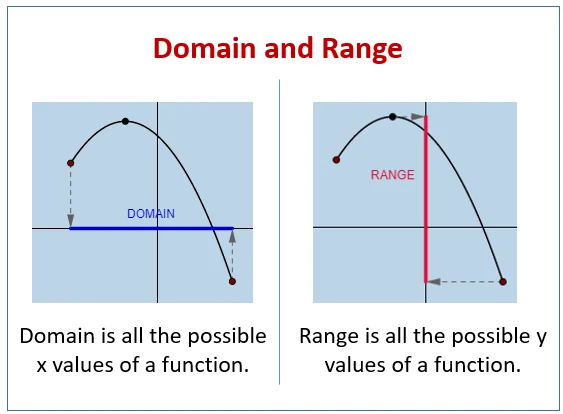
The domain represents all possible input values for which a function or graph is defined.
In simpler terms:
- Domain answers the question: “What values can x take?”
Key Points About Domain
- Domain values lie on the x-axis
- They represent allowed inputs
- Invalid inputs are excluded
Example:
If a machine only works for temperatures above zero, then negative values are excluded from the domain.
Conceptual Meaning of Range
The range represents all possible output values produced by the function.
Simply put:
- Range answers: “What values can y take?”
Key Points About Range
- Range values lie on the y-axis
- They depend entirely on the domain
- Outputs may be limited or infinite
Domain and Range of a Graph Explained Visually
Understanding the domain and range of a graph becomes much easier when viewed visually.
Image Placeholder
Image: Cartesian graph with shaded x-axis and y-axis
Alt text: domain and range of a graph visual explanation
From the image:
- Horizontal spread → Domain
- Vertical spread → Range
Why Domain and Range Are So Important
Understanding domain and range helps in:
- Preventing invalid calculations
- Modeling real-world systems accurately
- Building machine learning models
- Data preprocessing in analytics
- Interpreting scientific experiments
Without defining domain and range, mathematical models become unrealistic or misleading.
Types of Graphs and Their Domain and Range
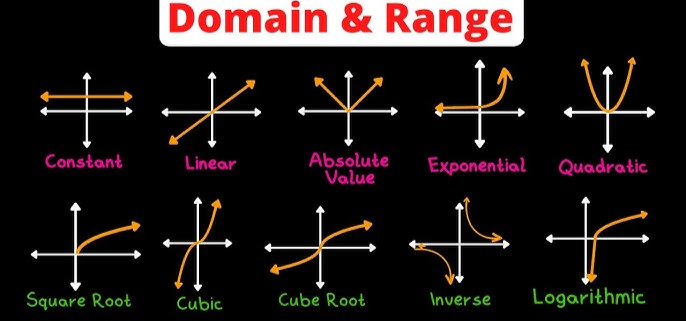
Linear Graphs
- Domain: All real numbers
- Range: All real numbers
Quadratic Graphs
- Domain: All real numbers
- Range: Limited depending on vertex
Square Root Graphs
- Domain: Values ≥ zero
- Range: Values ≥ zero
Rational Graphs
- Domain: Excludes values causing division by zero
Each graph behaves differently, making domain and range of a graph highly context-dependent.
Real-World Examples of Domain and Range
Example 1: Online Shopping Price Filter
- Domain: Prices user can select
- Range: Products displayed
Example 2: Speed vs Fuel Efficiency
- Domain: Speed of vehicle
- Range: Mileage obtained
Example 3: Age vs Height
- Domain: Age values
- Range: Height values
These examples show how domain defines constraints while range shows outcomes.
How to Find Domain of a Graph Step by Step
- Look at the x-axis coverage
- Identify gaps or breaks
- Check for restrictions:
- Division by zero
- Square roots of negative numbers
- Write domain using:
- Interval notation
- Set notation
How to Find Range of a Graph Step by Step
- Observe y-axis values
- Identify minimum and maximum outputs
- Look for asymptotes
- Express range appropriately
Domain and Range Using Tables
| x (Domain) | y (Range) |
| -2 | 4 |
| -1 | 1 |
| 0 | 0 |
| 1 | 1 |
| 2 | 4 |
From the table:
- Domain = {-2, -1, 0, 1, 2}
- Range = {0, 1, 4}
Domain and Range Using Set Notation
- Domain: {x | x ≥ 0}
- Range: {y | y ≤ 10}
Set notation is commonly used in higher mathematics and computer science.
Domain and Range in Functions vs Relations
Functions
- Each input has exactly one output
- Clear domain and range
Relations
- Inputs may have multiple outputs
- Domain may repeat values
Understanding this difference is critical in advanced graph analysis.
Interpretation of Domain and Range in Different Coordinate Systems
While most learners understand graphs in a standard Cartesian plane, domain and range concepts also apply to other coordinate systems.
Polar Coordinates
- Domain represents angle values (θ)
- Range represents radius values (r)
Example:
- Domain: 0 ≤ θ ≤ 2π
- Range: r ≥ 0
This is widely used in physics, signal processing, and robotics.
Domain and Range in Piecewise Functions
Piecewise functions define different rules for different input values.
Why This Matters
- Domain is split into intervals
- Range varies for each piece
Example scenario:
- Electricity billing slabs
- Tax calculation models
Each slab has a separate domain and produces a different range.
Domain and Range in Exponential and Logarithmic Graphs
Exponential Graphs
- Domain: All real numbers
- Range: Positive real numbers
Real-life usage:
- Population growth
- Compound interest
- Viral content spread
Logarithmic Graphs
- Domain: Positive real numbers
- Range: All real numbers
Used in:
- Earthquake intensity (Richter scale)
- Sound intensity (decibel scale)
Impact of Asymptotes on Domain and Range
Asymptotes influence graph behavior without being part of the graph.
Vertical Asymptotes
- Exclude specific x-values from domain
Horizontal Asymptotes
- Restrict the range
This is common in:
- Rational functions
- Engineering models
- Physics simulations
Domain and Range in Statistical Graphs
Statistical graphs also follow domain-range logic.
Histogram
- Domain: Class intervals
- Range: Frequency
Box Plot
- Domain: Data distribution
- Range: Quartile values
Understanding this helps in:
- Exploratory Data Analysis
- Outlier detection
- Distribution interpretation
Domain and Range in Time-Based Graphs
Time-series data is a major real-world application.
Examples
- Stock price vs time
- Website traffic vs date
- Heart rate vs time
Here:
- Domain = time interval
- Range = measured quantity
This is crucial in finance, healthcare, and IoT analytics.
Domain and Range Constraints in Real-World Modeling
Mathematical models must respect real-world limitations.
Practical Constraints
- Negative age is invalid
- Speed cannot exceed mechanical limits
- Revenue cannot be negative
Ignoring domain constraints leads to:
- Incorrect predictions
- Model failure
- Business losses
Domain and Range in Programming and Validation Logic
In software systems:
- Domain defines valid input values
- Range defines expected output values
Example
- API input validation
- Form field restrictions
- Sensor data limits
This ensures system reliability and error prevention.
Relationship Between Domain, Range, and Inverse Functions
For inverse functions:
- Domain of original function becomes range of inverse
- Range of original becomes domain of inverse
This concept is widely used in:
- Cryptography
- Signal decoding
- Mathematical transformations
Domain and Range in Machine Learning Pipelines
Before training models:
- Input features must lie within expected domain
- Output predictions must fall within acceptable range
Example
- Image pixel values (0–255)
- Probability outputs (0–1)
Feature scaling and normalization depend heavily on domain awareness.
Domain and Range Through Graph Transformations
Graph transformations change the appearance of a graph, but they also influence domain and range.
Horizontal Shifts
- Domain shifts left or right
- Range remains unchanged
Vertical Shifts
- Range shifts up or down
- Domain remains unchanged
Stretching and Compressing
- Vertical scaling affects range
- Horizontal scaling affects domain
Real-world use case:
Signal amplification systems rely on scaling transformations that directly affect output range.
Effect of Absolute Value Functions on Domain and Range
Absolute value functions reflect parts of a graph.
Key Observations
- Domain often remains all real numbers
- Range becomes non-negative
Example:
Temperature deviation models where only magnitude matters, not direction.
Domain and Range in Inequality Graphs
Graphs of inequalities introduce shaded regions.
Domain
All x-values where the inequality holds true
Range
All y-values covered by the shaded region
This is widely used in:
- Optimization problems
- Linear programming
- Resource allocation models
Domain and Range in Discrete vs Continuous Graphs
Discrete Graphs
- Domain consists of separate values
- Range contains individual outputs
Examples:
- Number of students vs class sections
- Daily sales count
Continuous Graphs
- Domain is an interval
- Range is also an interval
Examples:
- Speed vs time
- Temperature changes
Domain and Range in Engineering Applications
Electrical Engineering
- Domain: Input voltage
- Range: Output current
Civil Engineering
- Domain: Load applied
- Range: Structural displacement
Design safety heavily depends on respecting domain constraints.
Economic Interpretation of Domain and Range
In economics:
- Domain often represents time, price, or quantity
- Range represents profit, demand, or cost
Example:
Demand curve analysis strictly limits domain to positive price values.
Domain and Range in Scientific Experiments
Experiments require controlled inputs.
- Domain defines experimental conditions
- Range defines observed outcomes
Ignoring domain boundaries invalidates scientific results.
Domain and Range in Probability Distributions
Continuous Distributions
- Domain: Possible values of random variable
- Range: Probability density values
Discrete Distributions
- Domain: Countable outcomes
- Range: Probability mass values
Understanding this is essential in statistics and data modeling.
Domain and Range in Optimization Problems
Optimization problems depend on feasible regions.
- Domain defines constraints
- Range defines objective outcomes
Applications:
- Cost minimization
- Profit maximization
- Resource efficiency
Domain and Range in Graphical Simulations
Simulation tools rely on bounded inputs.
Example:
Physics engines define:
- Domain for force input
- Range for motion output
This ensures realistic behavior.
Cognitive Learning Perspective on Domain and Range
Educational research shows:
- Visual representation improves comprehension
- Interactive graphs increase retention
- Stepwise domain-range identification builds confidence
This supports blended learning strategies.
Domain and Range in Real-Time Monitoring Systems
Examples:
- Heart rate monitoring
- Server performance tracking
- Environmental sensors
Domain defines acceptable input ranges; alerts trigger when outputs exceed expected range.
Error Propagation Related to Domain and Range
Invalid domain values can cause:
- Mathematical exceptions
- Software crashes
- Model instability
Defensive programming always checks domain validity first.
Advanced Notation for Domain and Range
Interval Notation
- (-∞, ∞)
- [0, ∞)
Builder Notation
- {x | x ≥ 0}
Advanced math and programming rely on precise notation to avoid ambiguity.
Visualization Best Practices for Domain and Range
To improve clarity:
- Shade domain on x-axis
- Highlight range on y-axis
- Use color coding
- Add axis labels clearly
These practices improve learning outcomes and engagement.
Graphing Tools and Technology Support
Modern tools simplify understanding:
Common Mistakes Students Make
- Confusing domain with range
- Ignoring graph breaks
- Assuming domain is always infinite
- Forgetting real-world constraints
Avoiding these mistakes builds strong analytical skills.
Domain and Range in Data Science and AI
In machine learning:
- Domain = input features
- Range = predicted outputs
For example:
- Domain: Customer age, income
- Range: Purchase probability
This makes domain and range of a graph foundational in analytics modeling.
Summary and Key Takeaways
- Domain refers to all valid input values
- Range refers to all possible output values
- Graphs visually represent relationships
- Real-world systems always have constraints
- Understanding domain and range improves analytical thinking
Final Thought
Mastering the domain and range of a graph is not just about passing exams—it builds the foundation for logic, reasoning, data science, and AI-driven decision-making. With practice and visualization, this concept becomes intuitive and powerful.
FAQ’s
How to find domain and range in graph?
To find the domain, look at all x-values the graph covers, and to find the range, identify all y-values the graph attains, considering endpoints and direction of the graph.
What is an example of a domain and range?
For the function f(x)=x2, the domain is all real numbers (−∞,∞), and the range is [0,∞).
How do you write domain and range?
Domain and range are written using set notation or interval notation, for example:
Domain: , Range: .
How do you find the domain and range of coordinates?
The domain is found by listing all the x-values of the coordinates, and the range is found by listing all the y-values, removing duplicates and ordering them if needed.
What are the domain and range rules?
Domain includes all valid input values (x) where a function is defined, excluding values that cause division by zero or invalid operations, while range includes all possible output values (y) produced by the function.