
In today’s data-driven world, decisions are increasingly guided by evidence rather than intuition. From business optimization and healthcare research to machine learning model validation, statistical reasoning plays a central role. At the heart of this reasoning lies hypothesis testing, a structured approach to validating assumptions using data.
Before any meaningful test can be conducted, researchers must establish a clear baseline assumption. This is where the concept becomes crucial, forming the foundation upon which statistical decisions are built.
Why Hypothesis Testing Matters in Real Life
Hypothesis testing is not limited to academic research. It influences everyday decisions, such as:
- Determining whether a new product feature improves user engagement
- Evaluating if a marketing campaign increases conversion rates
- Assessing whether a medical treatment produces measurable improvement
- Validating assumptions in A/B testing for digital platforms
Each of these scenarios begins with a default assumption that must be tested objectively.
Background: The Foundations of Statistical Inference
Statistical inference allows analysts to draw conclusions about a population using sample data. Since analyzing entire populations is often impractical, inference provides tools to make reliable judgments under uncertainty.
Key elements of statistical inference include:
- Population and sample relationships
- Random sampling techniques
- Probability distributions
- Hypothesis formulation and testing
Understanding these fundamentals is essential before attempting to define null hypothesis in a structured and meaningful way.
What Does It Mean to Define Null Hypothesis?
To define null hypothesis is to formally state a default assumption that there is no effect, no difference, or no relationship between variables under study. This assumption is treated as true unless sufficient statistical evidence suggests otherwise.
In simpler terms, the null hypothesis represents the status quo. It assumes that any observed differences in data occur due to random chance rather than a meaningful underlying cause.
This concept is typically denoted as H₀ and serves as the starting point for statistical testing.
Formal Structure of a Null Hypothesis
A well-written null hypothesis has specific characteristics:
- It is precise and unambiguous
- It focuses on population parameters
- It states equality or no-effect conditions
- It is testable using statistical methods
Example Structure
- H₀: The average customer satisfaction score remains unchanged after the update.
- H₀: There is no difference in mean delivery time between two logistics partners.
Learning to define null hypothesis correctly ensures clarity and reduces ambiguity during analysis.
Null vs Alternative Hypothesis Explained
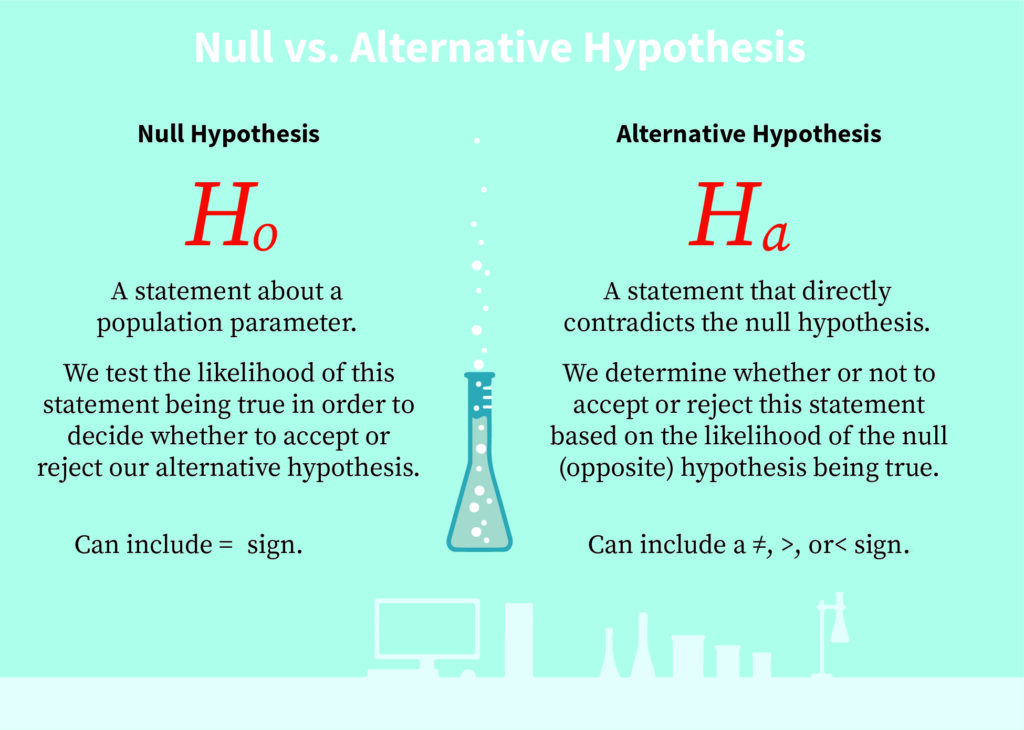
In hypothesis testing, two competing statements are evaluated:
Null Hypothesis (H₀)
- Assumes no change or no effect
- Represents the default position
- Is tested directly using data
Alternative Hypothesis (H₁ or Hₐ)
- Represents the researcher’s claim
- Suggests a measurable effect or difference
- Is accepted only when evidence against H₀ is strong
Together, these hypotheses create a structured framework for decision-making.
Types of Null Hypotheses in Practice
Depending on the context, null hypotheses can take different forms:
- Equality-based: Assumes two parameters are equal
- No association: Assumes no relationship between variables
- No improvement: Assumes no performance gain after intervention
Each type is designed to address a specific analytical question while maintaining objectivity.
Role of the Null Hypothesis in Hypothesis Testing
The primary purpose of hypothesis testing is not to prove the null hypothesis, but to assess whether available data provides enough evidence to reject it.
Key points include:
- The null hypothesis is assumed true initially
- Statistical tests evaluate the likelihood of observed data
- Decisions are based on predefined significance levels
Without a properly defined baseline, statistical conclusions lose their reliability.
Step-by-Step Workflow of Hypothesis Testing
A typical hypothesis testing workflow involves:
- Defining the research question
- Formulating the null and alternative hypotheses
- Selecting an appropriate statistical test
- Choosing a significance level
- Collecting and analyzing data
- Making a decision based on results
At the core of this process lies the ability to define null hypothesis accurately and consistently.
Concepts Related to the Null Hypothesis
Directional and Non-Directional Testing
When analysts define null hypothesis, it is also important to understand whether the test is directional or non-directional.
- Non-directional (two-tailed) tests assume that any deviation from equality is possible in either direction.
- Directional (one-tailed) tests assume a specific direction of effect, such as an increase or decrease.
Directional tests require stronger justification because they limit the scope of possible outcomes.
Real-Time Examples Across Industries
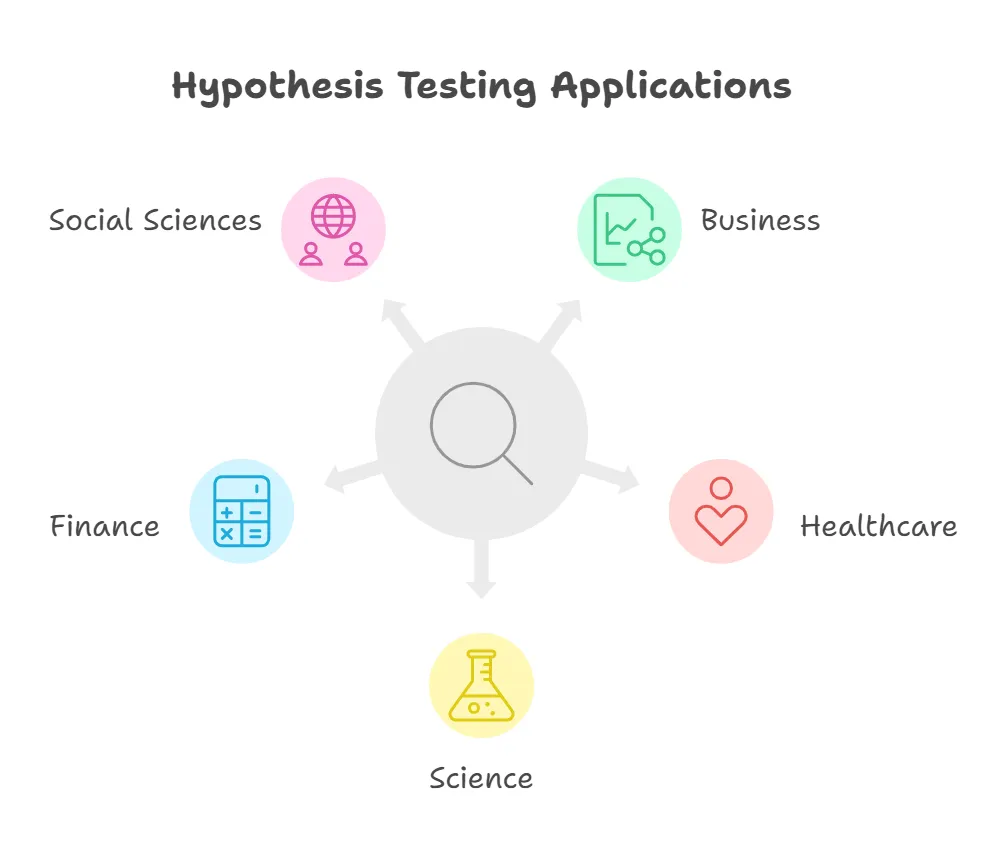
Business Analytics Example
An e-commerce company wants to evaluate a redesigned checkout page.
- H₀: The average conversion rate remains the same after redesign.
- H₁: The average conversion rate changes after redesign.
Healthcare Research Example
A clinical study examines a new medication.
- H₀: The treatment has no effect on recovery time.
- H₁: The treatment reduces recovery time.
Education Sector Example
An institution introduces a new learning platform.
- H₀: Student performance remains unchanged.
- H₁: Student performance improves.
These examples highlight how the concept translates into real-world decisions.
Null Hypothesis in Data Science and Machine Learning
In data science, hypothesis testing supports:
- Feature selection decisions
- Model comparison and validation
- Experiment evaluation in A/B testing
Even in advanced machine learning pipelines, analysts must define null hypothesis statements to validate assumptions and interpret results responsibly.
One-Tailed and Two-Tailed Hypothesis Tests
When researchers define null hypothesis, an important decision involves choosing between a one-tailed test and a two-tailed test. This choice determines how evidence against the null hypothesis is evaluated and directly affects statistical conclusions.
The distinction is based on whether the research question is directional or non-directional.
What Is a One-Tailed Hypothesis Test
A one-tailed hypothesis test evaluates evidence in only one direction. It tests whether a parameter is either greater than or less than a specified value, but not both.
In this case, the null hypothesis assumes no effect or no difference, while the alternative hypothesis specifies a direction.
Example formulation:
- Null hypothesis (H₀): The mean performance is equal to or less than the baseline
- Alternative hypothesis (H₁): The mean performance is greater than the baseline
Only outcomes in the specified direction are considered significant.
When One-Tailed Tests Are Used
One-tailed tests are appropriate when:
- Prior evidence strongly suggests a specific direction
- Only one outcome is meaningful for decision-making
- Opposite effects are irrelevant or impossible
Real-world example:
A company introduces a new algorithm designed only to improve system speed. The null hypothesis states that speed does not increase. A one-tailed test evaluates whether the new algorithm performs better, not worse.
Advantages and Risks of One-Tailed Tests
Advantages:
- Greater statistical power in the chosen direction
- More sensitive detection of directional effects
Risks:
- Misses effects in the opposite direction
- Can introduce bias if direction is chosen after seeing data
For this reason, one-tailed tests must be justified before data analysis.
What Is a Two-Tailed Hypothesis Test
A two-tailed hypothesis test evaluates evidence in both directions. It tests whether a parameter is significantly different from a specified value, regardless of whether the difference is positive or negative.
Example formulation:
- Null hypothesis (H₀): The mean equals the baseline
- Alternative hypothesis (H₁): The mean is not equal to the baseline
Both extremes of the sampling distribution are considered.
When Two-Tailed Tests Are Preferred
Two-tailed tests are widely used because they are more conservative and objective.
They are appropriate when:
- Any deviation from the baseline matters
- There is no strong prior belief about direction
- Research aims to detect unexpected effects
Real-world example:
In clinical trials, researchers test whether a new drug has any effect—positive or negative—compared to a placebo. A two-tailed test ensures safety concerns are not ignored.
Comparison Between One-Tailed and Two-Tailed Tests
| Aspect | One-Tailed Test | Two-Tailed Test |
| Direction tested | Single | Both |
| Statistical power | Higher in one direction | Lower per direction |
| Risk of bias | Higher if misused | Lower |
| Common usage | Limited | Standard practice |
Impact on Significance Level
The significance level (alpha) is distributed differently:
- In a one-tailed test, the entire alpha is placed in one tail
- In a two-tailed test, alpha is split equally across both tails
For example, with an alpha of 0.05:
- One-tailed test uses 0.05 in one direction
- Two-tailed test uses 0.025 in each direction
This affects critical values and rejection thresholds.
Choosing the Correct Test When You Define Null Hypothesis
To select the appropriate test:
- Use a one-tailed test only when direction is justified before analysis
- Use a two-tailed test when uncertainty exists
- Document the rationale clearly in research reports
Choosing incorrectly can invalidate conclusions, even if calculations are correct.
Common Mistakes to Avoid
- Switching from two-tailed to one-tailed after seeing results
- Using one-tailed tests to artificially achieve significance
- Failing to align the test choice with the research question
Proper test selection protects the integrity of hypothesis testing.
Common Misconceptions and Errors
Several misconceptions surround this concept:
- Rejecting H₀ does not prove H₁ with absolute certainty
- Failing to reject H₀ does not confirm it is true
- Statistical significance does not imply practical importance
Avoiding these pitfalls improves analytical credibility.
Interpreting Results and Decision-Making
Once a test is completed, analysts must interpret outcomes carefully:
- Rejection of H₀ suggests evidence of an effect
- Non-rejection suggests insufficient evidence
- Context and domain knowledge remain essential
Clear interpretation ensures insights are actionable rather than misleading.
Visual Representation and Statistical Tools
Visual tools such as distribution plots, confidence intervals, and hypothesis test diagrams help communicate findings effectively.
Business, Academic, and Research Use Cases
The ability to define null hypothesis plays a crucial role in:
- Market research and consumer behavior analysis
- Academic publishing and peer-reviewed studies
- Policy evaluation and social research
- Quality control and process optimization
Its universal applicability makes it a foundational statistical skill.
Best Practices for Writing a Strong Null Hypothesis
Follow these guidelines:
- Keep language simple and direct
- Focus on population parameters
- Avoid vague terms
- Align with research objectives
Strong formulation improves test validity and interpretability.
Relationship with P-Values and Significance Levels
P-values quantify the probability of observing results under the assumption that H₀ is true. When this probability falls below a chosen threshold, analysts reject the null hypothesis.
Understanding this relationship is essential to correctly define null hypothesis and evaluate outcomes.
Practical Implementation Using Python
In Python-based analytics, hypothesis testing is commonly implemented using libraries such as:
These tools allow practitioners to apply statistical tests efficiently while adhering to sound methodological principles.
Conclusion and Key Takeaways
Statistical reasoning is a cornerstone of modern decision-making. Learning to define null hypothesis correctly empowers analysts, researchers, and business leaders to evaluate evidence objectively and draw reliable conclusions.
By applying structured hypothesis testing, real-world data can be transformed into actionable insights. Whether in academia, industry, or data science, mastering this foundational concept enhances analytical confidence and credibility.
FAQ’s
What are the 7 steps of hypothesis testing?
The seven steps of hypothesis testing are defining hypotheses, choosing a significance level, selecting the test statistic, determining the decision rule, collecting data, calculating the test statistic and p-value, and making the final decision.
Is 0.05 a null hypothesis?
No, 0.05 is not a null hypothesis; it is a significance level (α) used to decide whether to reject or fail to reject the null hypothesis.
What are the 4 ways to test a hypothesis?
The four common ways to test a hypothesis are z-test, t-test, chi-square test, and ANOVA, each used based on data type, sample size, and variance assumptions.
What is the null hypothesis in hypothesis testing?
The null hypothesis (H₀) is a statement that assumes no effect, no difference, or no relationship between variables and serves as the baseline for statistical testing.
What are the six types of hypothesis?
The six types of hypothesis are null hypothesis, alternative hypothesis, simple hypothesis, complex hypothesis, directional hypothesis, and non-directional hypothesis, commonly used in research and statistical analysis.


