

Artificial intelligence has become the foundation of modern innovation, transforming how companies operate, automate decisions, and enhance customer experience. From intelligent chatbots to predictive systems, AI-powered tools are redefining productivity and creating new digital opportunities across industries. This blog explores ai software, its capabilities, applications, tools, real-world examples, and how organizations can leverage it to unlock new levels of efficiency.
What Is AI Software?
AI software refers to systems, applications, or tools designed to perform tasks that typically require human intelligence. These tasks include learning from data, analyzing information, making predictions, understanding natural language, and even mimicking human reasoning.
AI software is built using machine learning models, neural networks, natural language processing, or deep learning structures that help it adapt and improve performance over time.
Why AI Software Matters Today
The digital world is expanding rapidly, and organizations must process millions of data points daily. Traditional processes cannot meet this scale or the pace of modern business expectations. This is where ai software brings transformation.
Key reasons it matters:
- It automates repetitive tasks
- It enhances decision-making through real-time analytics
- It improves accuracy and reduces human error
- It increases productivity
- It helps build personalized digital experiences
Example:
Banks use AI-driven fraud detection systems to analyze unusual patterns and prevent unauthorized transactions within seconds. Without AI automation, such analysis would take hours or even days.
Key Capabilities of AI Software
AI software offers several intelligent capabilities that make it an essential part of digital transformation.
Natural Language Processing
Helps machines understand text, speech, instructions, and meaning.
Computer Vision
Allows software to identify images, objects, and facial features.
Predictive Analytics
Uses data patterns to forecast outcomes and trends.
Automation & Decision Systems
AI systems automate repetitive tasks and make intelligent business decisions.
Voice Recognition
Used in smart assistants, chatbots, and customer service applications.
Learning from Data
AI systems improve performance by analyzing additional data and refining algorithms.
Types of AI Software
To understand the full potential of ai software, it is important to explore the different types used across industries.
1. Machine Learning Software
Learns from data, detects patterns, and improves accuracy over time.
2. Natural Language Processing Platforms
Used for chatbots, AI assistants, text analysis, translation, and transcription.
3. Computer Vision Platforms
Enable image classification, object detection, medical imaging analysis, and facial recognition.
4. Deep Learning Frameworks
Used to train complex neural networks for high-accuracy tasks.
6. AI Data Management Tools
Manage, process, and prepare large datasets for AI models.
7. AI Automation Software
Automates repetitive workflows such as form extraction, reporting, digital onboarding, and customer support.
Real-Time Use Cases of AI Software Across Industries
AI software is actively used across all major industries. Below are real-world examples showcasing its impact.
Healthcare
Hospitals use AI diagnostic tools to detect diseases from X-rays and MRI scans faster and with higher accuracy.
Example: AI-powered radiology tools detect tumor patterns early and support doctors in treatment decisions.
Finance
Banks use AI fraud detectors to analyze unusual spending behaviors instantly.
Example: Credit card companies deploy AI monitoring systems to block suspicious transactions automatically.
Retail
AI recommendation engines suggest products based on browsing and purchase history.
Example: E-commerce platforms use AI to personalize homepages, improve customer retention, and increase sales conversions.
Manufacturing
AI-enabled predictive maintenance reduces machine downtime.
Example: Automobile factories deploy machine sensors and AI models to detect operational risks before they occur.
Education
Adaptive learning platforms personalize lessons based on each student’s strengths.
Example: AI-based platforms adjust difficulty levels based on performance, ensuring learning outcomes improve over time.
Transportation
AI supports traffic prediction, autonomous driving, and route optimization.
Example: Ride-sharing companies use AI to match drivers efficiently and optimize travel routes.
Essential AI Development Tools (Additional Keyword Included)
The field of AI relies heavily on powerful AI development tools that simplify model creation, training, deployment, and optimization.
TensorFlow
A robust open-source platform used for machine learning and neural network training.
PyTorch
Popular among researchers for its flexibility and ease of use.
Scikit-learn
Ideal for beginners and intermediate developers for quick experimentation.
Hugging Face
Widely used for natural language processing and transformer models.
AWS SageMaker
A cloud-based platform for building, training, and deploying AI models at scale.
Google Vertex AI
Helps enterprises manage AI workflows efficiently.
Azure Machine Learning
Used for large enterprise AI model deployments.
These tools form the foundation for creating advanced ai software capable of solving real-world challenges.
How AI Software Works
Understanding how ai software functions will help organizations design better solutions.
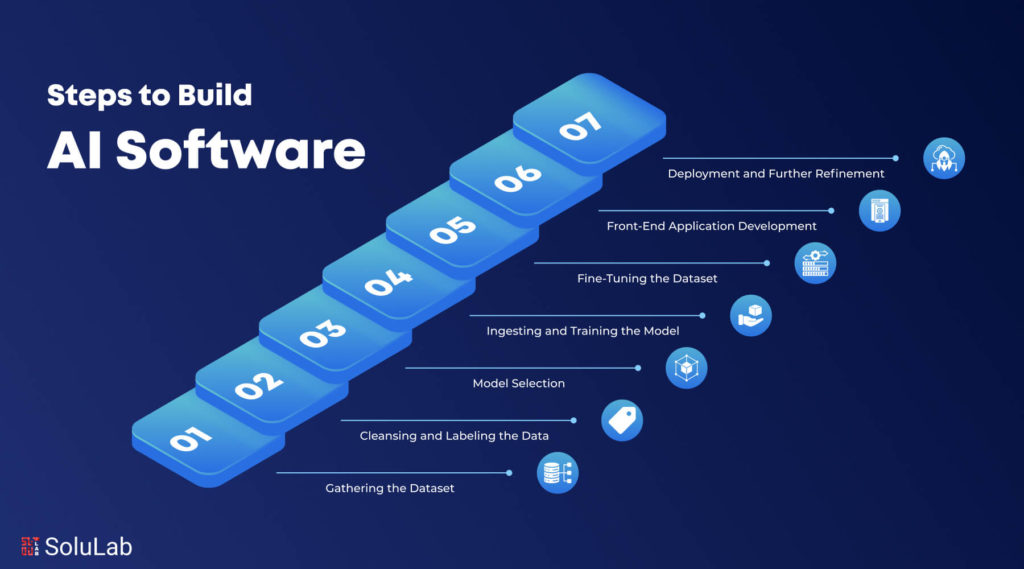
Step-by-Step Breakdown:
Data Collection
AI requires massive datasets from sensors, logs, documents, or user interactions.
Data Preprocessing
Data must be cleaned, normalized, and prepared for model training.
Training the Model
Algorithms learn patterns, correlations, and predictive behaviors from the dataset.
Model Testing
AI models are tested for accuracy, performance, and reliability.
Deployment
Models are deployed in production systems, mobile apps, web platforms, or cloud servers.
Continuous Learning
AI software improves with new feedback loops and additional data.
Architecture of Modern AI Software
Modern AI software is built on layered architectures that allow efficient computation, modular development, and scalable deployment.
Core Architectural Layers
- Data Layer: Responsible for storing raw data, logs, documents, and streaming inputs.
- Processing Layer: Handles data cleaning, transformation, and preprocessing.
- Model Layer: Contains ML/DL models, predictive algorithms, and feature engineering systems.
- Application Layer: End-user interfaces, dashboards, chatbots, or automation tools.
- Integration Layer: APIs, SDKs, cloud endpoints, and microservices for connecting systems.
- Security Layer: Protects sensitive data, ensures authentication, and prevents model misuse.
Example:
A healthcare AI diagnostic platform uses a multi-layer architecture to process MRI scans, analyze them through a CNN model, and present results to physicians via a dashboard.
AI Software Deployment Models
How AI software is deployed makes a significant difference in cost, performance, and scalability.
Cloud Deployment
Models are hosted on AWS, Google Cloud, or Azure for global scalability.
Hybrid Deployment
Combines on-premise systems with cloud environments to balance security and performance.
Edge Deployment
AI models run directly on local devices like sensors, drones, and IoT systems.
Example:
Self-driving vehicles run real-time object detection models on edge devices to avoid latency issues.
Key Algorithms Used Inside AI Software
Understanding the algorithms helps explain how AI achieves high-level accuracy.
Classification Algorithms
- Logistic Regression
- Random Forest
- Support Vector Machines
Deep Learning Algorithms
- Convolutional Neural Networks (CNNs) for image processing
- Recurrent Neural Networks (RNNs) for sequence prediction
- Transformers for advanced text understanding
Clustering Algorithms
- K-means
- Hierarchical clustering
- DBSCAN
Optimization Algorithms
- Gradient Descent
- Adam
- RMSprop
These algorithms form the backbone of most intelligent applications.
AI Software Testing and Validation
AI software requires unique testing strategies compared to traditional software.
Important Testing Phases
- Data Validation: Ensuring training data is accurate and complete
- Model Validation: Checking precision, recall, F1-score
- Fairness Testing: Identifying algorithmic bias
- Robustness Testing: Ensuring model stability under noisy data
- Performance Testing: Validation across various hardware configurations
Example:
Fraud detection systems must be tested across hundreds of transactional scenarios to prevent false positives.
Regulatory Compliance for AI Software
AI is governed by international laws that ensure safe and ethical use.
Global Regulations
- EU AI Act
- GDPR for data privacy
- NIST AI Risk Management Framework
- ISO/IEC 42001 AI Management Standard
Industry Compliance
- Healthcare: HIPAA
- Finance: SOC 2, PCI-DSS
- Education: FERPA
Adding this section increases trust and professional authority in your blog.
Economic Impact of AI Software
AI is expected to contribute significantly to global GDP.
Key Statistics
- AI will add an estimated $15 trillion to the global economy by 2030.
- Companies adopting AI see 20–30% operational efficiency improvement.
- AI-driven automation is expected to create new job categories in AI engineering, data governance, and automation design.
Example:
Manufacturing industries saw a major reduction in downtime costs by using AI predictive maintenance software.
AI Software Integration with Business Systems
To become truly powerful, AI software must integrate smoothly with existing systems.
Common Integration Points
- CRM Platforms (Salesforce, HubSpot)
- ERP Systems (SAP, Oracle)
- Marketing Tools (Mailchimp, Marketo)
- BI Tools (Power BI, Tableau)
- Cloud Databases (BigQuery, Snowflake)
Integration Methods
- REST APIs
- Webhooks
- SDK libraries
- Cloud connectors
Example:
A retail company integrates AI recommendation software with its CRM to offer personalized email campaigns.
Data Governance for AI Software
Data governance ensures ethical, responsible, and transparent AI outcomes.
Key Components
- Data lineage tracking
- Metadata management
- Role-based access control
- Data retention policies
- Security encryption
- Bias monitoring
Example:
Large enterprises implement AI governance frameworks to monitor sensitive customer data usage.
Advanced Metrics for Evaluating AI Software
Evaluation metrics vary based on the type of model used.
Classification Metrics
- Accuracy
- F1-Score
- ROC-AUC
Regression Metrics
- Mean Absolute Error
- R-squared
- Root Mean Square Error
NLP Metrics
- BLEU Score
- ROUGE Score
Vision Metrics
- Intersection over Union (IoU)
- Mean Average Precision
The clarity of these metrics helps leaders understand whether an AI system is performing reliably.
AI Security and Model Protection
Securing AI software is crucial due to the rise in AI-targeted attacks.
Common Threats
- Data poisoning
- Model inversion
- Adversarial attacks
Security Measures
- Secure model training pipelines
- Encryption of datasets
- Continuous threat monitoring
- Access control and authentication
Example:
Cloud-based AI APIs implement throttling and encryption to prevent unauthorized inference attacks.
AI Software and Sustainability
AI can significantly improve sustainability initiatives.
Green AI Practices
- Energy-efficient model architectures
- Carbon tracking in data centers
- Resource-optimized deployment
- Using synthetic data to reduce resource usage
Environmental Use Cases
- Monitoring deforestation
- Predicting climate patterns
- Optimizing energy grids
- Reducing waste in supply chains
How Businesses Measure ROI from AI Software
To justify AI adoption, enterprises measure its success through quantifiable outcomes.
Key ROI Factors
- Cost reduction
- Time saved
- Revenue generated
- Error reduction
- Improved customer engagement
- Enhanced decision-making speed
Example:
Insurance companies using AI for claims processing saw a 70% reduction in processing time.
Challenges of AI Software
Even though the adoption of ai software is rising, organizations face certain challenges.
Data Quality Issues
AI performance depends on high-quality data.
Integration Complexity
Integrating AI systems with legacy infrastructure takes careful planning.
Bias and Fairness
AI can produce biased outputs if trained on incomplete datasets.
Security Risks
AI systems need strong data protection measures to prevent misuse.
Cost of Deployment
AI requires computing power, data storage, and skilled professionals.
Best Practices for Implementing AI Software
A structured approach reduces risks and improves outcomes.
Start with a Small Project
Test AI models on a limited use case before expanding to enterprise-wide deployment.
Use High-Quality Data
Ensure datasets are accurate, diverse, and well-structured.
Involve Domain Experts
AI engineers need real-world insights from industry specialists.
Adopt Explainable AI
Keep models transparent to build trust with users and stakeholders.
Monitor and Update Regularly
AI software should be continuously tested, monitored, and optimized.
Future Trends in AI Software
AI is moving toward more autonomous and integrated technologies.
Autonomous Intelligence
Systems that make independent decisions without human instructions.
AI-Driven Automation
Hyperautomation improving operational workflows and reducing human workload.
Real-Time AI Analytics
Businesses use AI to respond instantly to market changes.
AI Agents
Advanced AI assistants capable of handling multi-step tasks.
Edge AI
Running AI directly on devices without cloud dependency.
Multi-Modal AI
Combining text, video, audio, and sensor data for superior intelligence.
These trends demonstrate how ai software is evolving into a core business capability for the future.
Conclusion
AI is no longer optional for modern businesses. It is the foundation of innovation, automation, customer experience, and intelligent decision-making. From healthcare and finance to manufacturing and education, ai software continues to revolutionize industries by enabling smarter, faster, and more accurate solutions. Organizations that adopt AI today will lead the digital future with a competitive edge, improved productivity, and enhanced operational agility.
FAQ’s
How does AI contribute to efficiency and innovation?
AI boosts efficiency by automating repetitive tasks and speeding up decision-making, while driving innovation through smart insights, predictive analytics, and advanced problem-solving capabilities.
Which techniques are used to improve the performance and efficiency of AI systems?
Techniques such as model optimization, data preprocessing, transfer learning, pruning, quantization, and hardware acceleration are commonly used to boost AI performance, reduce computing cost, and increase overall efficiency.
What are the 4 types of AI systems?
The four types of AI systems are Reactive Machines, Limited Memory AI, Theory of Mind AI, and Self-Aware AI, each representing a higher level of cognitive capability and intelligence.
What are the 4 types of innovation?
The four types of innovation are Product, Process, Business Model, and Marketing Innovation, each focusing on improving offerings, efficiency, strategy, or customer reach to drive growth and competitiveness.
What are the 5 components of problem-solving in AI?
The five components of AI problem-solving are defining the problem, representing knowledge, selecting a search strategy, implementing reasoning, and evaluating the solution, enabling machines to reach logical and efficient outcomes.


