
Every AI model you’ve encountered—whether ChatGPT, facial recognition, or product recommendations—operates through two fundamentally different computational phases. Inference vs training represents the crucial distinction between teaching an AI system and putting that knowledge to work. Training consumes massive computational resources to build the model’s capabilities from raw data. Inference, by contrast, deploys that trained model to generate real-time predictions with relatively modest hardware requirements.
The difference between training and inference mirrors the distinction between education and application in human learning. According to research from Lenovo, training involves processing millions of examples to identify patterns, while inference applies those learned patterns to new, unseen data. This separation has profound implications for infrastructure costs, hardware selection, and deployment strategies.
Most organizations allocate 80-90% of their AI budget to training model architectures, yet inference accounts for the majority of actual computational operations once systems go live. Understanding this dichotomy determines whether your AI initiatives deliver ROI or drain resources without meaningful returns. The computational requirements differ dramatically: training might demand hundreds of GPUs running for weeks, while inference can operate on a single chip in milliseconds.
Step 1: Understanding AI Training
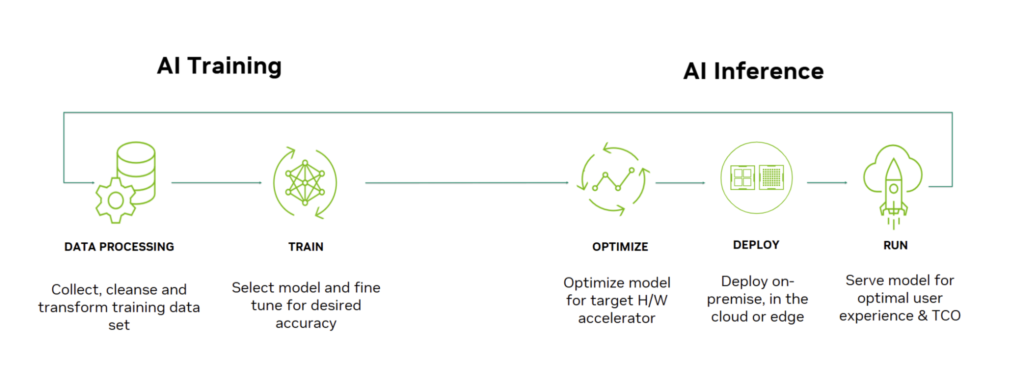
Machine learning training is where AI models acquire their intelligence—think of it as the educational phase where algorithms learn patterns from vast datasets. During this process, a model ingests thousands or millions of examples, adjusting internal parameters called weights to minimize prediction errors. A facial recognition system, for instance, might analyze millions of labeled images to learn distinguishing features between different faces.
The training process is computationally intensive by design. According to NVIDIA, training involves repeatedly feeding data through the model, calculating how wrong its predictions are, and backpropagating those errors to refine its parameters. This cycle—called an epoch—repeats until the model achieves acceptable accuracy. Complex models like GPT-4 can require weeks or months of training on specialized hardware clusters.
What makes training particularly resource-hungry is its iterative nature. The model must process entire datasets multiple times, with each pass requiring massive parallel computations. Research from Clarifai shows that training workloads typically demand high-memory GPUs capable of handling batch processing at scale. However, this investment happens once—after training completes, you have a model ready for deployment.
Understanding neural network architectures becomes critical here, as different structures require varying training approaches. The quality of your training data directly impacts model performance—garbage in, garbage out remains AI’s fundamental truth. This foundational phase sets the stage for effective inference and determines what your model can ultimately accomplish.
Common Techniques for Effective Training
Building an effective AI model requires more than raw data—it demands strategic techniques that maximize learning efficiency and accuracy. Supervised learning remains the most widely used approach, where models learn from labeled datasets that map inputs to known outputs. According to Lenovo’s analysis of ML workloads, supervised techniques power approximately 80% of commercial AI applications, from email filtering to medical diagnostics.
Transfer learning has revolutionized training efficiency by allowing models to leverage knowledge from previously trained networks. Instead of starting from scratch, developers can fine-tune pre-trained models for specific tasks—reducing training time by up to 90% while maintaining high accuracy. This approach proves particularly valuable when working with limited domain-specific data.
Data augmentation artificially expands training datasets through transformations like rotation, scaling, and or adding noise. This technique prevents overfitting and helps models generalize better to real-world scenarios. For instance, image recognition systems benefit from neural network architectures that process augmented datasets, improving their ability to handle variations during AI inference. Regularization techniques—including dropout and weight decay—combat overfitting by preventing models from memorizing training data. These methods ensure models learn underlying patterns rather than dataset-specific quirks, ultimately producing more reliable predictions when deployed. The balance between training thoroughness and generalization capability determines whether your AI performs well in production environments.
Step 2: Delving into AI Inference
AI inference represents the deployment phase where trained models transform theoretical capabilities into practical outputs. After model training concludes, inference puts that learned intelligence to work in real-world scenarios—analyzing inputs and generating predictions at scale.
Think of inference as the “production mode” of artificial intelligence. A trained model processes new, unseen data to deliver actionable results: classifying images, translating languages, or recommending products. Unlike training’s iterative learning cycles, inference emphasizes speed, and efficiency. The model’s weights remain fixed; no parameter updates occur during this phase.
Real-Time Decision Making
Inference operations demand low latency because users expect immediate responses. When you ask a voice assistant a question or unlock your phone with facial recognition, inference algorithms work within milliseconds. The focus shifts from computational intensity to optimization—delivering accurate predictions quickly while minimizing resource consumption.
Consider autonomous vehicles that must identify pedestrians, traffic signals, and road conditions instantaneously. These systems rely on inference engines processing sensor data continuously, making split-second decisions that directly impact safety. The inference pipeline must balance accuracy with real-time performance constraints, prioritizing practical deployment considerations over the exhaustive optimization cycles that characterize model training.
This transition from training to inference fundamentally changes hardware requirements, cost structures, and performance metrics—differences that become critical when scaling AI applications across production environments.
Inference Techniques and Use Cases
Deep learning inference operates through several specialized techniques designed for production efficiency. Quantization reduces model precision from 32-bit to 8-bit or lower, dramatically decreasing memory requirements and accelerating computation without significant accuracy loss. Model pruning eliminates redundant neural network connections, creating leaner architectures that maintain performance while running faster. Batching processes multiple requests simultaneously, maximizing hardware utilization—particularly valuable in high-throughput scenarios.
Real-world applications demonstrate inference’s versatility. In autonomous vehicles, models analyze sensor data in milliseconds to detect pedestrians, traffic signs, and road conditions. Healthcare systems deploy diagnostic models that interpret medical images, flagging potential abnormalities for radiologist review. E-commerce platforms use recommendation engines to generate personalized product suggestions based on browsing patterns and purchase history. Virtual assistants like Siri and Alexa continuously perform inference to understand voice commands and generate contextually appropriate responses.
According to TRG Datacenters, inference accounts for approximately 90% of AI’s total computational workload in production environments. This distribution reflects a fundamental reality: models train once but serve millions of users continuously. Financial institutions leverage fraud detection systems that score transactions in real-time, while streaming services analyze viewing habits to predict content preferences. Each interaction represents an inference event—a trained model applying learned patterns to new, unseen data.
However, deployment introduces practical constraints. Latency requirements vary dramatically across applications; chatbots tolerate minimal delay while autonomous systems demand sub-millisecond responses. These contrasting demands lead directly into understanding the fundamental differences between training and inference workflows.
Step 3: Contrasting Training and Inference
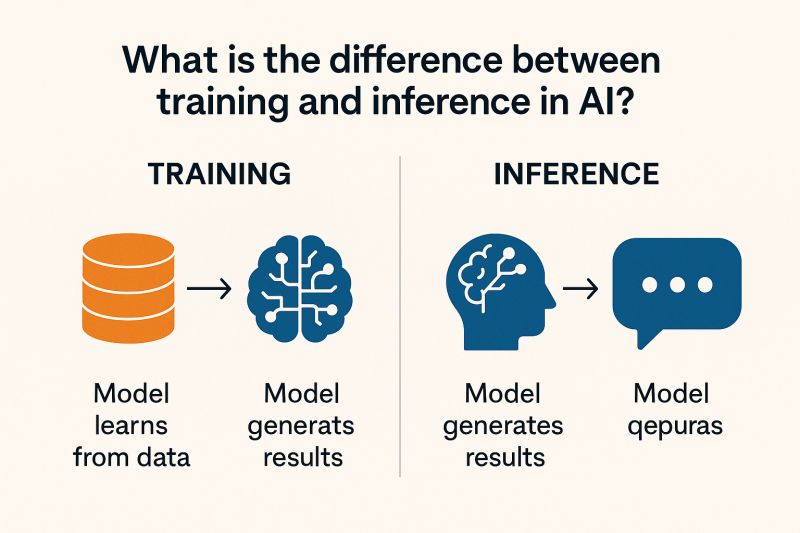
Training and inference represent fundamentally different computational workloads with distinct resource requirements and optimization strategies. The training phase demands massive parallel processing power to adjust millions or billions of parameters simultaneously, while inference prioritizes speed and efficiency for individual predictions.
Computational characteristics diverge significantly between these phases. Training requires extensive GPU clusters with high-bandwidth memory interconnects to process entire datasets repeatedly—a single large language model training run can consume several petaflops of compute over weeks or months. Inference operations, conversely, execute on optimized hardware ranging from cloud servers to edge devices, completing predictions in milliseconds using fixed model weights.
Hardware selection reflects these contrasting demands. Training environments favor high-performance GPUs like NVIDIA’s A100 or H100 with substantial VRAM for handling large batch sizes and complex backpropagation calculations. Inference deployments often utilize specialized accelerators—TPUs, FPGAs, or even CPU-based solutions—optimized for throughput and low latency rather than raw floating-point performance.
Latency tolerance creates another critical distinction. Training tolerates hours or days of processing time since it occurs offline as a one-time investment in model development workflows. Inference must deliver real-time responses for production applications, where delays of even 100 milliseconds can degrade user experience. This fundamental difference shapes every technical decision from architecture design to deployment strategy, setting the stage for understanding their economic implications.
The Economics of Training vs. Inference
Training costs dominate upfront investment, but inference expenses accumulate over time to represent the larger operational burden. A single training run for large language models can cost $5-10 million in compute resources, yet these one-time expenses pale against the ongoing inference costs of serving billions of daily requests.
The inference phase typically consumes 80-90% of a production model’s total lifecycle costs according to io.net’s analysis. When ChatGPT processes millions of queries daily, each request requires compute power—multiply that by operational duration, and inference costs quickly dwarf initial training investments. Organizations deploy optimization strategies at scale to manage these recurring expenses.
Hardware economics further differentiate these workloads. Training demands high-end GPUs like NVIDIA A100s or H100s at $10, 000-30, 000 per unit, while inference can run on less expensive hardware through quantization, and model compression. Cloud providers charge $2-8 per GPU-hour for training versus $0.10-0.50 for inference, though inference’s continuous operation shifts the economic equation. The cost structure reversal happens within months: a model trained once for $100,000 might incur $500,000 in inference costs annually at production scale. This reality forces engineering teams to prioritize inference optimization—reducing latency by 10ms or model size by 20% yields substantial savings across millions of predictions.
Fundamental Difference Overview
| Aspect | AI Training | AI Inference |
| Purpose | Learn patterns from data | Apply learned patterns to new data |
| Phase | Development phase | Deployment/production phase |
| Parameter Updates | Yes (weights adjusted) | No (weights fixed) |
| Frequency | Occasional / periodic | Continuous |
| Example | Training GPT model | Answering user query |
Limitations and Considerations
Model inference and training each face distinct constraints that organizations must navigate when deploying machine learning systems. While training demands massive computational resources upfront, inference introduces latency, scalability, and cost challenges that compound over millions of requests.
Latency constraints pose significant challenges for real-time applications. A model that performs excellently during training may struggle to meet production inference requirements, particularly when serving mobile devices or edge computing scenarios where millisecond delays impact user experience.
Hardware compatibility creates ongoing friction. Models trained on high-end GPUs may require optimization or quantization before deployment to resource-constrained environments. This adaptation process can introduce accuracy degradation—a tradeoff between model performance and operational feasibility that requires careful evaluation.
Data drift represents a persistent threat to model inference accuracy. Production data inevitably diverges from training distributions over time, causing performance degradation that training metrics cannot predict. Organizations must implement monitoring systems to detect drift and trigger retraining workflows when accuracy falls below acceptable thresholds.
Version management complexity escalates in production environments. Teams often maintain multiple model versions simultaneously—rolling out updates gradually while maintaining fallback options. This approach, while reducing risk, introduces infrastructure overhead and complicates debugging when issues arise.
These operational realities explain why successful deployment requires expertise beyond initial model development, spanning monitoring, optimization, and continuous improvement strategies that address real-world constraints.
Key Inference Vs Training Takeaways
The distinction between training and inference represents far more than a technical curiosity—it defines how organizations allocate resources, design systems, and deliver AI-powered experiences. Training creates the knowledge; ML inference applies it. One happens occasionally in controlled environments; the other occurs continuously in production, directly touching end users.
Organizations succeeding with machine learning recognize these phases demand fundamentally different approaches. Training infrastructure prioritizes raw computational power and memory bandwidth, often running in batch mode where slight delays matter little. Inference systems, conversely, optimize for response time and throughput, where milliseconds impact user satisfaction and business outcomes.
The hardware requirements reflect this divide clearly. While training benefits from high-precision GPUs with massive memory pools, inference often runs efficiently on specialized accelerators, edge devices, or even CPUs optimized for the task. Cost structures differ dramatically too—training represents a one-time investment that can be depreciated across millions of predictions.
What makes this framework powerful is its universality. Whether you’re building recommendation engines, fraud detection systems, or computer vision applications, understanding where training ends and inference begins shapes every architectural decision you’ll make. Organizations that align their infrastructure choices with these distinct requirements consistently deliver faster, more cost-effective AI solutions that scale gracefully from prototype to production.
FAQ’s
Can you use the same hardware for training and inference?
While technically possible, it’s rarely optimal. Training demands high-performance GPUs with substantial memory and parallel processing capabilities to handle massive datasets efficiently. Inference, however, can often run on less powerful hardware—including CPUs, edge devices, or specialized chips like TPUs, and NPUs. Organizations typically maintain separate infrastructure optimized for each workload’s distinct requirements. How often do models need retraining?
The retraining frequency depends entirely on your data patterns and performance requirements. Models serving static applications might operate for years without updates, while systems processing dynamic data—like fraud detection or recommendation engines—may require monthly or even weekly retraining cycles. Monitor performance metrics continuously to identify when model drift necessitates a fresh AI training cycle.
What happens if you skip model training and go straight to inference?
You can’t bypass training entirely. Every model requires an initial training phase to learn patterns from data. However, you can leverage pre-trained models and fine-tune them for specific tasks—a practice called transfer learning that dramatically reduces training time and computational costs. This approach works particularly well when applying established algorithms to new domains.
Is inference always faster than training?
Yes, inference operations consistently complete faster than training runs. A single prediction typically executes in milliseconds, while training sessions span hours or days depending on model complexity and dataset size.
What is AI training and inference?
AI training is the process of teaching a model by feeding it large datasets so it can learn patterns and optimize its parameters, while AI inference is the stage where the trained model makes predictions or decisions on new, unseen data in real time or production environments.
What is an inference in AI?
Inference in AI is the process where a trained model applies what it has learned to new, unseen data to generate predictions, classifications, or decisions in real-world applications.


