
The AI skills gap has evolved from a technology problem into a strategic crisis. Organizations across industries are racing to integrate artificial intelligence into their operations, yet 72% of executives report they lack the talent needed to execute their AI strategies effectively. This isn’t simply about hiring more data scientists—it’s about building comprehensive capabilities across entire teams.
The numbers reveal the urgency. According to research by DataCamp, only 27% of employees feel confident using AI tools in their daily work, while demand for AI skills has increased by 323% in the U.S. job market since 2023. Meanwhile, companies that have successfully implemented privacy-preserving techniques for AI training still struggle to find qualified professionals who can operationalize these systems.
What’s driving this disconnect? The rapid pace of AI advancement has outstripped traditional education and training models. New frameworks, tools, and methodologies emerge monthly, creating a moving target for skill development. Organizations are caught between immediate business needs and the time required to build genuine expertise. The challenge isn’t just technical proficiency—teams need statistical reasoning, ethical judgment, and business acumen to deploy AI responsibly and effectively.
This widening gap threatens to create a two-tier economy where AI-capable organizations accelerate while others fall further behind.
Core Strategies to Close the AI Skills Gap

Addressing the AI skills gap 2026 requires a multi-layered approach that extends far beyond traditional training programs. Organizations that successfully bridge this divide implement interconnected strategies spanning talent development, strategic hiring, cultural transformation, and technological infrastructure.
The most effective approach combines internal skill development with external talent acquisition. Research indicates that 72% of organizations are now prioritizing upskilling existing employees rather than relying solely on new hires—a strategic shift driven by both cost considerations and retention benefits. However, this doesn’t eliminate the need for specialized external talent in critical areas like machine learning security and AI ethics.
A comprehensive strategy must address three fundamental dimensions: technical competency building, organizational readiness, and ecosystem development. Technical competency involves structured learning pathways and hands-on experience with production AI systems. Organizational readiness requires leadership buy-in, resource allocation, and performance frameworks that reward AI adoption. Ecosystem development means building partnerships with educational institutions, technology vendors, and industry networks.
The strategic challenge lies in sequencing and integration. Organizations that attempt to implement all initiatives simultaneously often experience initiative fatigue and fragmented outcomes. A phased approach—starting with leadership alignment, moving to pilot programs, then scaling successful patterns—consistently outperforms scattered efforts. For those transitioning into AI careers, understanding these organizational dynamics proves as valuable as technical skills themselves.
Strategy 1: Investing in AI Training Programs
Structured AI training programs represent the most direct path to addressing the data skills shortage while building long-term organizational capability. Organizations that invest strategically in comprehensive training see measurable improvements in both technical proficiency and innovation capacity.
According to DataCamp’s 2026 research, companies implementing formal AI training programs report 40% faster adoption rates for new machine learning tools compared to those relying on ad-hoc learning. The key differentiator isn’t just budget allocation—it’s the structured approach to curriculum design.
Building Effective Training Frameworks
Successful training programs operate on three levels: foundational literacy for all employees, intermediate skills for data-adjacent roles, and advanced specialization for core technical teams. A common pattern is allocating 60% of training resources to intermediate-level content, where the highest ROI typically emerges.
National University’s AI trends analysis reveals that organizations with tiered training paths report 3x higher completion rates than those offering uniform programs. This approach acknowledges that a financial analyst needs different AI competencies than a data engineer, yet both require structured learning paths.
What typically happens when training programs succeed: teams begin experimenting with AI tools within weeks rather than months, creating a virtuous cycle of learning and application. Organizations should also consider how collaborative AI development approaches enhance team capability while maintaining security standards, setting the foundation for broader AI literacy initiatives.
Strategy 2: Fostering AI Literacy Across Teams
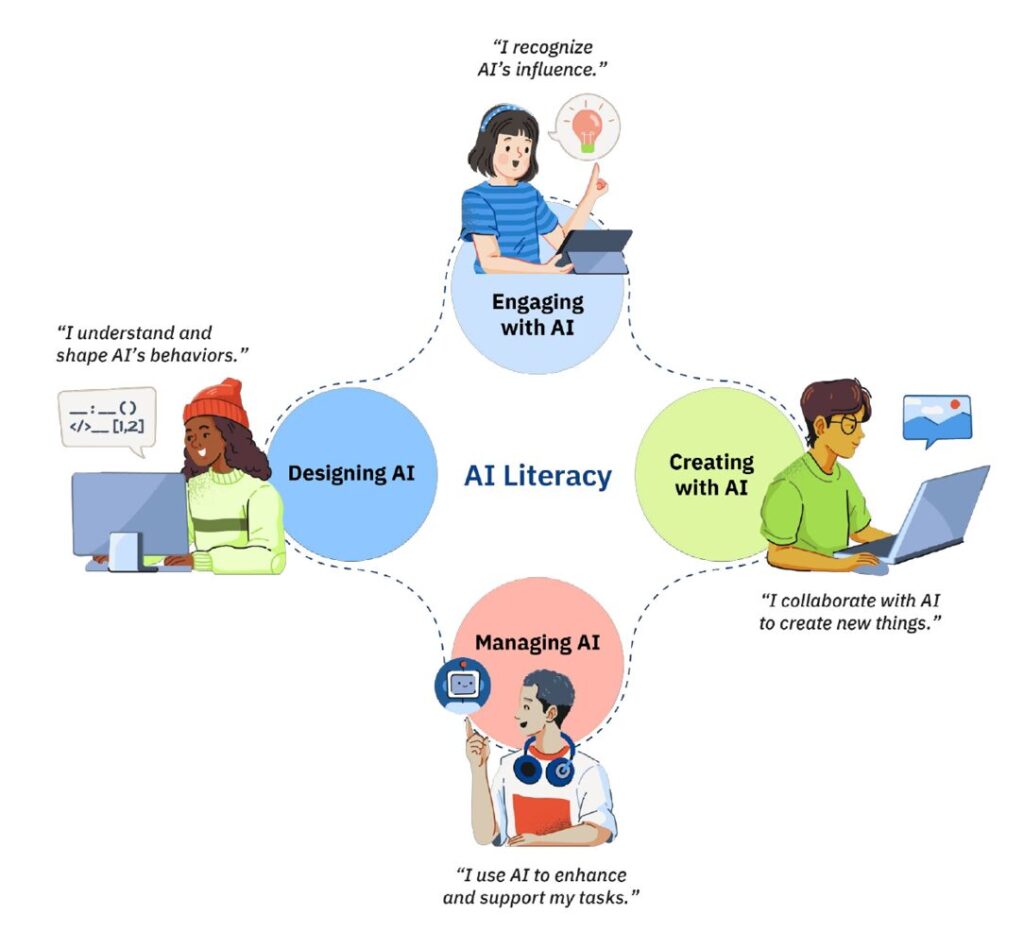
While technical training addresses the data teams skills gap at the specialist level, organizational transformation demands broader AI literacy that extends beyond traditional data roles. A study by the IMF reveals that 40% of global employment faces AI exposure, underscoring why AI competency must become a universal skill rather than a niche specialization.
AI literacy—the ability to understand AI capabilities, limitations, and ethical implications—creates a common language that bridges technical and business functions. When marketing teams grasp machine learning fundamentals, they make realistic requests of data scientists. When finance professionals understand predictive models, they apply insights more effectively. This democratization of knowledge reduces bottlenecks and accelerates adoption.
Effective literacy programs should focus on practical application rather than theoretical depth. Short-form learning modules work best: 15-minute sessions on “How Recommendation Engines Work” or “Interpreting Model Confidence Scores” prove more valuable than semester-long courses. Companies like Zapier report that 81% of businesses plan to increase AI investment in 2026, making cross-functional literacy a competitive necessity.
However, literacy alone doesn’t guarantee utilization. Organizations must create safe spaces for experimentation where non-technical staff can explore AI tools and workflows without fear of breaking systems or exposing sensitive data. Sandbox environments paired with guided tutorials transform theoretical knowledge into practical competence, building confidence that drives sustainable adoption.
Strategy 3: Encouraging Human-AI Collaboration
The future of data teams lies not in replacing human expertise with artificial intelligence, but in creating synergistic partnerships where each amplifies the other’s strengths. Human-AI collaboration represents a paradigm shift in how organizations approach the skills gap—transforming it from a deficit problem into an augmentation opportunity.
According to Zapier’s AI statistics, 65% of knowledge workers who use AI say it helps them be more creative, demonstrating that AI tools enhance rather than replace human capabilities. This collaborative approach acknowledges that while AI excels at pattern recognition and rapid data processing, humans bring contextual understanding, ethical judgment, and creative problem-solving to the equation.
Organizations implementing collaborative frameworks focus on AI training that emphasizes complementary skill development rather than competition. Data analysts learn to frame questions and interpret AI-generated insights, while AI systems handle computational heavy lifting. This division of labor allows teams to tackle increasingly complex problems—advanced AI literacy and human-AI collaboration are becoming foundational competencies for modern data professionals.
However, successful collaboration requires intentional design. Teams must develop shared vocabularies for discussing AI capabilities and limitations, establish clear workflows that define human and AI responsibilities, and create feedback loops where human expertise improves AI performance over time. The goal isn’t creating AI experts who work alongside machines—it’s cultivating data professionals who seamlessly integrate AI tools into their analytical workflows, maintaining human oversight while leveraging computational power for enhanced outcomes.
Comparison Table: Evaluating the Strategies
Understanding which upskilling strategies deliver the greatest impact requires evaluating multiple dimensions beyond simple effectiveness metrics. Different organizational contexts demand different approaches, and what works for a mid-sized fintech startup may fail spectacularly in a regulated healthcare enterprise.
| Strategy | Implementation Speed | Cost Efficiency | Scalability | ROI Timeline | Best For |
| Targeted Upskilling | Moderate (3-6 months) | High (focused resources) | Medium | 6-12 months | Technical teams needing specific AI/ML capabilities |
| AI Literacy Programs | Fast (1-3 months) | Very High (broad reach) | High | 3-6 months | Organizations with minimal AI exposure |
| Human-AI Collaboration | Slow (6-12 months) | Medium (requires tools + training) | High | 12-18 months | Mature teams ready for autonomous AI integration |
The cost-benefit analysis reveals an interesting pattern. According to Zapier’s AI statistics, organizations investing in foundational AI literacy see faster initial wins, while those committing to targeted upskilling programs report deeper technical capability development. Human-AI collaboration frameworks, though requiring the longest runway, ultimately demonstrate the highest potential for sustainable competitive advantage.
Critical consideration: No single strategy operates in isolation. What typically happens is organizations layer these approaches—starting with broad literacy initiatives to build organizational readiness, followed by targeted upskilling for critical roles, then evolving toward sophisticated collaboration models as technical maturity increases.
Limitations and Considerations
While the strategies outlined above provide robust frameworks for addressing AI skills gaps, organizations must recognize that no single approach guarantees universal success. The path to enhanced AI literacy varies significantly based on organizational context, existing technical capabilities, and cultural readiness for transformation.
Resource Constraints and ROI Uncertainty
Budget limitations pose immediate challenges for many data teams. According to Zapier’s 2026 AI statistics, organizations allocate widely varying percentages of their technology budgets to AI upskilling, with smaller teams often struggling to justify comprehensive training programs against competing priorities. The return on investment for AI education initiatives typically emerges over 12-18 months, creating tension in quarterly-focused business environments.
The Pace-of-Change Problem
AI capabilities evolve rapidly, potentially rendering specific technical training obsolete within months. In practice, organizations face a constant recalibration challenge: investing in current AI tools while preparing teams for capabilities that don’t yet exist. This temporal mismatch between training cycles and technology evolution creates persistent friction in skills development strategies.
Cultural and Psychological Barriers
Technical solutions alone cannot overcome resistance to AI adoption. Teams comfortable with established workflows may view AI integration as threatening rather than enabling. Additionally, implementing intelligent automation requires addressing concerns about job security and role transformation—considerations that extend beyond technical competency into organizational psychology.
The effectiveness of any strategy depends fundamentally on acknowledging these limitations while designing flexible, adaptable programs that can pivot as circumstances evolve.
Example Scenarios for Implementing AI Skills Strategies
Understanding theoretical frameworks is valuable, but translating them into action requires concrete examples. The following scenarios demonstrate how organizations at different stages can address data literacy challenges and bridge AI skills gaps effectively.
Scenario 1: Mid-Size Financial Services Firm
A regional bank with 800 employees identified that only 15% of its data analysts could effectively work with machine learning models. Rather than hiring externally, leadership implemented a blended approach combining internal boot camps with external certifications. Over six months, they established weekly lunch-and-learn sessions led by senior data scientists, paired with subsidized coursework through accredited online platforms. The result: 60% of the target group achieved foundational AI competency, with three analysts transitioning into full-time ML engineering roles.
Scenario 2: Healthcare Analytics Startup
A 50-person health tech company faced rapid growth but lacked the infrastructure for building scalable AI systems. They partnered with a university research lab, creating a practicum program where graduate students worked on real company projects while full-time staff mentored them. This symbiotic relationship accelerated model deployment timelines by 40% while simultaneously upskilling internal team members through knowledge transfer. The approach proved particularly effective because it addressed both talent acquisition and skill development simultaneously without significant capital expenditure.
The common thread across successful implementations: organizations that align upskilling strategies with existing workflows see 2-3x higher completion rates than those treating training as separate from daily responsibilities.
Key Takeaways
The AI skills gap represents both a challenge and an opportunity for data teams navigating the rapidly evolving landscape of 2026. Organizations that approach workforce upskilling as a strategic imperative rather than a reactive measure position themselves to capture significant competitive advantages in an increasingly AI-driven economy.
Three fundamental principles emerge from examining successful strategies: continuous learning must become cultural DNA, not an annual event; practical application accelerates retention far more effectively than theoretical training alone; and organizational support structures determine whether skills translate into business outcomes. According to DataCamp’s analysis, companies investing in comprehensive AI literacy programs see measurable improvements in both employee confidence and project success rates.
The path forward requires balanced investment across multiple dimensions—technical skill development, ethical frameworks, and change management capabilities. No single tactic closes the gap overnight, but consistent application of assessment, targeted training, hands-on experimentation, and collaborative learning creates momentum that compounds over time.Start where you are: conduct a skills inventory this quarter, launch a pilot program next quarter, and scale what demonstrates measurable impact. The organizations that thrive won’t be those with perfect strategies from day one, but those that commit to iterative improvement and develop foundational capabilities that adapt as AI technologies mature. The skills gap closes one deliberate action at a time.
FAQ’s
What is the AI skills gap?
The AI skills gap refers to the shortage of professionals with the technical and analytical skills needed to develop, deploy, and manage AI systems effectively.
Why is the AI skills gap growing in 2026?
Rapid AI adoption across industries is increasing demand for AI talent faster than organizations can train or hire skilled professionals.
What skills are most important for AI teams today?
Key skills include machine learning, data engineering, programming (Python), data analytics, AI ethics, and cloud-based AI infrastructure.
How can organizations close the AI skills gap?
Companies can address the gap through upskilling programs, AI training initiatives, hiring specialized talent, and encouraging cross-functional learning.
Why is upskilling important for data teams?
Upskilling helps existing employees adapt to evolving AI technologies, improving productivity, innovation, and long-term business competitiveness.