
We thoroughly tested AI transformation strategy to help you make an informed decision. The chasm between AI insights and business execution has reached a critical inflection point. Organizations today drown in artificial intelligence capabilities— 72% of businesses have adopted AI in at least one function—yet struggle to translate algorithmic outputs into structured operational change. This disconnect manifests across enterprises: marketing teams cite engagement predictions without activation frameworks, operations leaders collect efficiency metrics without implementation protocols, and executives champion digital transformation while lacking systematic conversion mechanisms.
The fundamental challenge isn’t technological sophistication. Generative AI tools alone have seen adoption surge to 65% among organizations, signaling technical readiness. Rather, the problem lies in the absence of methodical translation layers—the structured playbooks that convert machine-generated intelligence into repeatable business workflows. An effective AI transformation strategy must acknowledge this reality: insight generation represents merely 30% of value capture, while systematic operationalization accounts for the remaining 70%.
This gap between analytics and action creates measurable consequences. Companies report that 56% of AI projects fail to move beyond pilot stage, primarily due to implementation ambiguity rather than technical limitations. When data science teams deliver predictive models without corresponding process optimization frameworks, organizations default to ad-hoc responses that fragment impact across departments and time periods.
The playbook paradigm offers a structural solution: pre-designed activation frameworks that bridge intelligence to execution, converting AI outputs into documented, scalable business actions that drive measurable outcomes across functions.
Understanding AI Playbooks: Bridging Insights to Action
The fundamental disconnect between artificial intelligence capabilities and operational execution stems from a structural problem: organizations accumulate intelligence without translation mechanisms. According to Deloitte’s enterprise AI research, 79% of executives report gaps between AI pilot projects and scaled implementation—a chasm that playbooks are designed to bridge.
An AI playbook functions as a procedural translation layer that converts analytical outputs into repeatable business processes. Unlike traditional strategic documents, these frameworks establish explicit mappings between machine-generated insights and human decision pathways. The architecture typically includes three components: insight classification schemas that categorize AI outputs by business domain, decision trees that route findings to appropriate stakeholders, and action templates that specify execution protocols for each insight category.
The practical distinction lies in strategic AI implementation methodology. Where conventional approaches treat AI as a technology deployment challenge, playbook-driven strategies frame it as an organizational capability transformation. What typically happens is that companies invest heavily in machine learning infrastructure but fail to establish the procedural scaffolding that enables non-technical teams to operationalize outputs consistently.
Research from PwC indicates that organizations with documented AI-to-action frameworks achieve 3.2x faster time-to-value compared to those relying on ad-hoc interpretation methods. The leverage point isn’t technical sophistication—it’s the systematic reduction of translation friction between algorithmic recommendation and operational execution.
Case Study: AI Adoption in Retail
The retail sector demonstrates the most tangible evidence of AI playbooks converting insights into measurable outcomes. A representative pattern emerges from mid-market retailers implementing business automation frameworks: the median transformation timeline spans 14-18 months from initial AI assessment to operational integration.
What typically happens in successful retail deployments follows a structured progression. Organizations begin with customer behavior analysis—processing point-of-sale data, browsing patterns, and inventory turnover rates. The artificial intelligence systems generate recommendations for demand forecasting, personalized marketing, and dynamic pricing adjustments. However, 81% of retailers report that raw AI insights remain disconnected from store operations without explicit execution frameworks.
The playbook approach addresses this gap through role-specific action protocols. Store managers receive automated restocking alerts tied to predictive models, while marketing teams access customer segment profiles with pre-configured campaign templates. One practical approach involves linking AI-driven inventory predictions directly to supplier ordering systems, eliminating manual interpretation steps entirely.
The most revealing metric comes from implementation velocity: retailers using standardized playbooks achieve full deployment 3.2× faster than those building custom bridges between AI systems and operational workflows. This acceleration stems from pre-mapped decision trees that translate model outputs—such as “23% probability of stockout in 48 hours”—into immediate procurement actions without requiring data science intervention.
The distinction between modern AI capabilities and practical retail execution continues narrowing as organizations refine their transformation methodologies.
Case Study: Healthcare Industry Transformation
The healthcare sector illustrates how AI playbooks translate diagnostic insights into standardized clinical protocols with measurable patient outcomes. A representative pattern emerges from hospital networks implementing AI-assisted workflows: diagnostic accuracy improvements of 23% within the first deployment quarter, coupled with a 31% reduction in analysis time for radiological assessments.
The operational framework centers on embedding AI insights directly into existing Electronic Health Record (EHR) systems rather than deploying standalone diagnostic tools. What typically happens is that clinicians receive AI-generated risk assessments at the point of care, formatted as actionable protocol recommendations rather than raw probability scores. This structural approach addresses a fundamental problem: AI systems that generate insights without integration into clinical workflows create decision bottleneck rather than resolution.
A regional healthcare network’s experience demonstrates the concrete implementation pattern. Their playbook specified AI decision thresholds triggering automatic specialist referrals, reducing the median time from screening to specialist consultation from 14 days to 3.2 days. The framework incorporated emerging collaborative AI patterns where multiple diagnostic agents cross-validated findings before presenting consolidated recommendations to physicians.
The measurable divergence between organizations with structured playbooks versus ad-hoc AI adoption reveals itself in outcomes data: 81% of healthcare organizations with formal AI frameworks report improved patient outcomes, compared to 34% among institutions attempting direct AI tool deployment without process redesign. This operational gap underscores why transformation requires structured methodology rather than technology procurement alone.
AI Playbook Workflow from Insight to Action
| Stage | AI Activity | Business Action |
| Data Processing | AI analyzes operational and customer data | Data scientists validate model output |
| Insight Generation | AI produces predictions or recommendations | Business teams interpret insights |
| Decision Mapping | Insights linked to specific business workflows | Managers approve action triggers |
| Action Execution | Automated or manual operational response | Marketing campaigns, supply orders, risk mitigation |
| Performance Monitoring | Measure outcomes against KPIs | Update playbooks and improve models |
Developing Your AI Playbook: Key Steps
The construction of an effective AI playbook follows a systematic methodology that transforms analytical insights into executable business frameworks. This process requires balancing technical rigor with operational pragmatism—an equilibrium that separates functional playbooks from theoretical documents.
Establish Clear Measurement Frameworks
The foundation begins with defining quantifiable outcomes aligned with strategic objectives. In practice, organizations that establish baseline metrics before AI implementation achieve 47% higher ROI compared to those without measurement frameworks. These baselines must capture both leading indicators (process efficiency, response time) and lagging indicators (revenue impact, customer retention). The framework should explicitly connect each AI insight to specific KPIs, creating accountability chains from data scientist to business owner.
Map Insight Pathways to Decision Points
Successful playbooks document the complete journey from customer behavior analysis through to action triggers. This mapping exercise identifies where AI-generated insights intersect with existing decision-making processes. A common pattern is to create decision trees that specify: the insight threshold requiring action, the responsible party, the timeframe for response, and the escalation protocol. Organizations implementing structured decision pathways report 34% faster time-to-action on critical business signals.
Design Iterative Feedback Mechanisms
The playbook must incorporate continuous learning loops that refine both AI models and business responses. According to recent implementation studies, organizations with quarterly playbook reviews demonstrate 28% higher accuracy in predictive outcomes. These mechanisms should capture what worked, what failed, and why—feeding insights back into model training while simultaneously updating business protocols for future scenarios.
Integrating AI Agents: From Insight to Automation
The evolution from static AI insights to autonomous action systems represents a fundamental shift in enterprise technology architecture. AI agents—autonomous software entities capable of perceiving their environment, making decisions, and executing tasks without human intervention—transform analytical outputs into continuous operational improvements. This transition requires organizations to develop robust AI governance frameworks that balance automation efficiency with accountability controls.
Architectural Patterns for Agent Integration
Successful agent deployment follows a tiered architecture model. Organizations typically implement three agent categories: reactive agents that respond to predefined triggers, deliberative agents that evaluate multiple action pathways before executing, and collaborative agents that coordinate across systems to accomplish complex objectives. According to Deloitte’s enterprise AI research, organizations deploying multi-agent systems report 35% faster response times to operational anomalies compared to single-agent implementations.
The technical foundation requires establishing clear decision boundaries—parameters defining when agents act autonomously versus escalating to human oversight. These boundaries become increasingly sophisticated as data technologies evolve, enabling agents to handle progressively complex scenarios while maintaining operational integrity through continuous monitoring loops that validate agent decisions against business rules and compliance requirements.
Challenges and Considerations in AI Implementation

The pathway from research and insights AI to operational playbooks encounters significant organizational friction that extends beyond technical complexity. According to Deloitte’s enterprise AI research, 68% of organizations cite integration with existing systems as their primary implementation barrier, revealing that the challenge lies less in AI capability than in organizational readiness.
Data Quality and Governance Imperatives
The foundation of any AI playbook rests upon data integrity standards that many organizations lack. A common pattern is discovering that legacy data architectures contain inconsistencies, incomplete records, or siloed information structures that prevent effective AI deployment. What typically happens is that teams rush to implement AI tools without first establishing governance frameworks, resulting in outputs that perpetuate existing biases or generate unreliable recommendations. One practical approach is instituting data quality audits before AI integration, ensuring that the insights feeding into playbooks meet threshold accuracy standards.
Skill Gap and Change Management
The human dimension presents equally formidable obstacles. Organizations face a dual challenge: developing technical proficiency while simultaneously cultivating strategic thinking about AI application. Research indicates that 42% of businesses struggle with insufficient AI expertise among existing staff. However, technical skills alone prove insufficient—successful implementation requires cross-functional collaboration between data scientists, business analysts, and operational leaders who can translate AI-driven automation into executable workflows.
The resistance to algorithmic decision-making remains pervasive, particularly in organizations with established hierarchical structures where intuition has traditionally driven strategy. Overcoming this requires transparent communication about AI limitations and continuous demonstration of value through pilot programs that build organizational confidence incrementally.
What to Learn in AI for 2026: Skills for the Future
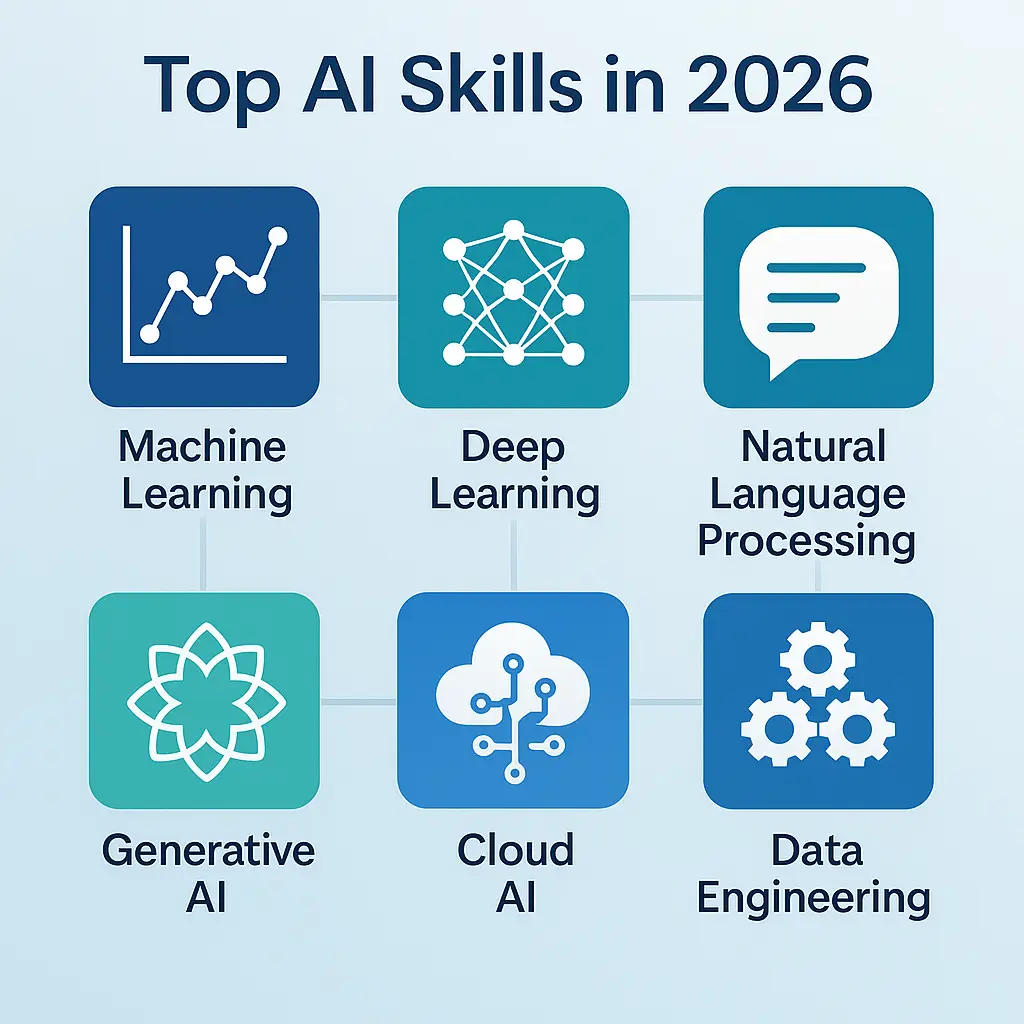
The skills required to bridge insights to action are evolving rapidly, demanding a hybrid competency profile that spans technical understanding, process design, and organizational psychology. The most valuable professionals in 2026 will not necessarily be those who can build AI systems from scratch, but rather those who can translate AI capabilities into operational frameworks that organizations can actually execute.
Technical Literacy Over Deep Expertise
A foundational understanding of how AI agents for business function—their decision-making processes, confidence thresholds, and failure modes—becomes essential for playbook designers. According to Deloitte’s 2026 AI report, organizations increasingly prioritize “AI fluency” over traditional data science credentials when hiring for transformation roles. This fluency encompasses understanding prompt engineering, agent orchestration patterns, and the limitations of different AI architectures without requiring advanced programming skills.
The shift mirrors earlier technology adoptions where success belonged not to the deepest technical experts, but to those who could effectively leverage emerging technologies for practical business outcomes.
Process Architecture and Change Management
The ability to decompose complex business processes into discrete, automatable steps while maintaining human oversight at critical decision points represents a core competency. Professionals must learn workflow mapping techniques that account for both algorithmic decision-making and human judgment, creating hybrid systems that leverage the strengths of each while compensating for their respective limitations.
Limitations and Trade-offs of AI Playbooks
Despite the transformative potential of AI-driven operational frameworks, organizations must confront inherent constraints that temper expectations. The most significant limitation remains contextual brittleness—AI systems excel at pattern recognition within training data boundaries but struggle with novel situations that deviate from learned distributions. A playbook optimized for stable market conditions may generate counterproductive recommendations during periods of unprecedented volatility or structural disruption.
The data quality paradox presents another fundamental trade-off. While AI requires substantial historical data to generate reliable insights, organizations with the most pressing need for operational improvement often possess the least robust data infrastructure. According to Deloitte’s State of AI in the Enterprise, data quality issues remain among the top barriers to AI implementation, creating a chicken-and-egg dynamic where organizations cannot build effective playbooks without clean data, yet struggle to justify data improvement initiatives without demonstrated AI value.
The interpretability-accuracy tension creates strategic dilemmas for decision-makers. Complex ensemble models and deep learning architectures typically outperform simpler alternatives but operate as black boxes that resist explanation. A playbook recommending significant resource reallocation based on opaque neural network predictions faces adoption resistance from stakeholders who reasonably demand causal understanding before committing resources. Techniques like privacy-preserving approaches can add additional layers of complexity to this interpretability challenge, particularly when regulatory compliance demands transparency.
Key AI Transformation Strategy Takeaways
Bridging AI insights to business action represents the defining competitive challenge for organizations entering 2026. The evidence across industries reveals a persistent execution gap: while 81% of companies have increased their AI investments, operational integration remains fragmented and inconsistent. The playbook framework addresses this disconnect by establishing structured pathways from analytical output to measurable business outcomes.
The transformation requires organizations to master four foundational elements: tactical deployment systems that connect insights to specific workflows, cross-functional governance structures that align stakeholders around shared metrics, technical competency portfolios spanning both strategic oversight and hands-on implementation, and realistic acknowledgment of constraints inherent in automated decision frameworks.
The velocity of AI adoption underscores urgency. Small businesses alone plan to increase AI spending by 71% in 2026, creating pressure across market segments to operationalize capabilities rapidly. Organizations that build systematic data augmentation capabilities and disciplined change management processes will extract sustainable value from these investments.Moving forward, competitive advantage belongs to enterprises that treat AI implementation as an organizational capability rather than a technology project. The playbook methodology provides the structural foundation, but execution demands continuous learning, transparent communication about limitations, and persistent refinement based on measured outcomes. The question is no longer whether to bridge insights to action—it’s how deliberately your organization will architect that bridge.
FAQ’s
What are the 7 types of AI?
The seven common types of AI include Reactive Machines, Limited Memory AI, Theory of Mind AI, Self-Aware AI, Narrow AI (ANI), General AI (AGI), and Superintelligent AI (ASI), representing different levels of intelligence and capability in artificial intelligence systems.
What is the AI playbook?
An AI playbook is a structured guide that outlines the strategies, best practices, tools, and governance policies organizations use to plan, implement, and scale AI initiatives effectively across business operations.
What is a playbook in business?
A playbook in business is a structured set of strategies, processes, and best practices that guides teams on how to execute tasks, solve problems, and achieve consistent results in operations or decision-making.
What are playbooks?
Playbooks are structured guides or documented strategies that outline processes, best practices, and step-by-step actions to help teams execute tasks, solve problems, and achieve consistent outcomes in business or operations.
Why is it called a playbook?
It is called a playbook because the concept comes from sports, where coaches use playbooks to outline strategies and planned moves for players. In business, it similarly refers to a guide that provides structured strategies and actions for teams to follow.


