

Statistics is the science of collecting, analyzing, and interpreting data to make informed decisions. In today’s data-driven world, probability distributions play a crucial role in understanding how outcomes are likely to occur. They help us model uncertainty and predict future results based on patterns in data.
One of the most important and widely used probability distributions is the binomial distribution. In simple terms, it helps calculate the probability of a fixed number of successes in a specific number of independent trials, where each trial has only two possible outcomes—success or failure.
The binomial distribution is commonly used in real-life scenarios like predicting the number of customers who will click on an ad, estimating how many students will pass an exam, or analyzing product defect rates in manufacturing. In analytics and data science, it is a foundational concept for decision-making and hypothesis testing.
In this guide, you’ll learn what the binomial distribution is, how it works, its key characteristics, and how to apply it to real-world problems with ease.
What is Binomial Distribution?
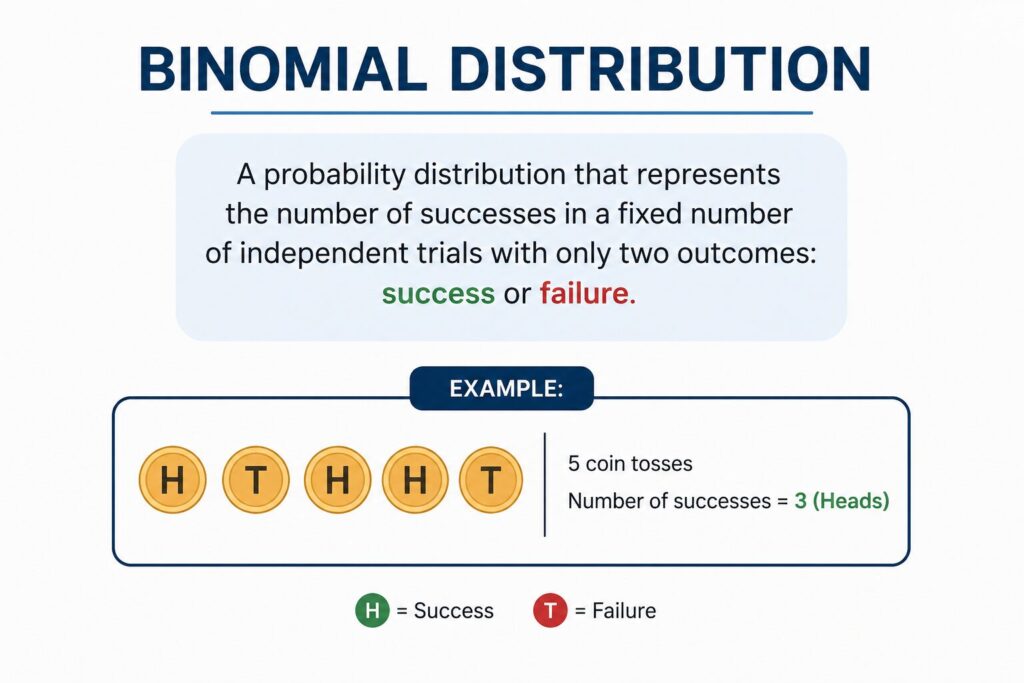
The binomial distribution is a type of discrete probability distribution that represents the number of successes in a fixed number of independent trials of an experiment. Each trial must have only two possible outcomes—commonly referred to as “success” and “failure.”
A key idea here is binary outcomes, meaning the result of each trial falls into one of two categories. For example, when you toss a coin, the outcome is either heads or tails. If we define “heads” as success, then every toss results in either a success (heads) or a failure (tails).
The binomial distribution also follows certain conditions: the number of trials (n) is fixed, the probability of success (p) remains constant in each trial, and each trial is independent of the others.
To make this more relatable, imagine tossing a coin 10 times and counting how many times it lands on heads. The binomial distribution helps calculate the probability of getting exactly 6 heads out of those 10 tosses.
Since the outcomes are countable (0, 1, 2, 3… successes), it is called a discrete probability distribution. This makes it especially useful in scenarios where we deal with counts rather than continuous measurements.
Key Features of Binomial Distribution
The binomial distribution is defined by a few essential characteristics that make it easy to identify and apply in real-life situations.
First, it involves a fixed number of trials (n). This means the total number of attempts or observations is predetermined. For example, flipping a coin 10 times gives you 10 fixed trials.
Second, each trial has only two possible outcomes—commonly called success and failure. For instance, in a light bulb quality check, the bulb is either defective (failure) or non-defective (success).
Third, the probability of success (p) remains constant in every trial. If the chance of a student passing an exam is 0.7, this probability does not change across students (assuming similar conditions).
Finally, all trials are independent. This means the outcome of one trial does not affect another. For example, getting heads in one coin toss does not influence the result of the next toss.
These features together make the binomial distribution a reliable model for analyzing repeated binary events.
Binomial Distribution Formula
The binomial distribution uses a mathematical formula to calculate the probability of getting exactly x successes in n trials. The formula is:
P(X = x) = nCx · pˣ · qⁿ⁻ˣ
At first glance, this may look complex, but it becomes simple once you break it down.
- n represents the total number of trials. For example, if you toss a coin 5 times, n = 5.
- x is the number of successful outcomes you want to measure. If you’re calculating the probability of getting 3 heads, then x = 3.
- p is the probability of success in a single trial. For a fair coin, p = 0.5.
- q is the probability of failure, which is simply 1 − p. So if p = 0.5, then q = 0.5.
The term nCx (also written as combinations) tells us how many different ways we can achieve x successes out of n trials.
This involves the concept of factorials, which is a way of multiplying whole numbers. For example, 5! (read as “5 factorial”) means 5 × 4 × 3 × 2 × 1.
In simple terms, the formula combines:
- the number of ways outcomes can occur, and
- the probability of those outcomes happening
This helps calculate exact probabilities in a structured and logical way.
Step-by-Step Example of Binomial Distribution
Let’s solve a simple example to understand how the binomial distribution works.
Problem: What is the probability of getting exactly 3 heads in 5 coin tosses?
Here, we identify the values:
- Number of trials (n) = 5
- Number of successes (x) = 3 (heads)
- Probability of success (p) = 0.5 (for a fair coin)
- Probability of failure (q) = 1 − p = 0.5
We use the binomial formula:
P(X = x) = \binom{n}{x} p^x q^{n-x}
Now plug in the values:
P(X = 3) = ⁵C₃ × (0.5)³ × (0.5)²
First, calculate combinations:
⁵C₃ = 5! / (3! × 2!) = 10
Now calculate probabilities:
(0.5)³ = 0.125
(0.5)² = 0.25
Multiply everything:
10 × 0.125 × 0.25 = 10 × 0.03125 = 0.3125
Final Answer: The probability of getting exactly 3 heads in 5 tosses is 0.3125 (or 31.25%).
Interpretation: This means that in repeated sets of 5 coin tosses, there is about a 31% chance of getting exactly 3 heads.
Mean and Variance of Binomial Distribution
In a binomial distribution, the mean and variance help us understand the overall behavior of outcomes.
The mean is calculated as np, where:
- n = number of trials
- p = probability of success
The mean represents the average number of successes you can expect. For example, if you toss a coin 10 times (n = 10) and p = 0.5, then:
Mean = 10 × 0.5 = 5
So, on average, you can expect 5 heads.
The variance is calculated as npq, where:
- q = 1 − p (probability of failure)
Variance tells us how much the outcomes vary or spread out from the mean. In the same example:
Variance = 10 × 0.5 × 0.5 = 2.5
A smaller variance means results are closer to the average, while a larger variance indicates more fluctuation.
Together, mean and variance give a quick summary of what to expect from a binomial experiment and how consistent the outcomes are likely to be.
Real-Life Applications of Binomial Distribution
The binomial distribution is widely used across industries to make data-driven decisions and predictions.
In business, it helps estimate customer behavior. For example, if a company knows that 20% of visitors convert into buyers, it can use the binomial distribution to predict how many conversions might occur out of 100 website visitors.
In quality testing, manufacturers use it to track defective products. Suppose a factory produces items with a 5% defect rate. The binomial distribution can calculate the probability of finding a certain number of defective items in a sample batch, helping maintain quality standards.
In marketing campaigns, it is useful for analyzing click-through rates. If an email campaign has a 10% chance of getting clicks, businesses can estimate how many users are likely to engage out of a specific audience size.
In healthcare, it helps evaluate treatment outcomes. For instance, if a medicine has a 70% success rate, doctors and researchers can estimate how many patients are likely to recover out of a group undergoing treatment.
These applications show how the binomial distribution simplifies decision-making by turning probabilities into actionable insights.
When to Use Binomial Distribution
You should use the binomial distribution when certain conditions are met. Think of it as a quick checklist to decide its applicability.
First, there must be a fixed number of trials. For example, analyzing results from exactly 50 survey responses.
Second, each trial should have only two possible outcomes, such as yes/no, success/failure, or pass/fail.
Third, all trials must be independent, meaning one outcome does not influence another. For instance, one customer’s purchase decision should not affect another’s.
Finally, the probability of success must remain constant across all trials. If the likelihood of success keeps changing, the binomial model may not be appropriate.
If your scenario satisfies all these conditions, the binomial distribution is a reliable and effective tool for probability analysis.
Binomial Distribution vs Other Distributions
The binomial distribution is often compared with other probability distributions, especially the normal and Poisson distributions, but each serves a different purpose.
The Normal Distribution is a continuous distribution, meaning it deals with data that can take any value within a range (like height or weight). In contrast, the binomial distribution is discrete, focusing on countable outcomes like the number of successes (e.g., number of people who clicked an ad). Interestingly, when the number of trials is large, the binomial distribution can be approximated using the normal distribution.
The Poisson Distribution is used for rare events occurring over a fixed interval, such as the number of customer complaints in a day. While the binomial distribution requires a fixed number of trials, the Poisson distribution focuses on the number of times an event happens in a given period or space.
In simple terms, use binomial for fixed trials with two outcomes, normal for continuous data, and Poisson for rare event counts.
Common Mistakes to Avoid
When working with the binomial distribution, a few common mistakes can lead to incorrect results.
One major error is confusing independent and dependent events. The binomial model only works when each trial is independent—if one outcome affects another, the results will be inaccurate.
Another mistake is using incorrect probability values. The probability of success (p) must remain constant across all trials. Changing probabilities can invalidate the model.
People also tend to misinterpret results, especially probabilities. For example, a probability of 0.3 does not mean something will happen exactly 3 out of 10 times every time—it represents likelihood, not certainty.
Lastly, avoid overcomplicating calculations. Breaking the formula into simple steps makes it much easier to understand and apply correctly.
Advantages and Limitations
Advantages:
- Easy to understand: The binomial distribution uses a simple structure, making it beginner-friendly and easy to apply.
- Widely applicable: It can be used in various real-world scenarios like business forecasting, quality testing, marketing analysis, and healthcare studies.
- Clear outcomes: Since it focuses on two possible results, it simplifies probability calculations and interpretation.
Limitations:
- Only binary outcomes: It works only when there are exactly two possible outcomes (success/failure), limiting its use in more complex scenarios.
- Assumes independence: Each trial must be independent, which may not always hold true in real-life situations.
- Constant probability required: The probability of success must remain the same across all trials, which can be unrealistic in some cases.
Conclusion
The binomial distribution is a fundamental concept in statistics that helps measure the probability of success across multiple trials. From understanding its key features and formula to applying it in real-life scenarios like marketing, healthcare, and business decisions, it offers a practical way to analyze uncertainty.
Its importance in statistics and analytics cannot be overstated, as it builds a strong foundation for more advanced concepts and data-driven decision-making. While it has certain limitations, its simplicity and effectiveness make it a go-to tool for analyzing binary outcomes.
To truly master the binomial distribution, practice is essential. Try solving different problems and applying the concept to everyday situations.
Practical takeaway: Whenever you encounter repeated events with two possible outcomes, think binomial—it’s often the simplest and smartest way to calculate probability.
FAQ’s
What are the conditions required for a binomial distribution?
A binomial distribution applies only when certain conditions are met: a fixed number of trials, two possible outcomes (success/failure), independent trials, and a constant probability of success.
What is the difference between binomial and normal distribution?
The binomial distribution is discrete and deals with countable outcomes (like number of successes), while the normal distribution is continuous and used for measurements like height or weight.
Where is binomial distribution used in real life?
It is widely used in areas like marketing (click rates), healthcare (treatment success), and quality control (defect rates), where outcomes are binary and repeated trials are analyzed.
What happens if the probability changes in each trial?
If the probability of success is not constant across trials, the binomial distribution cannot be used. In such cases, other models or distributions may be more appropriate.


