

In today’s digital era, organizations generate an enormous amount of information every second. From social media interactions to IoT sensors, mobile devices, and e-commerce transactions — data is everywhere. This explosion of information has given rise to what we call Big Data.
But managing and analyzing such vast data volumes is nearly impossible with traditional data processing systems. This is where Hadoop, an open-source framework by Apache, steps in. It provides a scalable and fault-tolerant system for storing and processing Big Data efficiently.
The combination of Big Data & Hadoop has revolutionized how organizations store, process, and derive insights from massive datasets.
What is Big Data?
Big Data refers to datasets that are too large or complex to be processed using traditional database systems. The size, speed, and diversity of this data exceed the capacity of conventional tools, requiring advanced frameworks like Hadoop and Spark to handle them effectively.
Definition:
Big Data can be defined as data that contains greater variety, arriving in increasing volumes and with higher velocity.
Big Data is not just about the size — it’s also about the value hidden within it. Businesses use Big Data analytics to uncover hidden patterns, customer behavior, market trends, and correlations.
Characteristics of Big Data (The 6 Vs Model)
Big Data is often defined by six key characteristics, known as the 6 Vs:
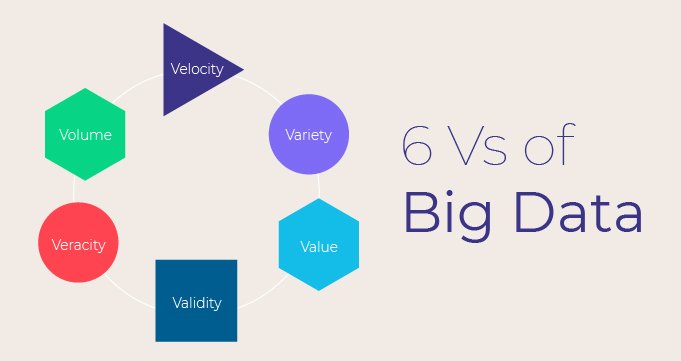
- Volume – Refers to the vast amount of data generated every second.
Example: Facebook stores more than 300 petabytes of user data. - Velocity – The speed at which data is generated and processed.
Example: Stock market systems process millions of transactions per second. - Variety – Data comes in multiple formats: structured, unstructured, and semi-structured.
Example: Text, images, videos, logs, and IoT data. - Veracity – Ensuring data accuracy and reliability.
Example: Filtering fake reviews from e-commerce platforms. - Value – Extracting meaningful insights from data.
Example: Netflix uses viewing data to recommend personalized content. - Variability – The inconsistency of data flow.
Example: Traffic spikes during online sales events.
Real-World Examples of Big Data
- Healthcare: Predicting disease outbreaks using global health records.
- Finance: Detecting fraud by analyzing transaction data in real-time.
- Retail: Personalizing shopping experiences using customer behavior analytics.
- Social Media: Monitoring trending topics and user engagement.
- Transportation: Using GPS and sensor data to optimize logistics.
Challenges of Big Data Management
- Data Storage and Scalability
- Data Security and Privacy
- Integration of Diverse Data Sources
- Real-time Data Processing
- Data Quality and Cleansing
Traditional systems fail to handle these challenges efficiently, which is why the Hadoop framework became a game-changer in the field of Big Data analytics.
Introduction to Hadoop Ecosystem
Hadoop is an open-source framework developed by the Apache Software Foundation to store and process massive datasets in a distributed computing environment. It is designed to scale from a single server to thousands of machines, each offering local computation and storage.
The main goal of Hadoop is to allow data processing across clusters of computers using simple programming models.
The Core Components of Hadoop
a. HDFS (Hadoop Distributed File System)
HDFS stores large data files across multiple machines. It splits data into smaller blocks and distributes them across nodes to ensure reliability and fault tolerance.
Key Features:
- Fault-tolerant storage
- High throughput
- Scalability
b. MapReduce
MapReduce is a programming model used for parallel processing of data.
Process Flow:
- Map Phase: Splits input data into key-value pairs.
- Reduce Phase: Aggregates the output from the Map phase into final results.
Example:
Counting word occurrences in a dataset using MapReduce logic.
c. YARN (Yet Another Resource Negotiator)
YARN manages resources and job scheduling across Hadoop clusters. It ensures efficient resource allocation to different processing tasks.
Key Tools in the Hadoop Ecosystem
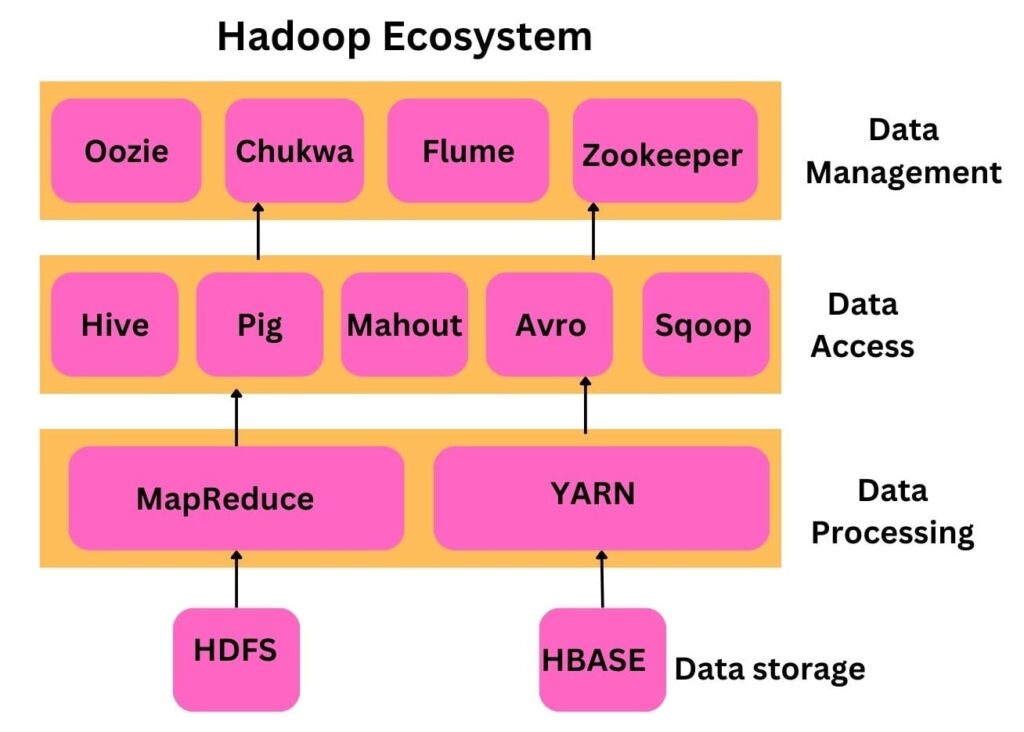
1. Apache Hive
- A data warehouse tool that provides SQL-like queries (HiveQL).
- Ideal for querying large datasets stored in HDFS.
2. Apache Pig
- A scripting platform for analyzing large data sets using Pig Latin language.
- Converts scripts into MapReduce jobs.
3. Apache HBase
- A NoSQL database built on top of HDFS.
- Suitable for real-time read/write access to Big Data.
4. Apache Spark
- A fast and general-purpose cluster-computing system.
- Provides in-memory data processing that is 100x faster than MapReduce.
5. Apache Flume
- Used to collect, aggregate, and move large amounts of streaming data into HDFS.
6. Apache Sqoop
- Facilitates data transfer between Hadoop and relational databases.
How Big Data & Hadoop Work Together
Big Data generates vast, complex data that needs to be stored and analyzed. Hadoop offers the infrastructure to handle it through distributed computing.
Workflow:
- Data ingestion using tools like Flume or Kafka.
- Storage in HDFS.
- Processing using MapReduce or Spark.
- Querying through Hive.
- Visualization via BI tools.
Big Data Processing Architecture with Hadoop
A typical Big Data architecture using Hadoop involves:
- Data Sources: IoT sensors, logs, social media feeds.
- Data Collection Layer: Flume, Kafka.
- Data Storage Layer: HDFS, HBase.
- Processing Layer: MapReduce, Spark.
- Analytics Layer: Hive, Pig.
- Visualization Layer: Tableau, Power BI.
Advantages of Using Hadoop for Big Data Analytics
- Scalable: Can easily handle petabytes of data.
- Cost-effective: Open-source and runs on commodity hardware.
- Fault-tolerant: Data replication ensures reliability.
- Flexible: Handles structured, semi-structured, and unstructured data.
- High Performance: Parallel processing ensures faster computation.
Real-World Applications of Big Data & Hadoop
- Netflix: Uses Hadoop for content recommendations and user behavior analysis.
- Amazon: Processes massive customer and product data for market predictions.
- Airbnb: Analyzes customer reviews and pricing trends using Hadoop clusters.
- Twitter: Handles real-time tweet analytics using HDFS and Spark.
- Healthcare Industry: Uses Hadoop for genomic data analysis and predictive diagnostics.
Hadoop vs Traditional Data Processing Systems
| Feature | Hadoop | Traditional Systems |
| Scalability | High | Limited |
| Cost | Low (open-source) | Expensive |
| Fault Tolerance | Yes | No |
| Data Variety | Structured + Unstructured | Structured only |
| Speed | Parallel processing | Sequential processing |
Limitations of Hadoop
- Not ideal for real-time processing.
- High latency compared to Spark.
- Complex configuration and management.
- Requires skilled professionals.
The Future of Big Data and Hadoop in the AI Era
With the growth of Artificial Intelligence (AI) and Machine Learning (ML), Hadoop continues to evolve. Integration with frameworks like Spark, TensorFlow, and Kubernetes enables more powerful and flexible Big Data solutions.
Future trends include:
- AI-driven data optimization.
- Cloud-based Hadoop (AWS EMR, Azure HDInsight).
- Real-time analytics with hybrid architectures.
Integration with Cloud Platforms
Cloud platforms have revolutionized how organizations deploy and scale Hadoop clusters. Leading vendors like Amazon EMR, Google Dataproc, and Microsoft Azure HDInsight provide managed Hadoop ecosystems that reduce infrastructure complexity and improve cost-efficiency.
Key benefits include:
- Elastic scaling: Adjusting resources dynamically for variable workloads.
- Pay-as-you-go pricing: Reducing costs by avoiding overprovisioned servers.
- Cloud-native integrations: Seamless access to cloud storage, AI, and ML services.
A practical example is Airbnb, which migrated its Hadoop workloads to Amazon EMR, enabling faster analytics and better integration with its cloud-based data warehouse (Redshift).
The Role of Big Data and Hadoop in Artificial Intelligence
Big Data fuels AI, and Hadoop acts as the data backbone. Machine learning algorithms thrive on vast and diverse datasets, which Hadoop stores efficiently across distributed nodes.
With the rise of Generative AI and LLMs (Large Language Models), data preprocessing at scale has become a prerequisite. Organizations use Hadoop-based architectures to:
- Aggregate massive training data.
- Filter and clean datasets using Spark jobs.
- Enable parallel data access for faster model training.
For instance, OpenAI’s GPT models rely on distributed data pipelines conceptually similar to Hadoop’s parallel data processing, though implemented with more modern frameworks.
Big Data Analytics and Business Intelligence Integration
Hadoop now integrates seamlessly with business intelligence (BI) tools like Tableau, Power BI, and QlikView. These tools allow non-technical users to visualize big data insights without learning complex query languages.
Advanced analytics pipelines may involve:
- Data stored in HDFS.
- Processed using Hive or Spark SQL.
- Visualized in BI dashboards for strategic decisions.
Example: Walmart uses Hadoop to analyze customer purchase patterns and integrates the results into BI dashboards for better inventory management.
Edge Computing and IoT with Hadoop
The exponential growth of IoT devices has pushed computing to the edge. While edge nodes handle immediate data processing, Hadoop clusters serve as centralized repositories for aggregated insights.
For instance, in smart manufacturing, IoT sensors collect production metrics in real time. Hadoop aggregates this data for long-term analysis, detecting patterns in equipment failure or productivity bottlenecks.
This hybrid approach enables predictive maintenance and energy optimization—crucial for Industry 4.0 applications.
Real-Time Data Streaming and Hadoop Integration
Real-time analytics has become essential in sectors like finance, e-commerce, and IoT. While Hadoop traditionally excels at batch processing, modern ecosystems integrate it with Apache Kafka and Apache Storm to process real-time event streams.
Architecture example:
- Kafka ingests live data from sensors or web applications.
- Spark Streaming processes data in near real time.
- HDFS stores processed data for historical analysis.
Use Case: Uber combines Kafka, Spark, and Hadoop to process millions of ride requests per minute, enabling real-time surge pricing and demand forecasting.
Data Governance and Security in Hadoop Ecosystem
As enterprises handle petabytes of sensitive information, data governance and security have become mission-critical. Hadoop provides tools like:
- Apache Ranger: Centralized security management, policy enforcement, and auditing.
- Apache Atlas: Metadata management and data lineage tracking.
- Kerberos Authentication: Strong user verification for secure access.
Real-world implementation: JPMorgan Chase uses Apache Ranger to manage fine-grained access control across its Hadoop clusters, ensuring compliance with financial regulations like GDPR and PCI DSS.
Hadoop and Machine Learning Integration
Modern businesses use Hadoop as a data lake feeding machine learning (ML) and deep learning models. Tools like Apache Mahout, H2O.ai, and TensorFlow on Hadoop (TFoH) are popular for distributed training on large datasets.
Here’s how this integration benefits organizations:
- Data Preparation: Hadoop stores massive unstructured data (text, video, logs) for preprocessing.
- Feature Engineering: Spark MLlib or Mahout can process terabytes of data efficiently.
- Model Training: Parallelized training speeds up predictive analytics (e.g., churn prediction or recommendation engines).
Example: LinkedIn uses Hadoop-based pipelines for feature extraction and Spark for training recommendation models that suggest connections and content.
The Evolution of Big Data Frameworks Beyond Hadoop
- While Hadoop remains a foundational big data technology, the ecosystem has evolved dramatically. Frameworks like Apache Spark, Apache Flink, and Apache Beam have redefined large-scale data processing with in-memory computation, streaming analytics, and real-time insights.
- However, Hadoop continues to play a key role in batch data processing and as a storage backbone (HDFS) for hybrid architectures. Modern data pipelines often integrate Hadoop for storage and Spark for processing, ensuring both scalability and performance efficiency.
- For example, Netflix uses a hybrid data architecture combining Hadoop (for historical data) and Spark (for real-time recommendations) to power personalized viewing suggestions.
Conclusion
The combination of Big Data & Hadoop has transformed the way organizations collect, process, and analyze information. As industries continue to generate massive data, Hadoop remains a cornerstone of distributed data processing, enabling data-driven innovation across all domains.From financial analytics to AI-powered predictions, Big Data & Hadoop form the foundation of modern enterprise intelligence — powering the digital transformation of our world.
FAQ’s
What is big data and Hadoop?
Big Data refers to extremely large and complex datasets that traditional tools can’t handle, while Hadoop is an open-source framework that enables the distributed storage and processing of these massive datasets efficiently across multiple computers.
What are the 4 main components of Hadoop?
The four main components of Hadoop are Hadoop Distributed File System (HDFS) for data storage, MapReduce for data processing, YARN for resource management, and Common Utilities that support all Hadoop modules.
What is called Hadoop?
Hadoop is an open-source framework developed by Apache that allows for the storage and processing of large-scale data across distributed computer clusters using simple programming models.
What is the main purpose of Hadoop?
The main purpose of Hadoop is to store, manage, and process massive amounts of data efficiently by distributing tasks across multiple computers, ensuring scalability, fault tolerance, and high performance.
What is called big data?
Big Data refers to extremely large and complex datasets that are too vast for traditional data processing tools to handle, characterized by the three V’s — Volume, Velocity, and Variety.


