
Why Programming Matters Today
We live in a world powered by code. Whether you’re streaming a video, analyzing financial data, or building an AI chatbot, programming plays a critical role in making it possible. Yet, the world of programming is vast — and not all languages or techniques are the same.
From general-purpose giants like Python, to specialized tools like R, and optimization methods like linear programming, understanding the differences and benefits of each is vital.
What Is Programming and Why It’s Transforming the World
Programming is the act of creating a set of instructions that tell a computer how to perform a task. It serves as the foundation of software, apps, algorithms, AI, data analytics, and much more.
Why It’s So Impactful:
- Automates repetitive and manual tasks
- Drives innovation in healthcare, finance, and transportation
- Enables the development of smart systems and predictive models
- Powers everyday apps, websites, and services
Fun Fact: Over 90% of the world’s data has been generated in the last two years, and programming tools like Python and R are key to making sense of it.
Python Programming: Simplicity Meets Power
<img src=”https://upload.wikimedia.org/wikipedia/commons/c/c3/Python-logo-notext.svg” alt=”Python Programming Logo” width=”100″/>
Python has become the world’s most popular programming language — and for good reason. Its simplicity, readability, and extensive library support make it the top choice for developers and data scientists alike.
Key Features of Python:
- Easy to read and write
- Massive ecosystem (NumPy, pandas, TensorFlow, etc.)
- Supports multiple paradigms (OOP, functional, procedural)
- Great for web, automation, ML, AI, and scripting
Real-World Python Applications:
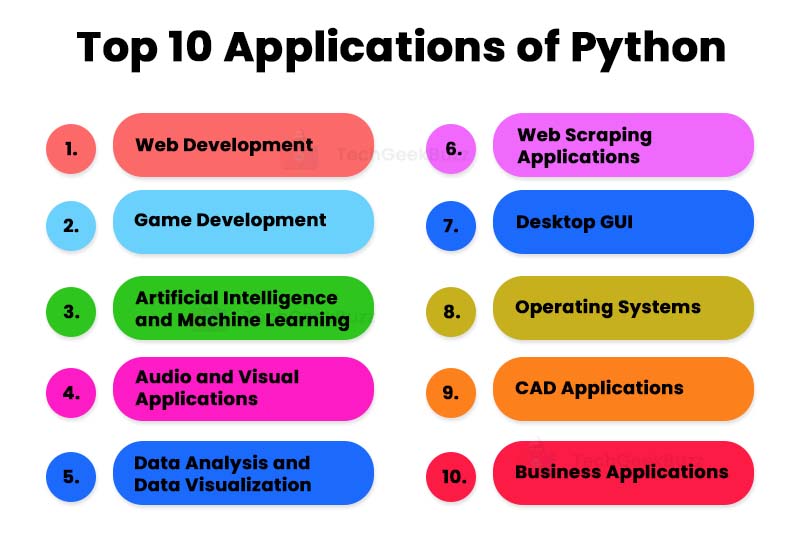
- Web Development: Using frameworks like Django or Flask
- Data Analysis & Visualization: With pandas and Matplotlib
- Machine Learning: With TensorFlow or scikit-learn
- Automation: From data scraping to email alerts
Example:
import pandas as pd
data = {‘Product’: [‘A’, ‘B’, ‘C’], ‘Sales’: [200, 340, 150]}
df = pd.DataFrame(data)
print(df.describe())
This simple Python snippet provides statistical insight into sales data, ideal for business intelligence.
R Programming: Data Science’s Best Friend
<img src=”https://upload.wikimedia.org/wikipedia/commons/1/1b/R_logo.svg” alt=”R Programming Logo” width=”100″/>
When it comes to statistical computing and graphics, R programming stands out. Used widely in academia, research, and by statisticians, R specializes in deep data analysis.
Why R Is Popular:
- Designed for statistical modeling
- Comprehensive visualization packages like ggplot2
- Strong community support
- Ideal for reproducible research with R Markdown
R Programming Use Cases:
- Academic research and simulations
- Advanced statistical analysis
- Bioinformatics and clinical trials
- Visualizing trends in complex datasets
Example:
library(ggplot2)
data <- data.frame(
category = c(“A”, “B”, “C”),
values = c(10, 23, 17)
)
ggplot(data, aes(x=category, y=values)) + geom_bar(stat=”identity”)
This R code creates a bar chart for categorical data — perfect for insights at a glance.
Linear Programming: Optimization in Action
<img src=”https://upload.wikimedia.org/wikipedia/commons/thumb/9/9e/Feasible_region.svg/300px-Feasible_region.svg.png” alt=”Linear Programming Graph” width=”300″/>
While Python and R focus on computation and analysis, linear programming is all about optimization. It’s a mathematical technique used to achieve the best outcome (like maximizing profit or minimizing cost) given constraints.
What Is Linear Programming?
It involves:
- Objective function: What you want to maximize or minimize
- Constraints: Conditions that must be met
- Variables: Values you control
Real-World Linear Programming Use Cases:
- Optimizing supply chains and logistics
- Portfolio optimization in finance
- Manufacturing resource planning
- Airline scheduling
Example in Python (using PuLP):
from pulp import LpMaximize, LpProblem, LpVariable
model = LpProblem(name=”profit-maximization”, sense=LpMaximize)
x = LpVariable(name=”x”, lowBound=0)
y = LpVariable(name=”y”, lowBound=0)
model += 20 * x + 30 * y, “Profit”
model += (2 * x + 3 * y <= 100, “Constraint_1”)
model.solve()
print(f”x = {x.value()}, y = {y.value()}”)
This problem solves for the best mix of products x and y to maximize profit.
Comparing Python, R, and Linear Programming
| Feature | Python Programming | R Programming | Linear Programming |
| Use Case | General-purpose | Statistics, Research | Optimization |
| Learning Curve | Beginner-friendly | Moderate | Conceptually Complex |
| Libraries & Tools | NumPy, pandas, sklearn | ggplot2, dplyr, caret | PuLP, SciPy, Gurobi |
| Visualization | Matplotlib, Plotly | ggplot2 | Not native, needs external plotting |
| Ideal For | Web, AI, Automation | Data science, BioStats | Business ops, Resource planning |
Real-Time Examples and Case Studies
1. Netflix Recommendation Engine (Python)
Netflix uses Python’s machine learning capabilities to predict what you want to watch next, improving user engagement and satisfaction.
2. COVID-19 Data Visualization (R)
Governments and research institutions used R to model virus spread, analyze health data, and present dashboards.
3. Airline Crew Scheduling (Linear Programming)
Delta Airlines saves millions by using linear programming to create cost-efficient staff schedules while adhering to regulatory constraints.
The Three Pillars of Modern Computing: Python, R & Optimization
Most professionals think Python and R are simply programming languages, and linear programming is just a mathematical technique—but in modern tech ecosystems, these three form the core of intelligent automation:
✔ Python → Automation, AI, and systems integration
✔ R → Statistical depth, inferential modeling, domain-specific analytics
✔ Linear Programming (LP) → Strategic decision-making under constraints
Together, they create end-to-end solutions such as:
- Forecasting demand (R)
- Automatically cleaning & modeling data (Python)
- Optimizing production and logistics (LP models)
This tri-layered workflow mirrors how Fortune 500 companies build real analytics pipelines.
Python vs R vs LP: Advanced Technical Comparison (Beyond Basics)
| Feature / Depth Level | Python | R | Linear Programming |
| Underlying Engine | CPython (C-based), PyPy, JIT support | R Engine + LAPACK, BLAS | Simplex, Interior-Point, Branch & Bound |
| Memory Model | Reference counting + garbage collection | Copy-on-modify memory model | Sparse matrix optimizations |
| Parallel Computing | multiprocessing, Ray, Dask | parallel, Rcpp, data.table threads | Parallel simplex + GPU solvers |
| Execution Speed | Medium (improved with Numba/Cython) | Slower (unless optimized with C++) | Very fast when using commercial solvers (Gurobi/CPLEX) |
| Scalability | Excellent for production | Moderate for enterprise apps | High (used in airline, logistics, finance) |
How Python, R, and Optimization Power Enterprise Systems
Data Engineering Pipeline
- Python handles ingesting data pipelines via Airflow or Spark.
- R performs statistical analysis and inference on subsets.
- Optimization engines allocate resources or schedule operations.
Example:
A logistics company:
- Python → collects GPS, orders, routes
- R → predicts demand, delays, reliability
- LP → optimizes delivery routing
Advanced Python Concepts for Modern Developers
a. Python’s Role in AI Infrastructure
Python dominates AI not because of speed but because of:
- C/C++ backend libraries (TensorFlow, PyTorch)
- GPU support via CUDA
- Strong API ecosystem
Python is the “glue layer” of modern AI systems.
b. Python in Cloud & DevOps
- Used for AWS Lambda Serverless Functions
- Infrastructure as Code (IaC) with Pulumi
- Container orchestration scripts via Kubernetes APIs
c. Python for Big Data
Technologies:
- PySpark → distributed data processing
- Dask → parallel computing
- Polars → lightning-fast dataframe engine
d. Advanced Python Data Models
Python supports:
- Custom metaclasses
- Decorators
- AsyncIO
- Memory profiling
These features make it powerful for building large-scale systems.
Advanced R Capabilities for High-Complexity Data Science
R has deep computational and statistical strengths that Python lacks natively.
a. Specialized Statistical Libraries
- mgcv (Generalized Additive Models)
- lme4 (Mixed effects models)
- survival (Survival analysis)
- forecast (ARIMA, ETS)
b. R + C++ Hybrid Computing
Using Rcpp, critical computations run in C++:
→ Much faster than pure R or Python in some cases.
c. R for Reproducible Science
- R Markdown
- Quarto
- Knitr
Automates end-to-end research workflows with executable documents.
d. R Shiny for Web Apps
Used in:
- Healthcare dashboards
- Economic forecasting tools
- Government policy dashboards
This makes R popular among statisticians who need interactive communication tools.
Advanced Concepts in Linear Programming
LP is the foundation of operations research and high-end decision automation.
1. LP Solvers and Their Efficiency
Different solvers use:
- Simplex algorithm → fast for business problems
- Interior-Point Methods → used for large-scale LP
- Cutting Plane / Branch & Bound → for MILP
Top solvers:
- Gurobi (industry standard)
- IBM CPLEX
- Google OR-Tools
- GLPK (open-source)
2. Mixed Integer Linear Programming (MILP)
Most real-world problems require integer constraints:
- Scheduling employees
- Knapsack planning
- Transportation routing
MILP = LP + logical constraints → widely used in corporates.
3. Nonlinear Optimization (NLP)
LP is linear, but real systems often aren’t.
Examples:
- Portfolio optimization with risk
- Chemical engineering models
- Renewable energy optimization
Advanced solvers handle nonlinear and quadratic programming.
Real-World High-Level Enterprise Case Studies
Case Study 1: Amazon Supply Chain Optimization
- Python → ingests product, warehouse, delivery data
- R → applies demand forecasting models
- LP → optimizes warehouse storage, routing, delivery schedules
Result: Millions saved annually.
Case Study 2: Goldman Sachs Portfolio Optimization
- Python → collects market data via APIs
- R → performs time series forecasting
- LP/MILP → allocates portfolio weights under risk constraints
Result: Lower risk exposure & increased returns.
Case Study 3: Airline Flight Crew Scheduling
One of the hardest optimization problems in OR.
LP helps airlines:
- Reduce delays
- Save fuel
- Maintain crew rest regulations
LP-based scheduling tools save airlines millions every month.
Integration of Python, R, and Optimization in One Workflow
Modern data science teams often integrate all three:
Workflow Example
Python → ETL Pipeline + Data Cleaning
R → Statistical modeling & Monte Carlo simulations
LP → Optimization of resources based on model outputs
Python → Deployment into production (Flask/FastAPI)
This multi-language synergy is becoming the new norm.
Essential Tools and Libraries
For Python Programming:
- Jupyter Notebook – Interactive coding and analysis
- VS Code – Lightweight and powerful editor
- pandas, NumPy – Data analysis and manipulation
For R Programming:
- RStudio – Best IDE for R users
- tidyverse – Collection of R packages for data science
- shiny – Build interactive web apps in R
For Linear Programming:
- PuLP – Python library for LP modeling
- Gurobi – Commercial solver with powerful optimization tools
- OpenSolver – Excel-based LP tool
Learning Resources and Communities
Python:
- Real Python
- GeeksforGeeks Python
- Stack Overflow Python tag
R:
- R-bloggers
- Tidyverse
- RStudio Community
Linear Programming:
- Operations Research Models and Methods
- Google OR-Tools
- MIT OpenCourseWare: Linear Optimization
Final Thoughts: Embracing the Programming Revolution
Whether you’re an aspiring developer, a data scientist, or a business analyst, programming unlocks a world of opportunities. Python offers the flexibility to build anything, R provides the precision for data-driven research, and linear programming brings mathematical rigor to decision-making.
No matter where you start, now is the best time to learn, practice, and apply these powerful tools.
FAQ’s
What are the advantages of using a programming language like Python or R for analytics?
Python and R offer powerful libraries, flexibility, and automation capabilities, making it easy to clean data, run complex analyses, build models, and generate insights efficiently and at scale.
What is the significance of linear programming for optimization?
Linear programming is crucial for optimization because it helps identify the most efficient solution—such as minimizing cost or maximizing profit—by mathematically modeling constraints and objective functions.
What is the power of Python programming?
Python’s power lies in its simplicity, vast libraries, and versatility, enabling everything from data analysis and AI to web development and automation with minimal code and maximum efficiency.
What is the future of R and Python?
The future of R and Python remains strong, with Python leading in AI and application development while R continues to dominate advanced statistics—together shaping the evolving landscape of data science and analytics.
What are the 5 steps of optimization?
The 5 steps of optimization are: define the problem, set constraints, build the objective function, apply an optimization method, and analyze the optimal solution for decision-making.


