Artificial Intelligence (AI) is no longer just a buzzword — it’s shaping industries, healthcare, business, and daily life. At the forefront of this transformation is DeepMind, Google’s AI research lab that has produced some of the most influential breakthroughs in machine learning and deep reinforcement learning.
From creating AlphaGo, the AI that defeated world champions in the ancient game of Go, to AlphaFold, which solved a 50-year biological challenge by predicting protein structures, DeepMind has redefined what AI can achieve.
Historical Background of DeepMind
DeepMind was founded in 2010 in London by Demis Hassabis, Shane Legg, and Mustafa Suleyman. The vision was simple yet revolutionary: to build artificial general intelligence (AGI) capable of solving problems just like the human brain.
The startup quickly gained attention due to its innovative use of neural networks and reinforcement learning. By 2014, Google recognized its potential and acquired DeepMind for nearly $500 million, integrating it into its ecosystem while keeping its research direction autonomous.
Google’s Acquisition of DeepMind
The acquisition was a turning point. With Google’s computational resources and DeepMind’s research expertise, the lab accelerated its progress. Unlike other acquisitions, DeepMind maintained its independence in ethical decision-making, even establishing an AI ethics board to oversee research impact.
This collaboration gave rise to groundbreaking projects that positioned Google as a leader in the AI race.
Core Research Areas of DeepMind
DeepMind focuses on several research domains:
- Reinforcement Learning (RL): Training agents through trial and error to make decisions.
- Neuroscience-Inspired AI: Mimicking the human brain to improve machine learning efficiency.
- Healthcare AI: Developing models for diagnostics, treatment recommendations, and medical imaging.
- Robotics: Creating autonomous robots that learn through interaction.
- Fundamental Science: Applying AI to solve scientific mysteries such as protein folding.
Breakthrough Projects and Achievements
AlphaGo and Board Game Mastery
DeepMind’s AlphaGo became famous in 2016 when it defeated Lee Sedol, one of the world’s best Go players. This was a landmark in AI history, as Go is far more complex than chess.
AlphaFold in Protein Folding
In 2020, DeepMind introduced AlphaFold, an AI system that predicted protein structures with remarkable accuracy. This solved a 50-year challenge in biology, accelerating drug discovery and biotechnology research.
DeepMind in Healthcare
DeepMind collaborated with healthcare providers to improve diagnostics for eye diseases, predict acute kidney injuries, and enhance medical imaging analysis. These applications are already transforming patient care in real time.
Robotics and Reinforcement Learning
Robots trained by DeepMind can learn locomotion, navigation, and manipulation tasks using RL-based models. This opens doors for real-world automation.
DeepMind vs Other AI Labs
DeepMind competes with AI giants such as OpenAI, Meta AI, and Anthropic. While OpenAI focuses on large language models (like GPT), DeepMind emphasizes reinforcement learning and scientific discovery. This distinction makes it unique in the global AI landscape.
DeepMind and Neuroscience Connection
- Demis Hassabis studied hippocampus function in memory & imagination.
- Many DeepMind models are inspired by cognitive neuroscience, such as reinforcement learning paralleling dopamine reward systems.
DeepMind’s AI Learning Approaches
- Reinforcement Learning (trial and error).
- Deep Neural Networks (pattern recognition).
- Transfer Learning (applying skills from one domain to another).
- Self-Supervised Learning (learning without labeled data).
Ethical Considerations and Responsible AI
With great power comes great responsibility. DeepMind has taken steps to ensure its research aligns with ethical AI development. The lab emphasizes fairness, transparency, and accountability, often publishing papers on AI safety and interpretability.
DeepMind’s Core Technologies
- Deep Reinforcement Learning (DRL): Combining neural networks with reward-based learning.
- Neural Turing Machines (NTM): Models that mimic memory, allowing AI to store and recall information.
- Generative Models: WaveNet (used in Google Assistant voices).
- Graph Neural Networks (GNNs): For understanding structured data like molecules and protein structures.
Key Projects in Detail
- AlphaZero: AI that mastered chess, shogi, and Go without human data — trained purely through self-play.
- AlphaStar: Competed at a professional level in StarCraft II.
- WaveNet: Now powering Google Assistant’s natural-sounding speech synthesis.
- MuZero: Learned rules of games (like Atari, Chess, and Go) without prior knowledge of rules.
- Gato: A single AI model trained to perform 600+ tasks — from playing Atari to robotic control.
DeepMind’s Competitive Landscape
- Competes with OpenAI, Anthropic, Meta AI, and Microsoft Research.
- Differentiator: DeepMind focuses heavily on science and societal benefit, not just chatbots.
DeepMind in Science Beyond Biology
- Physics: AI models predicting material properties.
- Mathematics: AI helped prove complex theorems.
- Chemistry: AlphaFold accelerating drug discovery pipelines.
- Climate Science: AI reducing Google Data Center energy usage by 40%, helping sustainability.
Partnerships and Collaborations
- With NHS (UK healthcare system): Eye disease diagnosis project.
- With Nature journal: Published AlphaFold research.
- With Google Brain & Google Research: Joint efforts on scaling deep learning models.
Partnership with Google Research
- Works closely with Google Brain (now merged into Google DeepMind).
- Focus areas: scaling AI, multimodal learning, robotics, and AGI safety.
DeepMind’s Ethical Approach
- Established DeepMind Ethics & Society division.
- Focus areas:
- AI transparency
- Fairness and bias reduction
- AI alignment with human values
- AI transparency
DeepMind vs. OpenAI vs. Anthropic vs. Meta AI
| Lab | Key Focus | Famous Projects | Goal |
| DeepMind | Reinforcement learning, science | AlphaGo, AlphaFold, MuZero, Gato | AGI with real-world applications |
| OpenAI | Language models, alignment | GPT, DALL·E, Codex | AGI safely benefiting all humanity |
| Anthropic | AI safety, interpretability | Claude | Reliable and steerable AI |
| Meta AI | Research + consumer apps | LLaMA, FAIR projects | Open-source AI development |
DeepMind’s Impact on Society
- Healthcare diagnosis for millions.
- Energy efficiency for industries.
- Education: AI tutors and learning models.
- Entertainment: Smarter game AI and music generation.
Real-Time Applications of DeepMind AI
- Gaming: Reinventing strategies for complex games.
- Healthcare: AI-powered diagnosis and predictions.
- Climate Change: Optimizing energy usage in Google data centers, reducing cooling costs by 40%.
- Science: Solving biological puzzles with AlphaFold.
DeepMind in Google Ecosystem
- Energy efficiency → Saved 40% cooling costs in Google data centers.
- Google Assistant Voice → Powered by DeepMind’s WaveNet, making speech more natural.
- Search & YouTube Optimization → Reinforcement learning models improve recommendations.
Comparison with OpenAI
- DeepMind: Research-first, longer timelines, more focus on scientific breakthroughs.
- OpenAI: Product-driven (ChatGPT, Codex), heavy focus on scaling large language models.
- Key Difference: DeepMind focuses on general-purpose AI via RL, OpenAI on scaling transformers.
Popular AI Projects Beyond AlphaGo
- AlphaZero → Learned chess, shogi, and Go without human data.
- AlphaFold → Revolutionized biology by predicting 3D protein structures.
- WaveNet → Deep generative model for human-like speech (adopted in Google Assistant).
- MuZero → Learned to master Atari, Go, chess without knowing the rules upfront.
- AlphaTensor (2022) → Found faster matrix multiplication algorithms than humans.
Scientific Impact
- AlphaFold Database: Released in collaboration with EMBL-EBI, providing 200+ million protein structures for free to scientists worldwide.
- Nature & Science Publications: DeepMind consistently publishes in top journals, bridging academia + industry.
- AI for Weather: AI nowcasting models outperform traditional forecasts in predicting rainfall.
DeepMind’s Contribution to the Future of Artificial Intelligence
The lab is shaping the path toward Artificial General Intelligence (AGI) — AI that can perform any intellectual task like humans. While AGI is still a vision, DeepMind’s work shows how close we are to achieving it.
Future of DeepMind
- Moving toward Artificial General Intelligence (AGI).
- Expanding AI for Science — tackling unsolved problems in physics, chemistry, and medicine.
- Increasing focus on AI Safety & Governance.
- Building AI models that are general-purpose (like Gato).
DeepMind’s Future Goals
- Artificial General Intelligence (AGI) → machines that learn like humans.
- Expanding AlphaFold-style AI into other sciences (astronomy, chemistry).
- Using AI for policy-making and global sustainability challenges.
DeepMind’s Commitment to Open Science
- Unlike many AI labs, DeepMind often publishes in Nature, Science, and NeurIPS.
- Commitment → advancing scientific knowledge, not just products.
DeepMind and Nuclear Fusion Research
- Partnered with UK Atomic Energy Authority.
- AI controls nuclear fusion plasma in tokamaks, which is notoriously unstable.
- A step toward clean, limitless energy powered by AI.
DeepMind’s Cultural Impact
- Inspired a wave of AI-inspired movies, documentaries, and startups.
- Popular culture now sees AI as more creative and unpredictable due to AlphaGo’s moves.
DeepMind’s Energy Impact at Google
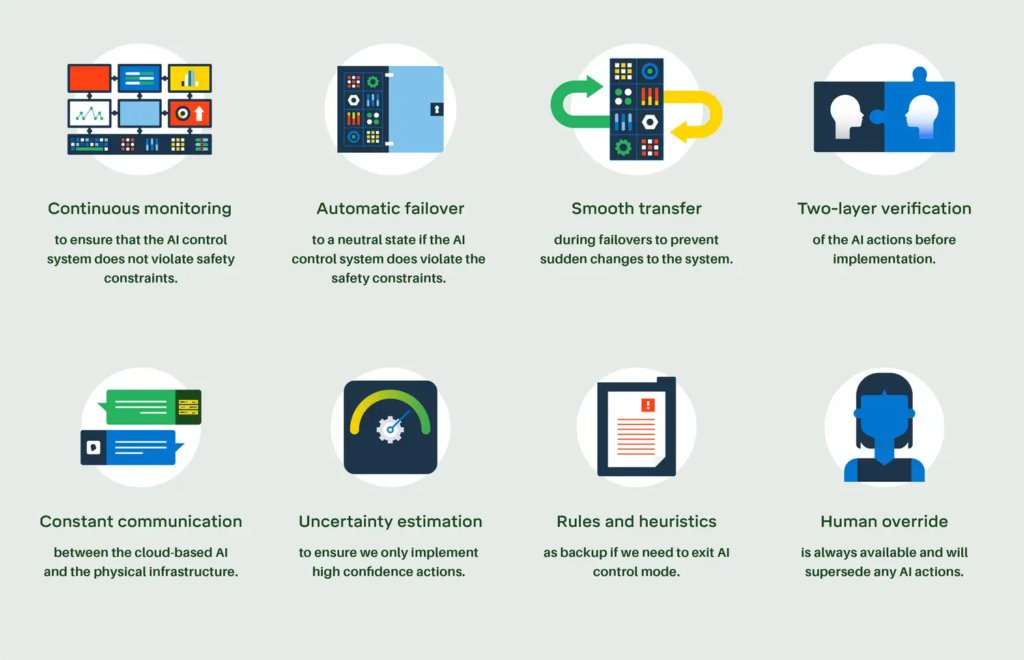
- Applied AI to cool Google data centers, reducing energy by 40%.
- This showed AI + sustainability can directly cut costs and help climate goals.
DeepMind’s Contribution to AI Theory
- Introduced deep reinforcement learning as a mainstream technique.
- Advanced attention mechanisms used in later NLP models.
- Pioneered transfer learning ideas applied in multi-task agents.
DeepMind in Language Models
- Before ChatGPT, DeepMind created Gopher, a large language model with strong reasoning abilities.
- Later released Chinchilla (2022) → demonstrated that data efficiency is more important than sheer size.
- These findings influenced OpenAI and Anthropic model design.
DeepMind’s Future Path
- From narrow AI (AlphaGo) → to general-purpose AI (Gato).
- Working on AI for drug design and material discovery.
- Likely to influence global AI regulations and safety standards.
Real-World Applications
- Healthcare:
- Predicting acute kidney injury in hospitals.
- Reading X-rays and CT scans.
- Climate & Sustainability:
- AI predicting floods in India and Bangladesh.
- Wind farm energy optimization.
- Robotics:
- Training agents to perform complex real-world tasks (grasping, locomotion).
Challenges Ahead for DeepMind
Despite successes, DeepMind faces challenges:
- High computational costs for training models
- Balancing research freedom vs. Google’s commercial goals
- Addressing AI bias and ethical dilemmas
- Competition from rival AI labs
Conclusion
DeepMind stands as a pioneer in AI research, consistently pushing the boundaries of what’s possible. From healthcare breakthroughs to scientific revolutions, its impact is undeniable.
As AI continues to evolve, DeepMind’s work will influence not just technology but also society, healthcare, and global science. Its journey reflects the future of AI — innovative, impactful, and transformative.
Which areas is Google DeepMind exploring?
Google DeepMind is exploring cutting-edge areas such as reinforcement learning, neuroscience-inspired AI, healthcare applications, robotics, and scientific discovery, including breakthroughs like protein structure prediction.
In which area has Google’s DeepMind demonstrated significant advancements through the use of AI?
Google’s DeepMind has demonstrated significant advancements in healthcare, protein structure prediction, game-playing AI (like AlphaGo), and energy optimization, showcasing how AI can tackle complex real-world and scientific problems.
What is the difference between DeepMind AI and OpenAI?
DeepMind AI, owned by Google, primarily focuses on scientific discovery and applying AI to fields like healthcare and biology, while OpenAI emphasizes building safe, general-purpose AI systems (like ChatGPT) for broad accessibility and real-world applications.
Who is the competitor of DeepMind?
The main competitors of DeepMind include OpenAI, IBM Watson, Microsoft Research, and Meta AI, all of which are leading organizations advancing artificial intelligence research and applications.
What is DeepMind famous for?
✦ SUMMARIZE THIS ARTICLE WITH AI
 ChatGPT
DeepMind is famous for developing AlphaGo, the first AI to defeat a world champion in the game of Go, and for its groundbreaking work in protein structure prediction (AlphaFold), along with major contributions to reinforcement learning and healthcare AI.