

Something fundamental has shifted in the global labor market — and it’s not what most headlines suggest. The real impact of Big Tech on employment isn’t simply a story of robots replacing workers. It’s a deeper, more complex reconfiguration of what human contribution actually means in a digitally saturated economy.
Big Tech operates as a double-edged force. On one side, platforms and automation tools are eliminating routine tasks at scale. On the other, they’re generating entirely new categories of work that didn’t exist a decade ago. The tension between these forces is reshaping careers, industries, and economic geography simultaneously.
Here’s what’s easy to miss: as AI tools become increasingly accessible, technical proficiency is rapidly becoming a baseline expectation rather than a competitive advantage. The worker who knew how to build a spreadsheet model once stood out. Today, that skill is table stakes.
The real differentiator is moving upstream — from collecting and processing data to modeling decisions, interpreting ambiguity, and applying judgment that algorithms can’t replicate.
This article traces that shift and what it means for workers, organizations, and the labor market broadly. But first, it’s worth understanding the raw structural numbers driving this transformation.
The Structural Shift: 170 Million New Opportunities vs. 92 Million Displacements
The numbers sound alarming at first glance — but context changes everything. The World Economic Forum projects that while automation will displace roughly 92 million jobs by 2030, it will simultaneously generate approximately 170 million new roles, resulting in a net gain of around 78 million positions globally. That’s not a crisis narrative. That’s a reconfiguration story.
Understanding this distinction matters enormously when evaluating the real opportunities and challenges in tech employment today.
Job Loss vs. Task Automation: A Critical Distinction
One of the most persistent misconceptions fueling anxiety is conflating job elimination with task automation. Research into AI’s labor market effects consistently shows that the majority of roles affected by AI don’t disappear — they transform. Studies suggest roughly 30% of tasks within a given job are automatable, not 30% of jobs themselves. A financial analyst still analyzes; they just spend less time cleaning spreadsheets and more time interpreting outcomes.
The job isn’t vanishing. The least-valuable parts of it are.
Digital Access and the Expanding Labor Pool
Broadband expansion and cloud-based tooling are pulling more workers into the global digital economy than ever before. According to Digital Planet research at Tufts University, geographic barriers to participation are eroding — which cuts both ways. Workers in previously underserved regions gain new access to opportunity, but established professionals simultaneously face wider competition from a global talent pool.
This dual pressure — more opportunity, more competition — sets up a defining question for data and IT professionals specifically: which skills will actually differentiate you when the barriers to entry keep dropping? That’s precisely where the next shift becomes critical.
The Decision-Centric Pivot: New Opportunities for Data and IT Professionals
The previous section established that net job creation is outpacing displacement — but the more consequential story is what kind of work is being created. Big Tech isn’t simply automating old tasks and hiring people to supervise machines. It’s rewiring the fundamental logic of how organizations use information, and that rewiring is opening genuinely new career territory for data and IT professionals.
From Collecting Data to Modeling Outcomes
For much of the past decade, “data-driven” became a corporate mantra — meaning, essentially, collect more data and report on what happened. The emerging model is something different: decision-centric analytics, where the goal is modeling what will happen and prescribing the best response. This shift matters enormously for career trajectories. Roles are moving away from dashboards and historical reporting toward simulation, scenario modeling, and outcome optimization. Professionals who can frame business problems as decision problems — not just measurement problems — are becoming disproportionately valuable.
The Rise of Agentic Analytics
One of the most significant structural changes shaping the future of jobs 2030 is the emergence of Agentic Analytics — a paradigm where AI agents autonomously handle data pipeline maintenance, anomaly detection, and routine cleaning tasks that once consumed analyst hours. Rather than replacing analysts, this shift elevates them. The new expectation is that data professionals orchestrate, audit, and govern fleets of AI agents rather than performing manual data wrangling themselves. Think of it as the difference between a craftsperson cutting every piece by hand versus a master builder directing precision equipment. The human role becomes more strategic, not less essential.
Composite AI and Enterprise Reliability
Underpinning both shifts is the growing adoption of Composite AI — the integration of multiple AI techniques (machine learning, knowledge graphs, optimization engines, and natural language processing) into unified enterprise systems. As research from MIT suggests, human expertise remains critical precisely because these systems require contextual judgment that pure automation cannot reliably supply. Building, validating, and maintaining Composite AI architectures demands professionals who understand both the technical stack and the business domain deeply.
The pattern emerging across industries is clear: the highest-value work sits at the intersection of AI capability and human judgment. However, accessing these opportunities requires something that many organizations are discovering is in critically short supply — a point the next section explores head-on.
Role of Big Tech Companies in Job Creation
Global tech leaders like Microsoft, Apple, Google, Amazon, and Meta are playing a powerful role in transforming modern careers and generating millions of job opportunities worldwide. These companies are not just employers—they are entire ecosystems that influence how industries hire, train, and evolve.
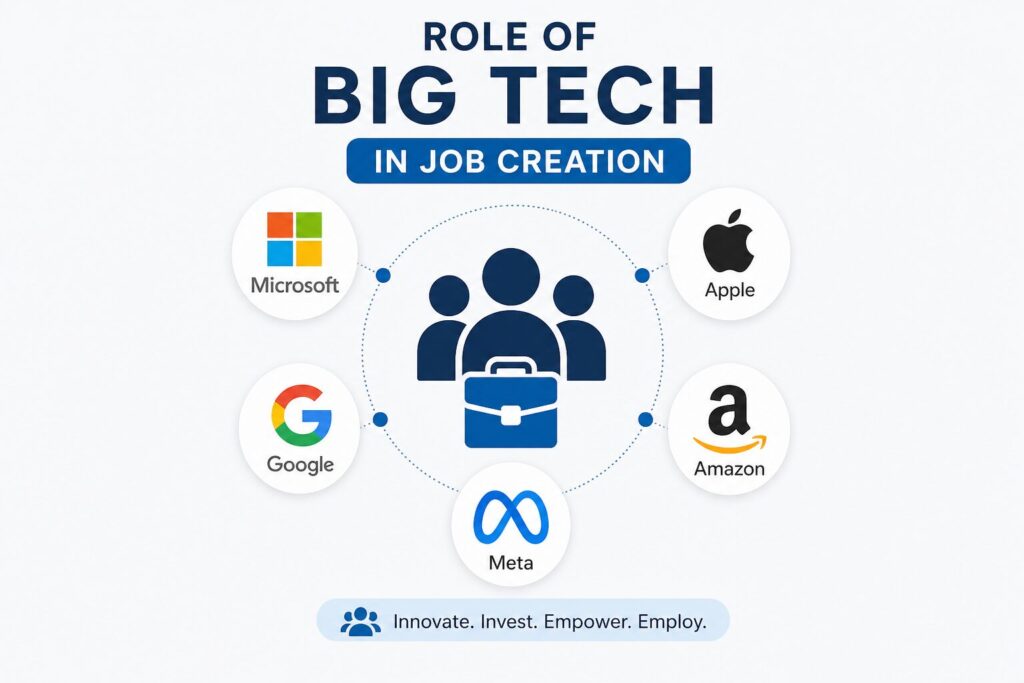
One of the biggest ways they drive job creation is through innovation. Advancements in areas like cloud computing, artificial intelligence, e-commerce, and digital marketing have led to the emergence of new roles such as data analysts, AI engineers, UX designers, and cybersecurity experts. As these technologies grow, so does the demand for skilled professionals across multiple sectors.
Additionally, Big Tech companies create indirect employment by supporting startups, vendors, and small businesses. For example, marketplaces, app stores, and cloud platforms enable entrepreneurs to build businesses, which in turn generate more jobs. This ripple effect significantly boosts global and local economies.
They also invest heavily in upskilling initiatives, certifications, and training programs, helping individuals stay relevant in a rapidly changing job market. By setting industry standards and encouraging digital transformation, these companies are reshaping career paths, making them more dynamic, tech-driven, and future-focused.
In essence, Big Tech is not just creating jobs—it is redefining what careers look like in the 21st century.
The Talent Gap Challenge: Why Companies are Struggling to Keep Up
The pivot toward decision intelligence — outlined in earlier sections — sounds promising on paper. But there’s a significant catch: the talent to support it simply isn’t there yet, at least not at the scale businesses need.
This is the central paradox defining today’s labor market. Demand for specialized tech roles is surging, while the supply of qualified professionals is falling dangerously short. It’s not a niche problem confined to startups or mid-size firms. It’s systemic, cutting across industries and geographies.
The Cloud Talent Gap in Sharp Relief
The cloud talent gap is one of the most concrete examples of this disconnect. Despite Big Tech’s dominance in cloud infrastructure — and years of investment in certification programs and training initiatives — roughly 60% of businesses report they cannot find the cloud-skilled professionals they need. Companies are building out ambitious AI-integrated platforms while simultaneously struggling to staff the teams required to run them.
The problem isn’t a lack of jobs — it’s a mismatch between the skills the market demands and the skills workers currently hold.
That mismatch is accelerating. As automation absorbs routine workflows, the roles that remain require deeper specialization: cloud architecture, AI model governance, data pipeline management. These aren’t skills that develop overnight, and traditional education pipelines haven’t fully adapted to produce them at speed.
Flexibility Without a Safety Net
There’s an additional layer of complexity emerging through the platform economy. Contract-based and gig-adjacent tech work offers flexibility, but it strips away the training investment, benefits structures, and career progression frameworks that once helped workers upskill organically within organizations.
For many professionals navigating this landscape, the burden of staying relevant falls almost entirely on their own shoulders — a challenge the next section explores in fuller depth.
The Global Workforce: Navigating the Platform Economy and Digital Access
The talent gap discussed in the previous section isn’t evenly distributed — geography, infrastructure, and access all determine who gets to participate in the emerging economy. As broadening digital connectivity pulls more workers into the global labor market, the rules governing that participation are shifting in ways that aren’t always visible from the surface.
Platform-based work — think gig marketplaces, freelance tech networks, and remote contract roles — has dramatically expanded opportunity for workers in regions previously locked out of high-skilled employment. Decision intelligence platforms are accelerating this trend, making sophisticated analytical tools available to independent professionals who once would have needed an enterprise employer to access them. The playing field is leveling, but unevenly.
The complication is what researchers call the “blurred employment relationship.” As this labor displacement debate highlights, platform workers often occupy an ambiguous space — contributing skilled labor while lacking the benefits, protections, and institutional support that traditional employment provides. No employer-sponsored training. No structured career ladder.
This makes self-led upskilling not just advantageous — it’s effectively non-negotiable. Workers who thrive in this environment treat professional development as a personal infrastructure investment.
The most resilient professionals in the platform economy don’t wait for employers to train them — they build the skills that make them impossible to replace.
Acknowledging this reality honestly is the first step. Knowing what to do about it is where the path forward begins.
Conclusion: The Path Forward in the Big Tech Era
The throughline across everything covered here is straightforward: tool ubiquity levels the playing field, but strategic thinking wins the game. When automation handles execution, the professionals who thrive are those who determine what gets executed and why.
The automation of working hours is accelerating, but that compression creates space — for sharper judgment, better decisions, and higher-value work. As MIT’s Shaping Work initiative notes, AI could ultimately elevate human expertise rather than erase it.
Certifications matter. Decision intelligence matters more. Credentials signal capability; applied judgment delivers outcomes.
The workers and organizations that succeed won’t be those who waited for disruption to arrive — they’ll be the ones who moved first. Proactive upskilling, strategic positioning, and a clear-eyed understanding of where automation ends and human value begins: that’s the real competitive advantage now.
FAQ’s
Which technical skills are most critical for staying employable?
Prompt engineering, AI output validation, and data literacy are highly in demand today. However, long-term success depends on combining technical skills with critical thinking and decision-making. Knowing when to trust or question AI outputs is what truly sets professionals apart.
How is AI changing the day-to-day role of a data scientist?
AI is automating repetitive tasks like data cleaning and basic modeling. As a result, data scientists now focus more on interpreting results, framing business problems, and communicating insights. Their role is becoming more strategic and decision-oriented.
Is cloud certification still a valuable investment for IT managers?
Yes, cloud certifications remain valuable as they demonstrate foundational knowledge and credibility. However, real-world experience and problem-solving abilities are what truly differentiate candidates. Employers increasingly look for practical application, not just credentials.
What are the main challenges of the platform economy for global workers?
While the platform economy expands opportunities, it also brings income instability and limited job security. Workers often lack benefits, structured career growth, and employer-supported training. Success in this space requires continuous self-upskilling and adaptability.


