

“Companies today run on data, not guesswork.”
In today’s digital-first economy, analytical jobs have become the backbone of modern businesses. These roles focus on interpreting data, identifying trends, and helping organizations make informed decisions rather than relying on intuition. From startups to multinational corporations, companies increasingly depend on professionals who can transform raw data into actionable insights.
The demand for analytical skills is skyrocketing in 2026 due to rapid advancements in artificial intelligence (AI), automation, and big data technologies. Organizations are collecting more data than ever before, and they need skilled professionals to analyze it effectively. According to industry insights, analytical thinking—such as problem-solving, data interpretation, and critical reasoning—is now considered a core competency across nearly all sectors.
Moreover, businesses are shifting toward data-driven decision-making to stay competitive. Whether it’s predicting customer behavior, optimizing operations, or managing financial risks, analytical roles play a crucial part. If you’re looking to build a future-proof career, exploring opportunities in analytics is a smart move.
What Are Analytical Jobs?
Analytical jobs are roles that involve examining data, identifying patterns, and using logical reasoning to solve problems and support decision-making. In simple terms, these jobs require professionals to “make sense” of complex information and turn it into meaningful insights that businesses can act upon.
At their core, analytical roles revolve around three key responsibilities: data interpretation, problem-solving, and strategic decision-making. Professionals in these roles collect and analyze data, evaluate outcomes, and provide recommendations to improve efficiency, reduce risks, or drive growth.
These jobs exist across a wide range of industries. In IT and technology, analysts work with software data and systems. In finance, they assess risks and manage investments. Healthcare analysts improve patient outcomes through data insights, while marketing analysts track consumer behavior and campaign performance.
As industries continue to embrace digital transformation, analytical jobs are no longer limited to data specialists—they are becoming essential across every business function.
Why Choose an Analytical Career in 2026?
Analytical careers are among the most promising professional paths in 2026, offering a powerful combination of high earning potential, stability, and global relevance. As organizations continue to rely heavily on data, roles such as data analysts, business analysts, and financial analysts are seeing consistent demand across industries.
One of the biggest advantages is high salary potential. According to global job market trends, data-focused roles often rank among the top-paying careers, especially as professionals gain experience and specialize in tools like AI and machine learning.
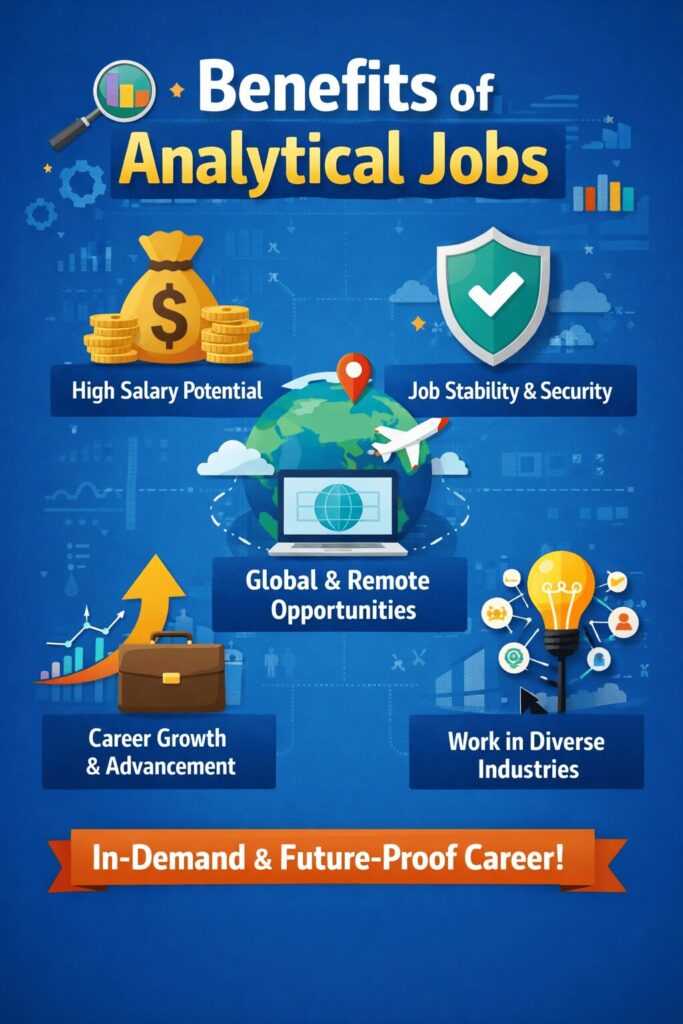
Job security is another key factor. With businesses increasingly adopting data-driven decision-making, analytical roles are becoming essential rather than optional. Reports suggest that data-related jobs will continue to grow significantly over the next decade, making them a future-proof career choice.
Additionally, analytical careers offer remote and global opportunities. Many companies now hire talent across borders, allowing professionals to work with international teams and clients from anywhere.
Finally, these roles provide strong career growth and versatility. Skills learned in analytics can be applied across multiple industries—from healthcare to finance to marketing—making it easier to switch domains or move into leadership roles. If you’re looking to build a long-term, flexible career, exploring structured learning paths on platforms like Data Expertise can be a great starting point.
Key Skills Required for Analytical Jobs
To succeed in analytical roles, professionals need a balanced mix of technical expertise and soft skills. These competencies enable them to interpret data effectively and communicate insights that drive business decisions.
- Technical Skills
A strong foundation in tools and technologies is essential. This includes proficiency in Microsoft Excel, SQL, and programming languages like Python or R. Knowledge of data visualization tools such as Power BI or Tableau is also valuable, as it helps present data in a clear and impactful way.
- Critical Thinking & Problem-Solving
Analytical jobs require the ability to evaluate complex information, identify patterns, and solve problems logically. Professionals must go beyond numbers to understand what the data actually means and how it can improve business outcomes.
- Communication & Storytelling with Data
Data is only useful if it can be understood. Analytical professionals must translate insights into simple, actionable narratives for stakeholders. Strong communication skills help bridge the gap between technical data and business strategy.
- Attention to Detail
Even small errors in data analysis can lead to incorrect conclusions. A keen eye for detail ensures accuracy, consistency, and reliability in every stage of analysis.
- Business Understanding
Beyond technical skills, it’s important to understand how businesses operate. Knowing industry trends, customer behavior, and organizational goals allows analysts to provide insights that are not just accurate, but also relevant and impactful.
Top Analytical Jobs in 2026
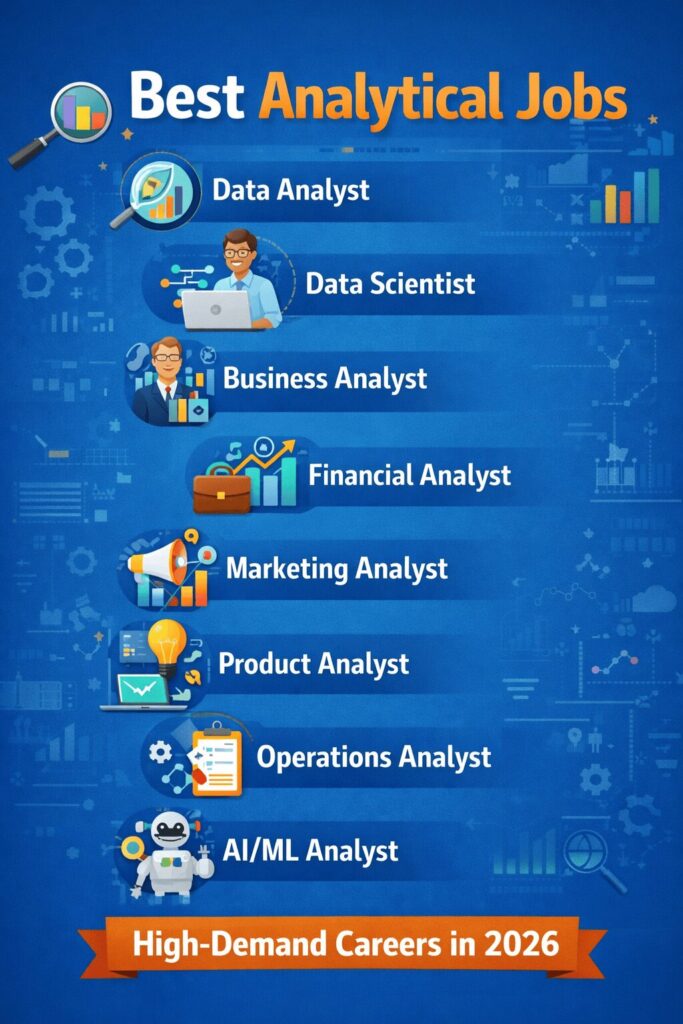
Analytical careers are evolving rapidly, driven by data, automation, and artificial intelligence. Below are some of the most in-demand analytical roles in 2026, along with their responsibilities, required skills, salary insights, and hiring industries.
Data Analyst
A Data Analyst is responsible for collecting, cleaning, and interpreting data to help organizations make informed decisions. They transform raw data into meaningful insights through reports, dashboards, and visualizations.
Key skills for this role include proficiency in Excel, SQL, and data visualization tools like Tableau or Power BI. Basic programming knowledge in Python or R is often an added advantage. Strong analytical thinking and attention to detail are essential.
The average salary for data analysts varies globally but typically ranges from $60,000 to $100,000 annually, depending on experience and location.
Industries hiring data analysts include IT, e-commerce, healthcare, finance, and retail, making it one of the most versatile analytical careers.
Data Scientist
Data Scientists go beyond basic analysis by building predictive models and using advanced algorithms to uncover deeper insights. Their role involves working with large datasets, creating machine learning models, and solving complex business problems.
They commonly use tools such as Python, R, SQL, and machine learning frameworks like TensorFlow or Scikit-learn. Knowledge of statistics and data modeling is critical.
Data scientists are among the highest-paid analytical professionals, with salaries often ranging between $90,000 and $150,000+ globally.
As companies increasingly adopt AI-driven strategies, the demand for data scientists continues to grow across sectors like technology, finance, healthcare, and logistics.
Business Analyst
Business Analysts act as a bridge between data and business strategy. Their primary role is to analyze processes, identify inefficiencies, and recommend improvements that enhance organizational performance.
They work closely with stakeholders to understand business needs and translate them into data-driven solutions. Key skills include problem-solving, communication, requirement gathering, and familiarity with tools like Excel, SQL, and business intelligence platforms.
Business analysts are in high demand across industries such as IT, banking, consulting, and healthcare. Salaries typically range from $70,000 to $120,000 globally.
This role is ideal for professionals who enjoy combining analytical thinking with business decision-making.
Financial Analyst
Financial Analysts focus on managing financial data, evaluating investment opportunities, and guiding organizations on budgeting and financial planning. They play a crucial role in helping businesses maximize profitability and minimize risks.
Core skills include financial modeling, forecasting, Excel proficiency, and a strong understanding of accounting principles. Certifications like CFA can further enhance career prospects.
High-paying sectors for financial analysts include investment banking, asset management, corporate finance, and insurance. Salaries often range from $80,000 to $130,000, with higher earnings in senior roles.
This career is ideal for individuals interested in finance, economics, and strategic planning.
Marketing Analyst
Marketing Analysts use data to understand consumer behavior, measure campaign performance, and optimize marketing strategies. They analyze metrics such as customer engagement, conversion rates, and ROI to improve business outcomes.
Key skills include data analysis, knowledge of digital marketing platforms, Google Analytics, and visualization tools. Creativity combined with analytical thinking is highly valuable in this role.
Marketing analysts are widely employed in e-commerce, advertising agencies, media companies, and corporate marketing teams. Salaries typically range from $60,000 to $110,000 globally.
As digital marketing continues to expand, this role is becoming increasingly critical for business growth.
Product Analyst
Product Analysts focus on understanding user behavior and improving product performance. They work closely with product managers and development teams to analyze data related to user engagement, feature usage, and customer feedback.
Their insights help shape product strategy, enhance user experience, and drive innovation. Key skills include SQL, data visualization, A/B testing, and strong problem-solving abilities.
Product analysts are in high demand in tech companies, startups, and SaaS-based organizations. Salaries generally range from $80,000 to $130,000 globally.
This role is ideal for individuals who want to combine data analysis with product development.
Operations Analyst
Operations Analysts focus on improving internal processes and increasing efficiency within an organization. They analyze workflows, identify bottlenecks, and recommend solutions to optimize performance and reduce costs.
Key skills include data analysis, process mapping, Excel, and problem-solving. Familiarity with supply chain and operations management tools is also beneficial.
Industries hiring operations analysts include manufacturing, logistics, retail, and healthcare. Salaries typically range from $65,000 to $110,000 globally.
This role is crucial for organizations aiming to streamline operations and improve productivity.
Risk Analyst
Risk Analysts assess potential risks that could impact an organization’s financial health or operations. They evaluate data to identify threats and develop strategies to mitigate them.
This role is especially important in industries like banking, insurance, and investment firms. Key skills include statistical analysis, financial knowledge, risk modeling, and attention to detail.
Salaries for risk analysts usually range from $75,000 to $120,000 globally, with higher compensation in specialized roles.
With increasing economic uncertainties and regulatory requirements, the demand for risk analysts continues to grow steadily.
AI/ML Analyst
AI/ML Analysts are at the forefront of technological innovation, working on artificial intelligence and machine learning models to automate processes and generate advanced insights.
They analyze large datasets, build predictive algorithms, and help organizations leverage AI for smarter decision-making. Key skills include Python, machine learning frameworks, data modeling, and statistics.
Due to the rapid growth of AI adoption, this role is one of the fastest-growing and highest-paying analytical careers, with salaries often exceeding $100,000 globally.
AI/ML analysts are in demand across industries such as technology, healthcare, finance, and e-commerce, making it a future-proof career option.
Analytical Jobs: Salary Scope & Roles
| Job Role | Entry-Level Salary (₹/year) | Mid-Level Salary (₹/year) | Senior-Level Salary (₹/year) |
| Data Analyst | ₹3 – ₹6 LPA ($3.3K–$6.6K) | ₹6 – ₹12 LPA ($6.6K–$13K) | ₹12 – ₹20+ LPA ($13K–$22K+) |
| Business Analyst | ₹4 – ₹8 LPA ($4.4K–$8.8K) | ₹8 – ₹15 LPA ($8.8K–$16.5K) | ₹15 – ₹25+ LPA ($16.5K–$27.5K+) |
| Data Scientist | ₹6 – ₹12 LPA ($6.6K–$13K) | ₹12 – ₹25 LPA ($13K–$27.5K) | ₹25 – ₹50+ LPA ($27.5K–$55K+) |
| Financial Analyst | ₹4 – ₹9 LPA ($4.4K–$9.9K) | ₹9 – ₹18 LPA ($9.9K–$19.8K) | ₹18 – ₹35+ LPA ($19.8K–$38.5K+) |
| Market Research Analyst | ₹3 – ₹7 LPA ($3.3K–$7.7K) | ₹7 – ₹14 LPA ($7.7K–$15.4K) | ₹14 – ₹25+ LPA ($15.4K–$27.5K+) |
| Operations Analyst | ₹4 – ₹8 LPA ($4.4K–$8.8K) | ₹8 – ₹16 LPA ($8.8K–$17.6K) | ₹16 – ₹28+ LPA ($17.6K–$30.8K+) |
| Big Data Analyst | ₹5 – ₹10 LPA ($5.5K–$11K) | ₹10 – ₹20 LPA ($11K–$22K) | ₹20 – ₹40+ LPA ($22K–$44K+) |
| Risk Analyst | ₹5 – ₹9 LPA ($5.5K–$9.9K) | ₹9 – ₹18 LPA ($9.9K–$19.8K) | ₹18 – ₹30+ LPA ($19.8K–$33K+) |
| Product Analyst | ₹6 – ₹12 LPA ($6.6K–$13K) | ₹12 – ₹22 LPA ($13K–$24K) | ₹22 – ₹40+ LPA ($24K–$44K+) |
| AI/ML Analyst | ₹6 – ₹14 LPA ($6.6K–$15.4K) | ₹14 – ₹28 LPA ($15.4K–$30.8K) | ₹28 – ₹50+ LPA($30.8K–$55K+) |
*Note – Salary figures may vary based on factors such as experience, location, skills, and employer
Industries Hiring Analytical Professionals
Analytical professionals are in demand across a wide range of industries, as organizations increasingly rely on data to drive decisions.
The IT & technology sector is one of the largest employers, with companies leveraging analytics for software development, cybersecurity, and data management.
In banking and finance, analytical roles are essential for risk assessment, investment planning, fraud detection, and financial forecasting. This sector consistently offers high-paying opportunities for skilled analysts.
The healthcare industry is rapidly adopting data analytics to improve patient care, optimize hospital operations, and support medical research.
E-commerce and retail companies rely heavily on analytics to understand customer behavior, personalize shopping experiences, and optimize pricing strategies.
Additionally, consulting firms hire analytical professionals to solve complex business problems for clients across industries. These roles often involve working on diverse projects, making them ideal for those who enjoy dynamic and challenging work environments.
Overall, the demand for analytical talent is global and continues to expand as industries embrace digital transformation.
How to Start a Career in Analytical Jobs
Starting a career in analytical jobs requires a combination of education, practical skills, and real-world exposure. A strong academic background in fields such as information technology, statistics, business administration, or economics provides a solid foundation for understanding data and its applications.
In addition to formal education, pursuing industry-recognized certifications can significantly boost your profile. Programs like the Google Data Analytics Certificate, Microsoft certifications, or courses in data science and business analytics help build job-ready skills and improve employability.
Building a portfolio is equally important. Showcase your ability to work with data by creating projects such as dashboards, case studies, or data analysis reports. This demonstrates your practical expertise to potential employers.
Gaining hands-on experience through internships is another crucial step. Internships allow you to apply your skills in real-world scenarios and understand industry expectations.
Finally, focus on networking. Connecting with professionals through platforms like LinkedIn, attending webinars, and joining analytics communities can open doors to job opportunities and career guidance.
With the right mix of skills, experience, and persistence, you can successfully enter and grow in the field of analytical careers.
Conclusion
Analytical careers have become a cornerstone of the modern workforce, offering strong job security, high earning potential, and global opportunities. As businesses increasingly rely on data-driven strategies, the need for skilled analytical professionals continues to grow across industries.
Whether you’re a student, a working professional, or someone considering a career switch, now is the perfect time to invest in analytical skills. From learning tools like SQL and Python to building real-world projects, every step you take brings you closer to a future-ready career.
The demand is only going to rise—so don’t wait. Start your journey today and position yourself for success in the data-driven world.
FAQ’s
What are the top 5 analytical skills?
The top analytical skills include data analysis, critical thinking, problem-solving, attention to detail, and communication. These skills help professionals interpret complex data and make informed decisions. Mastering both technical and soft analytical skills is essential for success in modern data-driven roles.
Which analytics job has the highest salary?
Among analytical careers, Data Scientist and AI/ML roles typically offer the highest salaries due to their advanced technical requirements. These roles involve machine learning, predictive modeling, and handling large datasets, making them highly valuable across industries.
What is the best job for an analytical person?
The best job depends on your interests, but roles like Data Analyst, Business Analyst, and Financial Analyst are excellent choices. They offer strong career growth, diverse opportunities, and the ability to apply analytical thinking in real-world business scenarios.
Can non-technical students pursue analytical careers?
Yes, non-technical students can pursue analytical careers by learning essential tools like Excel, SQL, and basic data analysis. With the help of online courses, certifications, and practical projects, individuals from non-technical backgrounds can successfully transition into analytical roles.