
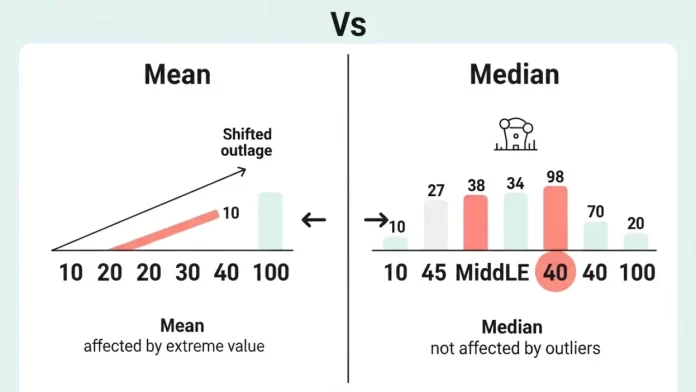
When working with data, one of the most common questions is: should you use median or average?
At first glance, both seem to represent the “center” of a dataset. However, they can produce very different results, especially when your data includes extreme values.
In this guide, you will learn everything about median vs average, including formulas, differences, real-life examples, and when to use each method effectively.
What is Average (Mean)?
The average (mean) is calculated by adding all values in a dataset and dividing by the total number of values.
Formula:
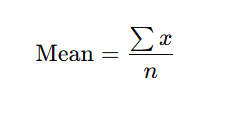
Where:
- ∑x = sum of all values
- n = number of values
Example:
Consider the dataset:
- 10, 20, 30, 40, 50
Calculation:
(10+20+30+40+50)/5=30
Result: The average is 30.
Key Characteristics:
- Uses all data points
- Sensitive to extreme values
- Suitable for balanced datasets
What is Median?
The median is the middle value in a dataset when values are arranged in ascending or descending order.
Rules:
- If the dataset has an odd number of values, the median is the middle value
- If the dataset has an even number of values, the median is the average of the two middle values
Example (Odd):
- 10, 20, 30, 40, 50
- Median = 30
Example (Even):
- 10, 20, 30, 40
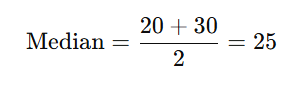
Result: The median is 25.
Key Characteristics:
- Not affected by outliers
- Represents the central position
- Useful for skewed data
Median vs Average – Quick Comparison
| Feature | Average (Mean) | Median |
| Definition | Sum ÷ count | Middle value |
| Impact of outliers | High | Minimal |
| Best use case | Normal distribution | Skewed distribution |
| Sensitivity | Sensitive | Robust |
| Real-world usage | General analytics | Income, pricing |
Why Median vs Average Matters
Understanding the difference is critical for correct data interpretation.
Salary Example:
Consider the following salaries:
- ₹20,000
- ₹25,000
- ₹30,000
- ₹35,000
- ₹5,00,000
Average:
Mean = ₹1,22,000
Median:
- ₹30,000
Interpretation:
- The average suggests a high earning level due to one extreme value
- The median reflects the typical earning more accurately
This demonstrates why choosing between median vs average can significantly impact conclusions.
Impact of Outliers
An outlier is a value that is significantly higher or lower than other values in the dataset.
Example:
- 5, 6, 7, 8, 100
Results:
- Mean = 25.2
- Median = 7
Insights:
- The mean is distorted by the outlier (100)
- The median remains stable and reliable
This is why median is often preferred in datasets with extreme values.
When to Use Median vs Average
Choosing between mean and median is not just a statistical decision—it directly affects how accurately your data represents reality. Different datasets behave differently, and using the wrong measure can lead to misleading conclusions. Understanding when to apply each method ensures that your analysis aligns with the true nature of your data.
Use Average (Mean) When:
- Data is evenly distributed
- There are no extreme values
- You need a general overall value
Examples:
- Exam scores
- Daily temperatures
- Manufacturing output
Use Median When:
- Data is skewed
- Outliers are present
- You want a realistic central value
Examples:
- Income distribution
- Property prices
- Customer spending patterns
Mean vs Median in Real Life
In real-world scenarios, data is rarely perfectly balanced. Factors like market fluctuations, human behavior, and economic inequality often create uneven distributions. This makes it essential to understand how mean and median behave in practical situations, where the choice of metric can influence decisions in business, policy-making, and everyday analysis.
Real Estate:
- Average price can be skewed by luxury properties
- Median price reflects the actual market trend
Income Analysis:
- Governments prefer median income
- It gives a more accurate picture of economic conditions
Business Analytics:
- Median helps identify typical customer behavior
- Useful for understanding spending patterns
Median vs Average in Excel
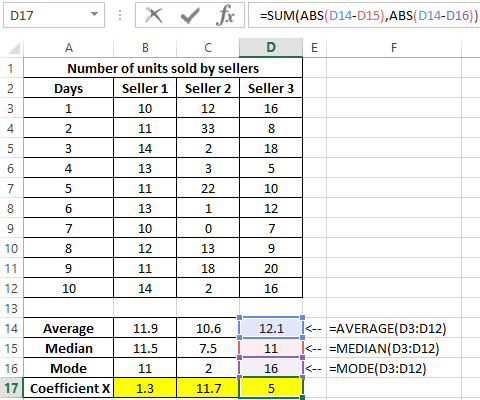
Excel provides built-in formulas for both calculations:
- Average: =AVERAGE(A1:A10)
- Median: =MEDIAN(A1:A10)
These functions help quickly analyze datasets without manual calculations.
Median vs Average in Python
import numpy as np
data = [10, 20, 30, 40, 100]
mean = np.mean(data)
median = np.median(data)
print("Mean:", mean)
print("Median:", median)
This is commonly used in data science workflows for quick statistical analysis.
Advantages and Disadvantages
No statistical measure is perfect—each comes with its own strengths and limitations. While mean provides a comprehensive view of all values, median offers stability in uncertain conditions. Evaluating their advantages and disadvantages helps you choose the right approach based on the type and quality of your dataset.
Advantages of Average:
- Easy to compute
- Uses all data points
- Widely accepted
Disadvantages:
- Highly sensitive to outliers
- Can misrepresent skewed data
Advantages of Median:
- Not affected by extreme values
- Better for skewed distributions
- Represents typical value
Disadvantages:
- Ignores distribution of all values
- Less useful for detailed statistical modeling
Mean vs Median in Statistics
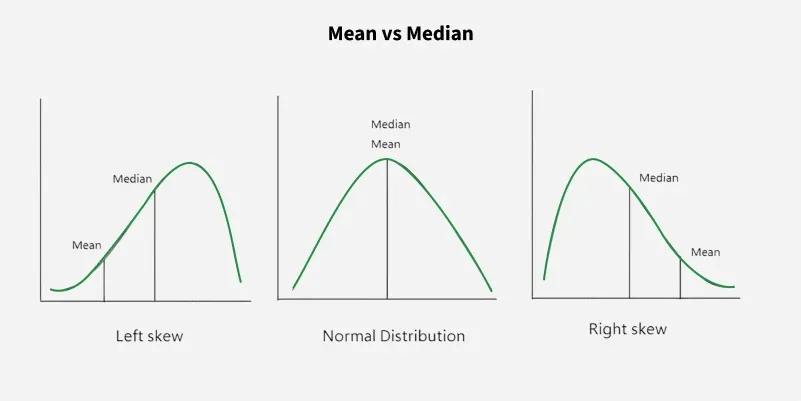
In statistics, mean and median are fundamental tools used to summarize data and understand its distribution. They are often analyzed together to provide deeper insights into patterns, variability, and central tendencies. Knowing how these measures interact is key to performing accurate and meaningful statistical analysis.
Both mean and median are measures of central tendency.
They help in:
- Understanding data distribution
- Identifying skewness
- Comparing datasets
They are often used together for better interpretation.
Skewed Data Explained
Not all datasets follow a symmetrical pattern—many are skewed due to extreme values or uneven distributions. Skewness affects how central values behave and can significantly distort results if not properly accounted for. Understanding skewed data helps in selecting the most reliable measure of central tendency for accurate interpretation.
Right-Skewed Data:
- Mean is greater than median
- Example: income distribution
Left-Skewed Data:
- Mean is less than median
In both cases, median provides a more accurate central value.
Common Mistakes
Some common errors when using median vs average include:
- Using average for skewed data like salaries
- Ignoring the presence of outliers
- Assuming both measures give similar results
It is important to understand the nature of the dataset before choosing a method.
Median vs Average: Which is Better?
There is no universally better option. The correct choice depends on the dataset.
| Scenario | Recommended Measure |
| Symmetrical data | Mean |
| Skewed data | Median |
| Presence of outliers | Median |
| General analysis | Mean |
A good practice is to calculate both and compare the results.
Final Thoughts
Understanding median vs average is essential for anyone working with data.
- Use average when the dataset is balanced
- Use median when the dataset is skewed or contains outliers
Choosing the right measure ensures accurate insights and better decision-making.
Pro Tip
Always calculate both mean and median.
If there is a significant difference between the two, it indicates:
- Presence of outliers
- Skewed data distribution
This simple check can improve the quality of your analysis significantly.
FAQ’s
What is the main difference between median and average?
The average considers all values in the dataset, while the median focuses only on the middle value. Because of this, the average is more sensitive to extreme values, whereas the median remains stable and reliable in skewed datasets.
Why is median preferred over average in income data?
Income data often contains extreme values, such as very high salaries. These values can distort the average significantly. The median provides a more accurate representation of what most people earn.
Can mean and median be equal?
Yes, mean and median can be equal when the dataset is perfectly symmetrical. In such cases, there are no outliers, and the distribution is balanced on both sides.
Which is more accurate: median or average?
Accuracy depends on the dataset. The average is more useful for evenly distributed data, while the median is more accurate when dealing with skewed data or outliers.