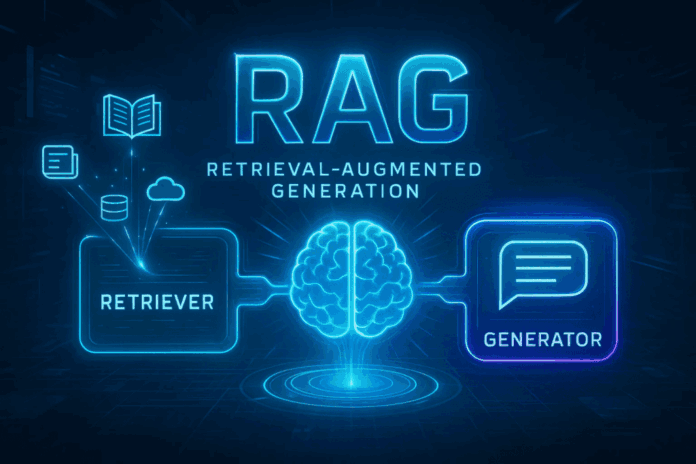
What Is RAG (Retrieval-Augmented Generation)?
Retrieval-Augmented Generation (RAG) is an AI architecture that combines two key components:
- Retrieval: Finding relevant data from external knowledge sources
- Generation: Using an LLM to generate answers based on that data
Instead of relying only on pre-trained knowledge, RAG systems dynamically fetch relevant information at query time.
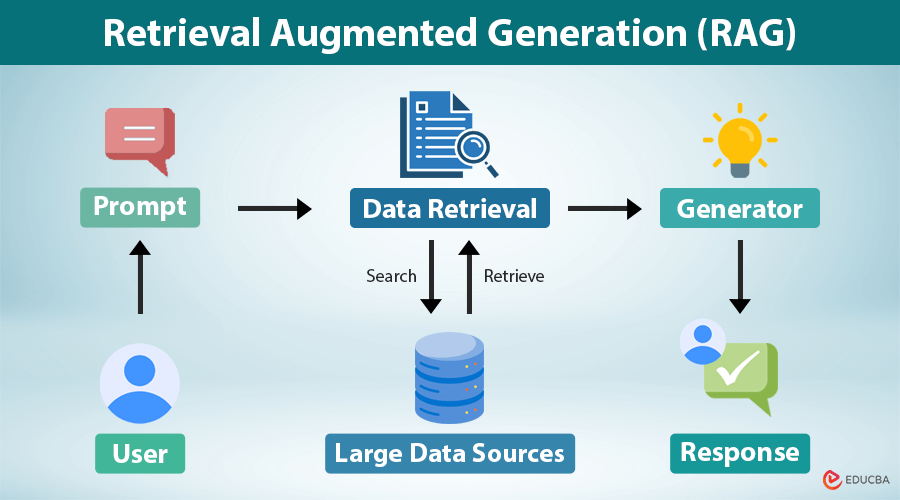
Example Workflow:
- User asks: “What is our company’s refund policy?”
- System retrieves: Policy document from internal database
- LLM generates: A clear, accurate answer using that document
Key Benefits:
- More accurate responses
- Reduced hallucinations
- Real-time or updated knowledge
- Ability to use private/internal data
Why RAG Matters
A) Overcomes Knowledge Limitations
LLMs don’t automatically know:
- Your company’s internal documents
- Latest product updates
- New research or regulations
RAG solves this by connecting models to external, up-to-date knowledge sources.
B) Reduces Hallucinations
LLMs may guess answers when unsure. This is risky in:
- Finance
- Healthcare
- Legal systems
RAG improves reliability by grounding answers in retrieved evidence.
C) Better Alternative to Fine-Tuning (for Knowledge Updates)
If your goal is to provide accurate information from documents, RAG is often better than fine-tuning.
- No retraining required
- Faster updates
- Lower cost
How RAG Works (Step-by-Step)
Step 1: Data Ingestion
Collect documents such as:
- PDFs, DOCX, PPT
- Knowledge bases
- Websites
- Databases
Step 2: Chunking
Split documents into smaller pieces:
- Typically 200–800 tokens
- May include overlapping content
Good chunking = better retrieval accuracy
Step 3: Embeddings
Convert text into vectors (numerical representations of meaning).
This enables semantic search, not just keyword matching.
Step 4: Vector Database
Store embeddings in systems like:
- Pinecone
- FAISS
- Weaviate
- Elasticsearch
Step 5: User Query
User asks a question → converted into embedding.
Step 6: Retrieval
System finds the most relevant chunks using similarity search.
Enhancements include:
- Filtering
- Hybrid search (keyword + vector)
- Re-ranking
Step 7: Prompt Augmentation
Retrieved data is added to the LLM prompt.
Example instruction:
- “Answer using only the provided context.”
Step 8: Generation
The LLM generates a final, context-aware answer.
Core Components of a RAG System
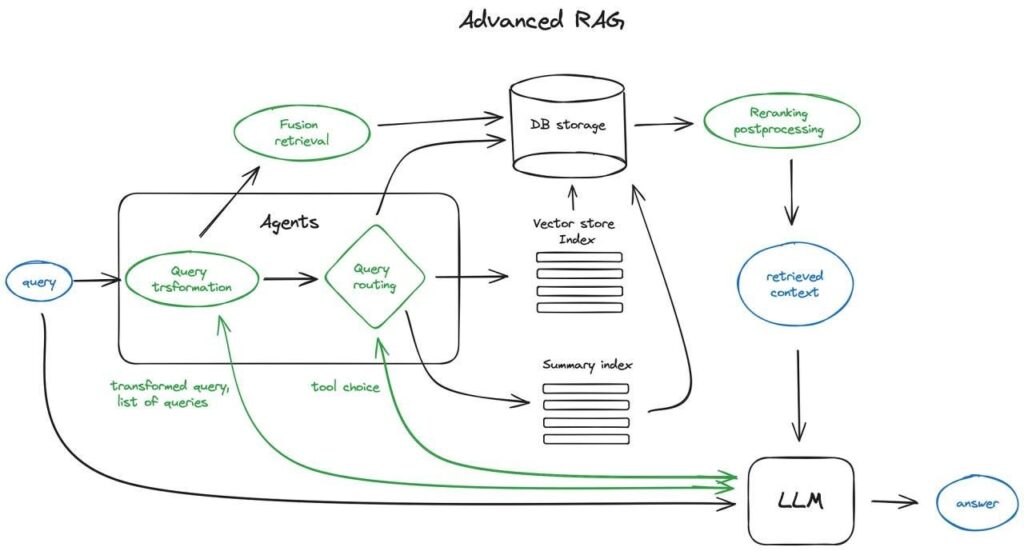
A production-grade RAG system includes:
- Document sources
- Chunking strategy
- Embedding model
- Vector database
- Retriever
- Re-ranker (optional)
- Prompt template
- LLM (generator)
- Monitoring & evaluation
The Role of Context in RAG Systems
One of the most critical aspects of a RAG system is how effectively it uses context. Unlike traditional models that rely only on internal knowledge, RAG systems depend heavily on the quality and relevance of the retrieved context. If the retrieved information is accurate and well-structured, the generated response becomes significantly more reliable. However, if irrelevant or noisy data is retrieved, even the most advanced LLM can produce incorrect or misleading answers. This makes context selection and ranking a key factor in the success of any RAG implementation.
Prompt Engineering in RAG
Good prompts dramatically improve output quality.
Example Prompt Template:
You are an AI assistant.
Use ONLY the context below to answer the question.
If the answer is not found, say "I don’t know."
Context:
{retrieved_chunks}
Question:
{user_query}
Advanced Prompt Tips:
- Ask for citations
- Control tone (formal, simple, technical)
- Add constraints (length, format)
Security and Privacy in RAG Systems
RAG introduces data access risks, especially in enterprises.
Key Considerations:
- Role-based access control (RBAC)
- Encryption of stored embeddings
- Secure API access
- Data masking for sensitive fields
- Audit logs for queries
Never expose confidential data through retrieval
RAG as a Foundation for Enterprise AI
In modern enterprises, RAG is becoming the backbone of AI-powered applications. Organizations are using RAG to connect LLMs with internal knowledge bases, enabling secure and context-aware decision-making. This approach allows businesses to scale AI without exposing sensitive data or retraining models repeatedly. As a result, RAG is increasingly viewed not just as a feature, but as a foundational layer in enterprise AI architecture.
Cost Optimization in RAG Systems
RAG systems can become expensive if not optimized.
Cost Drivers:
- Embedding generation
- Vector database storage
- LLM token usage
Optimization Techniques:
- Use smaller embedding models when possible
- Limit retrieved chunks (top-k optimization)
- Cache frequent queries
- Compress context before sending to LLM
RAG vs Knowledge Graphs
Many advanced systems combine both.
| Aspect | RAG | Knowledge Graph |
| Data Type | Unstructured | Structured |
| Strength | Retrieval + generation | Relationships |
| Flexibility | High | Moderate |
| Reasoning | Limited | Strong logical reasoning |
RAG vs Fine-Tuning vs Training
RAG
Best for:
- Knowledge-based Q&A
- Real-time updates
- Document-driven answers
Pros:
- No retraining needed
- Supports citations
- Cost-effective
Cons:
- Depends on retrieval quality
Fine-Tuning
Best for:
- Style control
- Formatting
- Domain-specific behavior
Cons:
- Expensive to update knowledge
- Still prone to hallucination
Training from Scratch
Best for:
- Large-scale AI development
- Custom foundation models
Not practical for most teams
Real-World Use Cases of RAG
Customer Support
- Retrieves FAQs and ticket history
- Provides consistent responses
Internal Knowledge Assistant
- Answers employee queries
- Uses company SOPs and policies
Legal & Compliance
- Retrieves clauses from contracts
- Ensures traceable answers
Healthcare & Research
- Summarizes papers
- Assists in knowledge discovery
Sales Enablement
- Provides product details
- Helps during live customer calls
Developer Support
- Retrieves API documentation
- Explains error codes
Advanced RAG Techniques
Hybrid Search
Combines keyword + semantic search for better accuracy
Re-Ranking
Improves relevance of retrieved results
Metadata Filtering
Filters based on:
- Document type
- Department
- Date
- Permissions
Query Rewriting
Transforms vague queries into clearer ones
Context Optimization
- Removes irrelevant chunks
- Compresses large context
Common RAG Mistakes
Poor Chunking
- Too small → loses context
- Too large → poor precision
Low-Quality Data
- Outdated or inconsistent documents
No Guardrails
- Model may guess answers
Too Much Context
- Reduces accuracy
No Evaluation
- Leads to unreliable systems
The Future Role of RAG in AI Ecosystems
Looking ahead, RAG is expected to play a central role in the evolution of AI systems. As models become more powerful, the focus will shift toward integrating them with reliable data sources. RAG will act as the bridge between static model knowledge and dynamic real-world information. With advancements in multimodal retrieval and agent-based systems, RAG will continue to evolve as a core component of next-generation AI architectures.
How to Evaluate RAG Systems
Retrieval Metrics
- Recall@k
- Precision@k
Generation Metrics
- Accuracy
- Faithfulness
- Helpfulness
- Citation quality
Future of RAG (2026 Trends)
- Agentic RAG → multi-step reasoning
- Multimodal RAG → text + image + audio
- Graph RAG → knowledge graph integration
- Tool-augmented RAG → API + DB integration
- Secure RAG → permission-aware systems
Conclusion
Retrieval-Augmented Generation (RAG) is one of the most practical and powerful techniques in modern AI. It enhances LLM capabilities by combining external knowledge retrieval with intelligent response generation.
Instead of relying only on pre-trained knowledge, RAG ensures:
- Accurate answers
- Up-to-date information
- Reduced hallucinations
- Better trust and reliability
If you’re building AI systems that need to be accurate, explainable, and scalable, RAG should be your starting point.
FAQ’s
What is the purpose of a RAG?
The purpose of RAG (Retrieval-Augmented Generation) is to enhance AI responses by retrieving relevant external data and combining it with language generation, improving accuracy, context, and up-to-date information.
What are the 7 types of RAG?
The seven common types of RAG include Naive RAG, Retrieval-Augmented RAG, Generative RAG, Hybrid RAG, Multi-Modal RAG, Conversational RAG, and Agentic RAG, each differing in how they retrieve and generate information.
What is augmented means in RAG?
In RAG (Retrieval-Augmented Generation), “augmented” means enhancing the AI’s response by adding relevant external data or retrieved information, making the output more accurate, contextual, and up-to-date.
What is RAG vs LLM?
RAG (Retrieval-Augmented Generation) vs LLM: an LLM generates responses based on its pre-trained knowledge, while RAG enhances an LLM by retrieving external, real-time information to produce more accurate and up-to-date answers.
What is the difference between RAG and generative AI?
The difference between RAG and generative AI is that generative AI creates content using pre-trained knowledge, while RAG (Retrieval-Augmented Generation) enhances generative AI by retrieving external data to improve accuracy and provide up-to-date, context-aware responses.