
Artificial Intelligence can feel overwhelming at first. With so many technical terms used in tutorials, research papers, and discussions, it’s easy to get lost. One term you’ll frequently encounter is “block.”
You might hear phrases like:
- Transformer blocks
- Attention blocks
- Residual blocks
- Pipeline blocks
But what does “block” actually mean in AI?
In simple terms, a block in AI is a reusable building unit—a small module that performs a specific function and can be repeated multiple times to build complex models. Understanding this concept is key to grasping how modern AI systems are designed and scaled.
In this guide, we’ll break down:
- What a block is
- Why it matters
- The most common types of blocks in AI
- How blocks are used in real-world systems
What Does “Block” Mean in AI?
In AI—especially deep learning—a block typically refers to:
- A self-contained module made of one or more layers
- A structure with input → processing → output
- A reusable unit that can be stacked multiple times
- A standard pattern in model architecture
Simple Analogy
Think of blocks like Lego pieces.
- One Lego piece → small and simple
- Many connected pieces → complex structure
Similarly:
- One block → basic function
- Many blocks stacked → powerful AI model
Important: “Block” is not a strict scientific term—it’s a practical engineering concept used to simplify design.
Why Are Blocks Important in Modern AI?
Modern AI models are massive—sometimes containing billions of parameters. Without modular design, they would be nearly impossible to build or maintain.
Blocks solve key challenges:
Simplify architecture design
Enable scalability (stacking blocks easily)
Improve debugging and testing
Allow reuse of proven patterns
Instead of designing 100 different layers, engineers:
Create one effective block
Repeat it multiple times
That’s why you’ll hear:
- “This model has 12 blocks”
- “The network uses 24 Transformer blocks”
Blocks vs Layers: What’s the Difference?
This is a common confusion for beginners.
Layers
- Single operation
- Examples: convolution, linear, normalization
Blocks
- Group of layers combined together
- Includes connections (like skip connections)
- Acts as a reusable module
Easy Way to Remember
- Layers = Ingredients
- Blocks = Recipes
- Model = Full dish
AI Blocks and Their Functions
| Block Type | Main Purpose | Key Components | Common Use Cases |
| MLP (Feed-Forward) | Feature transformation | Linear layers, activation functions | NLP, tabular data, Transformers |
| Convolution Block | Extract visual features | Convolution, activation, pooling | Image classification, detection |
| Residual Block | Improve deep network training | Skip connections, convolution layers | Deep CNNs, ResNet models |
| Attention Block | Focus on important input parts | Self-attention mechanism | NLP, vision transformers |
| Transformer Block | Core unit of modern AI models | Attention + MLP + normalization | LLMs, chatbots, NLP systems |
| U-Net Block | Image reconstruction & generation | Downsampling, upsampling, skip links | Image segmentation, diffusion AI |
Common Types of Blocks in AI (Explained Simply)
1. Feed-Forward (MLP) Block
A basic neural network component made of:
- Linear layers
- Activation functions
Used in:
- Transformers
- General neural networks
Why it matters:
- Helps models learn complex patterns
2. Convolution Block (CNN Block)
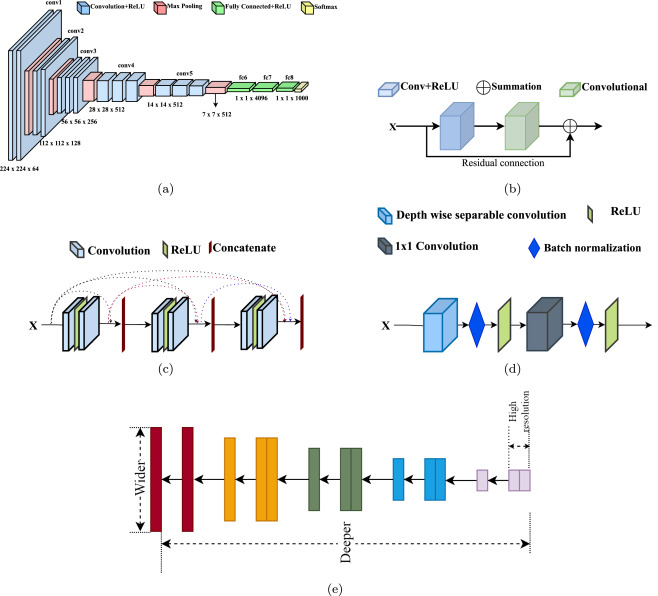
Widely used in computer vision.
Includes:
- Convolution layers
- Activation functions
- Normalization
- Pooling (sometimes)
Used in:
- Image classification
- Object detection
- Medical imaging
Why it matters:
- Extracts visual features like edges and textures
3. Residual Block (ResNet Block)
Introduces skip connections:
- Input is added back to output
Used in:
- Deep vision models
- ResNet architectures
Why it matters:
- Solves vanishing gradient problem
- Enables very deep networks
4. Attention Block
Helps models focus on important information.
In text:
- Connects words across sentences
In images:
- Links different regions
Used in:
- Transformers
- Vision Transformers (ViT)
- Multimodal AI
Why it matters:
- One of the biggest breakthroughs in modern AI
5. Transformer Block (Most Important Today)
The core building unit of modern AI models.
Typically includes:
- Normalization
- Self-attention
- Feed-forward network (MLP)
- Residual connections
Used in:
- Large Language Models (LLMs)
- Chatbots
- NLP systems
Why it matters:
- Backbone of today’s AI revolution
6. U-Net Blocks (For Image Generation)
Common in image processing and generation.
Structure:
- Downsampling blocks
- Middle processing block
- Upsampling blocks
- Skip connections
Used in:
- Image segmentation
- Diffusion models
Why it matters:
- Enables high-quality image generation
Blocks in AI Pipelines (Beyond Neural Networks)
“Block” isn’t limited to model architecture.
In real-world AI systems, it can also mean workflow steps, such as:
- Data collection block
- Data preprocessing block
- Training block
- Evaluation block
- Deployment block
- Monitoring block
Here, “block” means a modular stage in the AI lifecycle.
How Blocks Fit into the Overall AI Architecture
To truly understand blocks, it helps to see where they sit in the big picture of an AI system.
Typical AI Model Flow:
- Input Layer → Receives raw data (text, image, audio)
- Embedding Layer → Converts data into numerical form
- Stacked Blocks → Core processing happens here
- Output Layer → Produces predictions or results
The stacked blocks are the “brain” of the model, where learning and transformation happen.
Internal Flow of a Typical Block
Most AI blocks follow a structured internal pipeline:
Input → Transformation → Enhancement → Output
Example (Transformer Block Flow):
- Input embeddings
- Layer normalization
- Self-attention mechanism
- Add residual connection
- Feed-forward network
- Final normalization
- Output to next block
Each block refines the information step-by-step.
Depth vs Width: How Blocks Affect Model Design
When scaling AI models, two important concepts come into play:
1. Depth (Number of Blocks)
- More blocks stacked vertically
- Helps learn complex hierarchical patterns
2. Width (Size of Each Block)
- More neurons/features inside each block
- Improves representation power
Trade-Off Table:
| Factor | Depth (More Blocks) | Width (Bigger Blocks) |
| Learning | Better hierarchical learning | Better feature richness |
| Speed | Slower training | More memory usage |
| Usage | Deep networks, Transformers | Wide neural networks |
Modern AI balances both depth and width for optimal performance.
How Blocks Enable Transfer Learning
Blocks play a key role in transfer learning, which is widely used today.
How it works:
- Pretrained models already contain stacked blocks
- These blocks have learned general patterns
- You reuse them for new tasks
Example:
- Use existing Transformer blocks trained on large text data
- Fine-tune them for:
- sentiment analysis
- chatbot applications
- summarization
This saves time, cost, and data requirements.
Blocks in Multimodal AI Systems
Modern AI systems often handle multiple data types together (text + image + audio).
How blocks are used:
- Separate blocks process different modalities
- Shared attention blocks combine information
Example Workflow:
- Text → Transformer blocks
- Image → CNN / Vision Transformer blocks
- Fusion → Attention blocks
This is how systems like advanced AI assistants understand complex inputs.
Optimization Techniques Inside Blocks
Blocks are often optimized using advanced techniques:
1. Parameter Sharing
- Same parameters reused across blocks
- Reduces model size
2. Sparse Computation
- Only part of the block is activated
- Improves efficiency
3. Quantization
- Reduces precision of numbers
- Saves memory and speeds up inference
4. Pruning
- Removes unnecessary neurons
- Makes models lighter
These techniques are critical for deploying AI in real-world applications.
How Blocks Are Visualized in AI Diagrams
When reading AI papers or diagrams, blocks are usually shown as:
- Rectangular boxes
- Repeated vertical stacks
- Arrows connecting outputs to inputs
Common diagram pattern:
Input → Block → Block → Block → Output
Once you recognize this pattern, reading research papers becomes much easier.
How Blocks Impact Model Performance
Blocks directly influence:
1. Accuracy
- More refined transformations improve predictions
2. Generalization
- Better blocks reduce overfitting
3. Efficiency
- Optimized blocks reduce computation
4. Scalability
- Easy to expand model size
The design of blocks is often more important than just increasing model size.
Real-World Industry Perspective (2026)
In 2026, companies are focusing on:
Modular AI Systems
- Plug-and-play blocks
- Faster development cycles
AI-as-a-Service Architectures
- Pre-built blocks available via APIs
Custom Domain Blocks
- Healthcare-specific blocks
- Finance-specific blocks
- Retail recommendation blocks
Blocks are becoming standardized components across industries.
How Blocks Enable Scalability in Large AI Models
One of the biggest advantages of using blocks in AI is scalability.
Modern models—especially large language models—are built by simply stacking more blocks. Instead of redesigning the architecture, researchers scale models by:
- Increasing the number of blocks (depth)
- Increasing the size of each block (width)
- Improving block efficiency (optimization techniques)
For example:
- A small model might have 6–12 blocks
- A large model can have 50+ or even hundreds of blocks
This modular scaling approach allows:
- Faster experimentation
- Easier upgrades
- Consistent performance improvements
How Blocks Improve Model Training Stability
Blocks are not just about structure—they also improve training stability.
Techniques used inside blocks include:
1. Normalization Layers
- Keep data distributions stable during training
- Examples: BatchNorm, LayerNorm
2. Skip (Residual) Connections
- Help gradients flow backward efficiently
- Prevent vanishing gradient problems
3. Dropout Layers
- Reduce overfitting
- Improve generalization
These techniques are often bundled into blocks, making them robust and reliable building units.
Block Design Patterns in AI Architecture
Over time, researchers have developed standard block design patterns that are widely reused.
Common Design Patterns:
- Conv → Activation → Normalization (CNN blocks)
- Attention → Add & Norm → MLP → Add & Norm (Transformer blocks)
- Input → Layer → Add (skip connection) (Residual blocks)
These patterns are proven to work well, which is why they are reused across models.
How Engineers Customize Blocks
Blocks are not fixed—they can be customized depending on the problem.
Engineers modify blocks by:
- Changing activation functions (ReLU, GELU, etc.)
- Adjusting layer sizes (hidden units)
- Adding/removing normalization
- Tuning attention mechanisms
- Introducing new connections
This flexibility allows innovation while still keeping the modular structure intact.
Real-World Examples of Blocks in AI Systems
Understanding blocks becomes easier when you see them in action.
1. Chatbots and Language Models
- Built using multiple Transformer blocks
- Each block processes and refines text understanding
2. Image Recognition Systems
- Use convolution + residual blocks
- Detect patterns like edges, shapes, and objects
3. Recommendation Systems
- Use MLP blocks
- Learn user preferences and behavior patterns
4. Image Generation Models
- Use U-Net blocks
- Generate high-quality images step-by-step
Blocks and Model Efficiency (2026 Trend)
In 2026, AI research is focusing heavily on efficient block design.
Instead of just adding more blocks, researchers aim to:
- Make blocks lighter and faster
- Reduce computational cost
- Optimize memory usage
Emerging trends:
- Sparse attention blocks
- Lightweight transformer blocks
- Quantized and compressed blocks
The goal: better performance with fewer resources
Challenges with Block-Based Architectures
While blocks are powerful, they come with challenges:
1. Over-Stacking
Too many blocks can:
- Increase computation cost
- Slow down training
2. Diminishing Returns
Adding more blocks doesn’t always improve performance significantly.
3. Complexity in Optimization
More blocks = more parameters = harder tuning
Best Practices for Using Blocks in AI
If you’re building or learning AI systems, follow these best practices:
Start with standard block architectures
Avoid unnecessary complexity
Monitor performance when increasing blocks
Use pre-trained architectures when possible
Focus on data quality along with model design
Future of Blocks in AI
Blocks will continue to evolve as AI grows.
What to expect:
- More automated block design (AutoML)
- Domain-specific blocks (healthcare, finance, etc.)
- Better integration across multimodal AI systems
- Highly optimized blocks for edge devices
The concept of blocks will remain central, but their design will become smarter and more efficient.
Why Understanding Blocks Helps You Learn AI Faster
Once you understand blocks, everything becomes clearer.
You can:
✔ Read AI architecture diagrams confidently
✔ Understand model descriptions easily
✔ Identify repeating patterns
✔ Connect concepts across domains
Instead of seeing AI as “complex math,”
you start seeing it as structured systems built from reusable components.
Conclusion
So, what is a block in AI?
A block is a reusable building unit—a module made of one or more layers designed to perform a specific function and repeated multiple times to create powerful AI systems.
Whether it’s:
- Residual blocks in vision
- Transformer blocks in language models
- Pipeline blocks in workflows
The idea remains the same: modularity and scalability
Final Takeaway
- Layers = individual operations
- Blocks = reusable patterns
- Models = stacks of blocks
This simple concept is the foundation of modern AI architecture.
FAQ’s
What is an AI block?
An AI block is a modular component or building unit within an AI system, such as a neural network layer or functional module, that performs a specific task in processing data or making decisions.
What are AI building blocks?
AI building blocks are the core components of AI systems, such as data, algorithms, models, neural networks, and computing infrastructure, that work together to enable machines to learn, process information, and make decisions.
What are the building blocks of an AI agent?
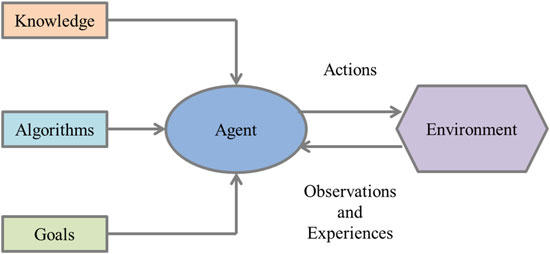
The building blocks of an AI agent include perception (data input), decision-making (models/algorithms), memory (knowledge storage), learning (adaptation), and action (output or execution), enabling it to interact with and respond to its environment.
What are the three primary building blocks of AI?
The three primary building blocks of AI are data, algorithms, and computing power, which together enable systems to learn, process information, and make intelligent decisions.
How is block using AI?
AI blocks are used by combining modular components (like neural network layers or functional units) to process data step-by-step, where each block performs a specific task such as feature extraction, transformation, or decision-making within an AI system.