Federated data governance isn’t about tightening control from the top—it’s about distributing responsibility where expertise actually lives. While traditional governance models funnel every decision through a central committee, creating bottlenecks that slow innovation to a crawl, federated approaches empower domain teams to own their data while adhering to organization-wide governance standards. According to Informatica, this model reduces time-to-insight by enabling teams to act on data without waiting in approval queues.
Think of it as constitutional democracy for your data ecosystem. The central governance body establishes the constitution—the non-negotiable principles around security, privacy, and quality—but individual domains govern themselves within those boundaries. Marketing owns customer engagement data, finance owns transactional records, and operations owns supply chain information. Each domain knows its data intimately and makes tactical decisions daily, while a lightweight central team ensures these decisions don’t create chaos or compliance risks.
This shift reflects a fundamental truth: the people closest to the data understand its nuances best. A centralized team can’t possibly grasp the context behind every dataset across a modern enterprise. Atlan reports that organizations adopting federated models see measurably faster data product delivery because domain experts don’t need to translate requirements through multiple layers of bureaucracy.
The federated model thrives in environments embracing modern architectures like data mesh, where organizational complexity demands both autonomy and alignment. However, federation isn’t anarchy. The tension between central oversight and domain independence defines the success or failure of this governance paradigm.
The Journey to Federated Data Governance
The shift toward federated models isn’t happening because organizations suddenly love complexity—it’s happening because centralized approaches can’t keep pace with modern data realities. When every department generates its own customer insights, product data, and operational metrics, a single governance team at headquarters becomes an impossible bottleneck.
Traditional centralized governance worked fine when data lived in a single ERP system. But today’s enterprises face a different challenge: data autonomy has already happened whether governance teams acknowledged it or not. Marketing teams deployed their own analytics platforms. Product teams built their own customer databases. Finance created separate reporting systems. The question isn’t whether to allow distributed data ownership—it’s how to govern what’s already distributed.
According to Informatica, this evolution represents “a shift from command-and-control to orchestration,” where central teams focus on setting standards rather than implementing every detail. The federated approach acknowledges that domain experts understand their data’s context better than any centralized committee ever could.
Data governance policies now need to work across boundaries, not within silos. A federated model establishes organization-wide standards for data quality, security, and compliance while delegating execution to teams who actually work with that data daily. The finance team defines what “revenue” means in their context. The marketing team determines how customer engagement gets measured. Central governance ensures these definitions connect properly.
This shift requires rethinking what control actually means—moving from “approving every decision” to “establishing guardrails for autonomous action.”
Defining the Federation Model of Governance
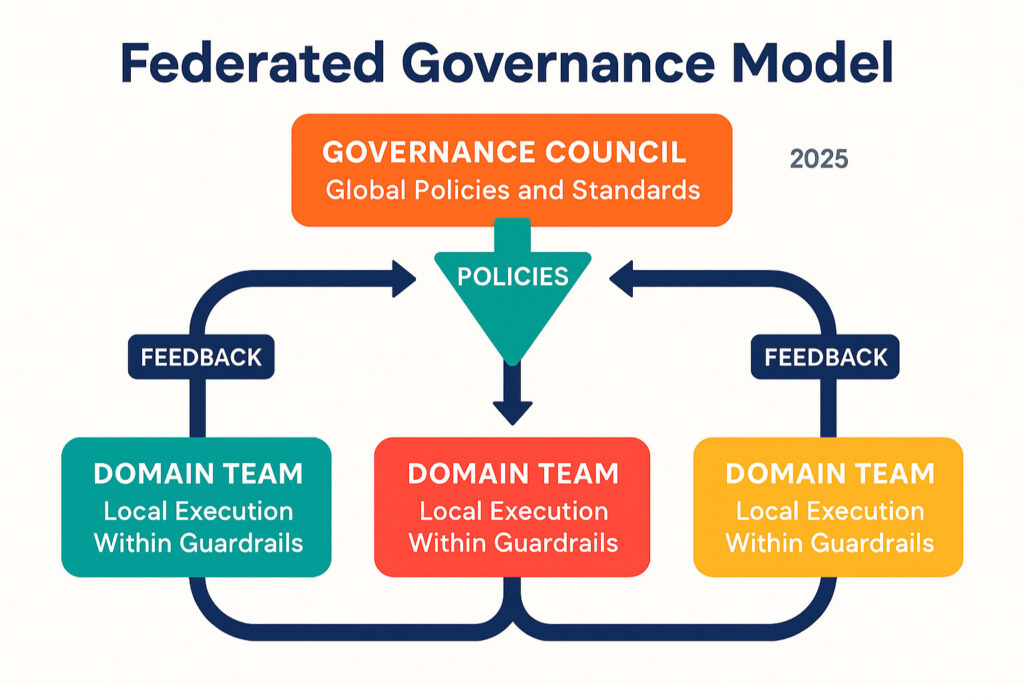
Federated governance operates on a principle of distributed accountability wrapped in centralized standards. Think of it as constitutional federalism applied to data: central authorities set the framework, while domain teams exercise autonomy within those guardrails.
At its core, federated data governance assigns ownership and decision-making authority to domain experts closest to the data, while maintaining organization-wide policies for consistency. A marketing team governs customer engagement data, finance owns revenue metrics, and engineering manages product telemetry—each following shared principles for security, privacy, and quality.
The model balances three critical tensions. Central oversight establishes non-negotiable requirements: data classification schemas, privacy frameworks, and audit protocols. Domain autonomy gives teams flexibility in metadata management, tooling choices, and workflow design. Shared services provide infrastructure—catalogs, observability platforms, and compliance monitoring—that individual domains would struggle to build alone.
This differs fundamentally from delegation. In delegated models, central teams assign tasks but retain ultimate control. In federated structures, domains own outcomes. They define success metrics for their data products, decide implementation approaches, and bear accountability for quality. The governance frameworks that support this model typically include clear escalation paths for cross-domain conflicts and regular synchronization points to prevent drift.
What makes federation work isn’t technology—it’s the operating agreement between central and domain teams. When that social contract holds, organizations get both consistency and speed.
Core Components of Federated Data Governance
| Component | Description | Business Benefit |
| Central Governance Team | Defines enterprise-wide policies and standards | Consistency across departments |
| Domain Data Owners | Responsible for governance within specific business domains | Better contextual decision-making |
| Shared Infrastructure | Data catalogs, metadata repositories, and governance tools | Unified visibility across data systems |
| Governance Policies | Security, privacy, and quality rules applied across domains | Regulatory compliance |
| Communication Framework | Processes for resolving cross-domain conflicts | Improved collaboration |
Implementing Federated Data Governance: A Step-by-Step Guide

Moving from theory to practice requires a structured rollout that respects both organizational culture and technical realities. A common pattern is starting small, proving value in one domain, then expanding systematically rather than attempting a full transformation overnight.
Phase 1: Establish the Central Framework
Begin by defining your core governance standards—the constitutional layer that applies everywhere. According to Boston Consulting Group, this includes data classification schemas, security baselines, privacy requirements, and metadata standards. These become non-negotiable guardrails while everything else remains flexible.
Create a lightweight central governance team, typically 3-5 people initially, focused on enablement rather than enforcement. Their job isn’t to control data—it’s to make distributed governance easier.
Phase 2: Identify and Empower Domain Owners
Map your organization’s natural data domains—typically aligned with business units, product lines, or functional areas. As Enterprise Knowledge notes, each domain should have clear ownership and sufficient autonomy to make implementation decisions.
This aligns closely with data mesh principles, where domain teams treat data as a product with defined SLAs and quality contracts. Each owner receives authority to establish domain-specific policies within the central framework, plus resources for data quality initiatives like profiling and validation.
Phase 3: Build Enabling Technology
Deploy tools that support distributed execution—self-service catalogs, automated policy enforcement, and transparent lineage tracking. However, start with basic infrastructure before adding complexity. A metadata repository and access management system often suffice initially.
The practical approach is iterating quarterly, measuring adoption metrics and data quality improvements while adjusting based on what domain teams actually need rather than theoretical requirements.
Technical Deep Dive: How Federated Data Governance Works
Underneath the organizational structure lies a distributed data governance architecture that balances autonomy with control. The technical foundation relies on three interconnected layers: a metadata fabric, domain-specific repositories, and a centralized policy engine.
The metadata fabric acts as the nervous system. It tracks data lineage, ownership, and quality metrics across all domains without requiring data movement. Tools like data catalogs with federated capabilities automatically harvest metadata from each domain’s systems, creating a unified view while data remains physically distributed. This approach reduces latency and preserves data sovereignty—critical when dealing with regulated industries or cross-border operations.
Each domain maintains its own governance layer within specified boundaries. A marketing team might use different tools than finance, but both publish metadata to the central fabric in standardized formats. The central governance team defines schemas, quality thresholds, and access protocols; domains implement these using technologies that match their workflows.
The policy engine enforces compliance at the point of data access. When a user requests data from multiple domains, the engine checks permissions against both central policies and domain-specific rules. According to research on federated governance models, organizations implementing automated policy enforcement see 40% fewer compliance violations compared to manual approval workflows.
Integration points include API gateways, privacy-preserving computation frameworks, and event-driven architectures that trigger governance workflows automatically. This technical scaffolding enables the organizational model discussed earlier—domains own their data operations while the center maintains visibility and control through metadata, not micromanagement.
Comparison: Centralized vs. Federated Data Governance
Understanding the spectrum of data governance models requires examining how organizations balance control and autonomy. While centralized approaches concentrate decision-making in a single team, federated models distribute responsibility across business units—each with distinct trade-offs that shape outcomes.
Control vs. Agility Trade-offs
Centralized governance creates uniformity through top-down enforcement. A single data office mandates standards, reviews all data requests, and maintains comprehensive documentation. This consistency comes at a cost: decision bottlenecks. When every analytics project requires central approval, innovation slows dramatically.
Federated governance distributes authority to domain teams while maintaining guardrails. Marketing owns customer data quality, finance controls revenue metrics, and product teams manage usage telemetry. Decisions happen closer to the data source, accelerating time-to-insight. However, this speed introduces coordination overhead—domains must align on shared definitions and interoperability standards.
Resource and Expertise Implications
The expertise requirements differ substantially. Centralized models need a large governance team with broad technical depth. One organization might staff 15 data stewards to cover enterprise-wide needs. Federated approaches instead embed governance skills within existing teams, requiring collaborative training in both domain knowledge and data principles.
Cost structures also diverge. Centralized governance concentrates expenses in a single budget line—salaries, tools, overhead. Federated models distribute costs across departments, which can obscure total investment but often proves more sustainable. Each domain funds its own governance capabilities, aligning accountability with budgetary control naturally.
Real-World Applications and Common Patterns
Federated data governance translates into practice across diverse organizational contexts, each revealing distinct implementation patterns. Financial services institutions typically deploy domain-specific governance around customer data, transaction records, and risk analytics—allowing each business unit to maintain specialized compliance requirements while adhering to central privacy standards. A common pattern in banking involves regional teams managing local regulatory requirements while the central governance function establishes cross-border data transfer protocols.
Healthcare organizations demonstrate another prevalent pattern, where federated structures enable research departments, clinical operations, and administrative functions to govern data according to their unique patient privacy and regulatory needs. Clinical trials teams, for instance, maintain rigorous data quality standards specific to research protocols, while administrative units focus on billing accuracy and operational metrics—all unified under a data governance program that ensures HIPAA compliance across domains.
Manufacturing and supply chain enterprises often implement federated governance around product lines or geographic regions. One practical approach involves empowering factory-level teams to define quality metrics and sensor data standards while central teams establish shared product master data definitions. This pattern becomes particularly valuable when organizations operate across multiple countries with varying data sovereignty requirements.
Technology companies frequently organize their federated frameworks around product teams or microservices architectures, with collaborative model training requiring coordinated governance across distributed data sources. What typically happens is that each product domain establishes its own data contracts and quality thresholds while participating in enterprise-wide metadata standards and discovery platforms.
These real-world applications share common characteristics: clear domain boundaries, strong communication channels between central and local teams, and technology platforms that enable both autonomy and coordination. However, successful implementation requires acknowledging inherent limitations and trade-offs.
Limitations and Considerations
While federated data governance offers compelling advantages, organizations must confront several inherent challenges before committing to this model. The balance between autonomy and consistency remains delicate—what works for one domain might create friction in another.
Coordination Complexity
The distributed nature of federated governance introduces coordination overhead that centralized models avoid. Enterprise Knowledge notes that maintaining alignment across autonomous teams requires robust communication frameworks and shared tooling. Without clear escalation paths, conflicts between domains can stall critical initiatives. Organizations often underestimate the time needed to resolve cross-functional disputes when no single authority can mandate decisions.
Resource Requirements
Implementing federated governance demands significant investment in both technology and talent. Each domain requires data stewards with specialized expertise, multiplying headcount needs compared to centralized teams. Domo emphasizes that smaller organizations may lack the resources to staff multiple governance functions effectively, making the centralized vs decentralized governance decision particularly challenging for companies without substantial data teams.
Inconsistency Risk
Even with strong frameworks, federated models can produce drift in standards and practices. Different domains may interpret policies differently or prioritize competing objectives. Establishing clear governance protocols becomes essential but doesn’t eliminate variance. The autonomy that enables agility simultaneously creates opportunities for fragmentation that undermine enterprise-wide data initiatives and complicate regulatory compliance efforts.
Key Takeaways
Federated data governance represents a strategic shift from traditional centralized control to a distributed model that empowers domain teams ownership while maintaining organizational alignment. This approach recognizes that business units closest to their data understand its nuances best, making them ideal stewards for day-to-day governance decisions.
The model’s success hinges on three core elements: clear decision rights that delineate central versus domain responsibilities, standardized frameworks that ensure consistency across business units, and enabling technology that provides visibility without creating bottlenecks. Organizations achieve the most value when they balance autonomy with accountability, allowing teams to move quickly while adhering to shared standards.
However, federated governance isn’t universally appropriate. Companies with highly regulated data, limited governance maturity, or fragmented technical infrastructure may find centralized models more practical initially. According to BCG research, the most successful implementations pair federated structures with strong change management and ongoing capability building.As data ecosystems grow increasingly complex, federated governance offers a sustainable path forward—one that scales with organizational growth rather than creating new constraints. Organizations ready to invest in cultural transformation alongside technical infrastructure will find this model delivers both the agility to innovate and the controls necessary for model management across decentralized environments. The question isn’t whether to adopt federated governance, but rather how to implement it in a way that matches your organization’s specific maturity and risk profile.
FAQ’s
What is a federated data governance model?
A federated data governance model is a collaborative approach where data governance responsibilities are shared between central leadership and individual business domains, ensuring consistent standards while allowing teams to manage their own data.
What is the federation model of governance?
The federation model of governance is a hybrid approach where decision-making authority is shared between a central governing body and independent teams or departments, allowing coordination while maintaining local autonomy.
What are the 4 pillars of data governance?
The four pillars of data governance are data quality, data management, data security, and data policies & compliance, ensuring that organizational data is accurate, protected, well-managed, and used responsibly.
What are the four types of governance models?
The four common types of governance models are centralized governance, decentralized governance, federated governance, and hybrid governance, each defining how decision-making and data responsibilities are distributed within an organization.
What is an example of a federated model?
An example of a federated model is when a central data governance team sets standards and policies, while individual business units or departments manage and control their own data according to those shared guidelines.


