
Businesses today rely heavily on analytics to make strategic decisions. Sales forecasting, inventory optimization, financial reporting, and marketing campaign analysis all require structured analytical systems.
Traditional databases support Online Transaction Processing (OLTP), but analytical processing demands faster aggregation, slicing, and summarization.
This need led to the development of specialized systems designed for analytical workloads.
What is a Multidimensional Database
A Multidimensional Database is a type of database optimized for Online Analytical Processing (OLAP). It organizes data into multiple dimensions, allowing users to perform complex queries efficiently.
Instead of storing data in flat tables, it structures information in data cubes.
These cubes allow analysis across:
- Time
- Product
- Region
- Customer
- Channel
For example, a retail company may analyze revenue by:
- Month
- Store location
- Product category
The system enables rapid aggregation and multidimensional querying.
Core Concepts of Multidimensional Modeling
Understanding the underlying structure is critical.
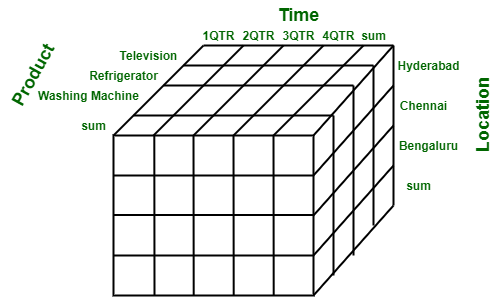
Data Cube
A data cube represents data across multiple dimensions.
For instance:
- Dimension 1: Time
- Dimension 2: Product
- Dimension 3: Geography
Each cell contains a measurable value such as sales amount.
Dimensions
Dimensions represent perspectives for analysis.
Examples include:
- Time (Year, Quarter, Month, Day)
- Location (Country, State, City)
- Product (Category, Brand, SKU)
Facts
Facts are numerical measures.
Examples:
- Revenue
- Profit
- Quantity Sold
- Cost
OLAP and Multidimensional Database
OLAP stands for Online Analytical Processing.
A Multidimensional Database supports OLAP operations such as:
- Slice
- Dice
- Drill-down
- Roll-up
- Pivot
Architecture of Multidimensional Systems
The architecture typically includes:
- Data Warehouse
- ETL Process
- OLAP Server
- Reporting Tools
ETL Layer
Extract, Transform, Load processes prepare raw data for analysis.
Storage Engine
Stores pre-aggregated multidimensional data.
Query Engine
Processes analytical queries efficiently.
Types of OLAP Models

MOLAP (Multidimensional OLAP)
Stores data in a multidimensional cube format.
Advantages:
- Fast query performance
- Pre-aggregated data
- Efficient calculations
ROLAP (Relational OLAP)
Uses relational tables for storage.
Advantages:
- Handles large volumes
- Scalable
HOLAP (Hybrid OLAP)
Combines MOLAP and ROLAP advantages.
Real-Time Business Applications
Retail Analytics
A supermarket chain analyzes:
- Daily sales
- Product performance
- Regional demand
Using a Multidimensional Database, management can drill down from yearly revenue to daily transactions in seconds.
Banking Sector
Banks analyze:
- Loan disbursement trends
- Risk exposure by region
- Credit performance
Manufacturing
Manufacturers monitor:
- Production efficiency
- Supply chain delays
- Equipment maintenance schedules
Comparison with Relational Databases
Relational Database:
- Optimized for transactions
- Normalized schema
- Slower complex aggregations
Multidimensional Database:
- Optimized for analytics
- Denormalized structure
- Faster aggregation queries
Relational databases handle inserts and updates efficiently, while multidimensional systems excel at complex reporting.
Performance Benefits
Performance is one of the biggest advantages.
Key benefits:
- Faster aggregation
- Precomputed summaries
- Improved reporting speed
- Efficient memory usage
In financial reporting systems, query execution time may reduce significantly when using multidimensional cubes.
Data Warehousing Integration
A data warehouse acts as a centralized repository.
The multidimensional layer sits on top of the warehouse to provide analytical capability.
Integration steps:
- Collect data from sources
- Clean and transform
- Load into warehouse
- Build cubes
- Connect reporting tools
You can explore more about data warehouse concepts in our internal guide on Data Warehousing Fundamentals.
Star Schema vs Snowflake Schema
Although multidimensional systems rely on cubes, the underlying data warehouse often uses dimensional schemas.
Star Schema
Structure:
- One central fact table
- Multiple denormalized dimension tables
Advantages:
- Faster query performance
- Simpler joins
- Easier maintenance
Example:
A retail system with:
- Fact table: Sales
- Dimension tables: Time, Product, Location, Customer
Snowflake Schema
Structure:
- Fact table
- Normalized dimension tables
Advantages:
- Reduced redundancy
- Better storage efficiency
Disadvantage:
- Slightly more complex queries
For performance-critical reporting systems, star schema is often preferred before cube creation.
Aggregation Design in Multidimensional Database Systems
One of the strongest features of a multidimensional analytical system is pre-aggregation.
What is Aggregation?
Aggregation refers to pre-calculating summary values such as:
- Total Sales by Month
- Revenue by Region
- Profit by Product Category
Instead of calculating totals at query time, values are computed and stored in advance.
This dramatically improves performance.
Aggregation Strategies
- Full aggregation
- Partial aggregation
- On-demand aggregation
Organizations must balance between storage cost and query speed.
For example, an e-commerce company may pre-aggregate daily revenue but compute hourly revenue dynamically.
Partitioning in Multidimensional Database
Partitioning improves scalability and manageability.
Why Partition?
- Faster processing
- Parallel data loading
- Easier maintenance
- Improved query performance
Example:
A financial institution partitions cubes by year:
- 2022 data
- 2023 data
- 2024 data
This ensures efficient processing of recent data while keeping historical data intact.
Storage Optimization Techniques
Multidimensional storage can grow rapidly.
To optimize storage:
- Use compression techniques
- Remove unnecessary dimensions
- Archive historical data
- Optimize attribute hierarchies
Some MOLAP engines compress cube data significantly, improving both performance and storage efficiency.
Hierarchies in Multidimensional Database
Hierarchies define relationships within dimensions.
Example: Time dimension hierarchy
- Year
- Quarter
- Month
- Day
Hierarchies allow drill-down and roll-up operations efficiently.
Well-designed hierarchies improve both usability and performance.
Calculated Members and Measures
Multidimensional systems allow advanced calculations.
Examples:
- Profit Margin = (Revenue – Cost) / Revenue
- Year-over-Year Growth
- Moving Averages
Calculated measures reduce the need for manual spreadsheet calculations.
In finance, this enables dynamic reporting dashboards.
MDX Query Language
MDX (Multidimensional Expressions) is commonly used for querying multidimensional systems.
It allows:
- Complex filtering
- Calculated members
- Advanced aggregations
- Time-based comparisons
Example use cases:
- Compare Q1 sales with previous year
- Rank products by profitability
- Identify top-performing regions
Learning MDX significantly enhances analytical capability.
Security in Multidimensional Database Systems
Security is critical in enterprise analytics.
Types of Security Controls
- Role-based access control
- Cell-level security
- Dimension-level restrictions
- Data masking
Example:
A regional manager can view only data related to their territory.
Financial institutions often implement strict cube-level security to prevent unauthorized access.
Governance and Data Quality
Data quality directly impacts analytics.
Governance strategies include:
- Data validation rules
- Consistency checks
- Audit trails
- Metadata management
Without governance, analytical systems may produce misleading insights.
Cloud-Based Multidimensional Database Systems
Cloud adoption is transforming analytical infrastructure.
Benefits of cloud-based systems:
- Scalability
- Reduced hardware costs
- Managed services
- Global accessibility
Platforms supporting analytical workloads include:
- Microsoft Azure Analysis Services
- Amazon Redshift
- Google BigQuery
These platforms integrate well with BI tools.
Integration with Business Intelligence Tools
Multidimensional systems are typically connected to visualization tools such as:
These tools allow:
- Interactive dashboards
- Drill-through reports
- Executive summaries
- KPI tracking
Example:
A CEO dashboard showing:
- Revenue trends
- Regional performance
- Product profitability
All powered by cube-based aggregation.
Real-Time Use Case: Global Retail Enterprise
Problem:
Slow performance in analyzing global sales across multiple regions and currencies.
Solution:
- Built multidimensional cubes
- Created currency conversion measures
- Enabled time-based hierarchy
Outcome:
- Reduced reporting time dramatically
- Improved executive decision-making
- Enhanced forecasting accuracy
Real-Time Use Case: Telecommunications Company
Problem:
Analyzing customer churn patterns across multiple demographics.
Solution:
- Created customer segmentation dimension
- Integrated usage metrics
- Used calculated measures for churn rate
Result:
- Identified high-risk customers
- Improved retention strategy
Performance Tuning Best Practices
To optimize a Multidimensional Database:
- Limit unnecessary dimensions
- Optimize attribute relationships
- Monitor query performance
- Remove unused measures
- Process partitions efficiently
Monitoring tools help identify bottlenecks.
Multidimensional Database vs Modern Data Lakehouse
With the rise of data lakehouse architecture, organizations compare approaches.
Multidimensional approach:
- Structured
- Optimized for reporting
- Strong aggregation support
Lakehouse:
- Flexible
- Handles structured and unstructured data
- Scalable
In many enterprises, both systems coexist.
Migration Strategy from Relational to Multidimensional
Migration steps:
- Analyze reporting requirements
- Design dimensional model
- Build ETL pipelines
- Create cube structure
- Validate aggregation logic
- Deploy BI dashboards
Careful planning ensures smooth transition.
Cost Considerations
Implementation cost includes:
- Infrastructure
- Licensing
- Development
- Maintenance
- Training
Cloud-based deployments often reduce upfront cost.
Strategic Role of Multidimensional Database in Enterprise Architecture
In large enterprises, analytical systems are layered within a structured architecture.
Typical enterprise data flow:
- Operational Systems (ERP, CRM, POS)
- Data Integration Layer (ETL/ELT)
- Data Warehouse
- Multidimensional Layer (Cubes)
- Business Intelligence Tools
- Executive Dashboards
The multidimensional layer sits between raw structured data and decision-making systems. It acts as an analytical accelerator.
Enterprise Cube Design Strategy
Designing a cube is not just technical implementation; it requires business alignment.
Step-by-Step Cube Design Approach
- Identify business KPIs
- Define measurable facts
- Identify analytical dimensions
- Design hierarchies
- Determine aggregation strategy
- Validate performance requirements
For example, in a global retail organization:
Facts:
- Revenue
- Cost
- Profit
- Discount
Dimensions:
- Time
- Product
- Store
- Customer
- Channel
Careful modeling ensures business users can perform advanced queries without writing SQL.
Advanced Time Intelligence in Multidimensional Database
Time is one of the most critical dimensions in analytics.
Advanced time intelligence supports:
- Year-over-Year comparison
- Quarter-over-Quarter growth
- Rolling averages
- Moving totals
- Seasonal trend analysis
Example:
A CFO may analyze Q2 revenue compared to Q2 of the previous year using built-in time hierarchies.
Multidimensional systems simplify this with pre-defined calculations.
Writeback Capabilities
Some multidimensional systems support writeback functionality.
This enables:
- Budget planning
- Forecast adjustments
- What-if analysis
- Scenario modeling
Example:
Finance teams can input projected revenue values directly into the cube to compare forecast vs actual performance.
This makes the system interactive rather than purely read-only.
Scenario Analysis and What-If Modeling
Advanced business intelligence includes predictive scenario testing.
Scenario examples:
- Increasing product price by 10 percent
- Reducing marketing spend
- Expanding to a new region
A multidimensional analytical engine can simulate potential outcomes by recalculating measures dynamically.
This capability is widely used in:
- Financial planning
- Supply chain forecasting
- Risk modeling
Query Optimization Techniques
Performance tuning is critical in large-scale systems.
Optimization Methods
- Optimize dimension relationships
- Reduce high-cardinality attributes
- Use selective aggregations
- Avoid unnecessary calculated members
- Monitor cache utilization
Proper query tuning ensures executives receive near-instant results.
Handling Large Data Volumes
Although multidimensional systems are optimized for aggregation, handling extremely large datasets requires careful planning.
Strategies include:
- Incremental processing
- Partition pruning
- Hybrid storage modes
- Archival of historical data
- Use of cloud elasticity
In large telecom companies, daily call data records can reach millions of rows. Efficient partitioning is essential.
Multidimensional Database and Big Data Integration
Traditional cubes were designed for structured warehouse data. However, modern architectures integrate big data platforms.
Integration approaches:
- Use data lake for raw storage
- Clean and transform structured data
- Feed aggregated data into multidimensional cube
- Use cube for executive reporting
This hybrid architecture combines flexibility and performance.
Automation in Cube Processing
Automation improves reliability.
Common automated processes:
- Scheduled cube refresh
- Automatic aggregation recalculation
- Metadata synchronization
- Failure alerts and logging
Many enterprises automate nightly processing to ensure dashboards reflect updated data every morning.
Multidimensional Database in Financial Reporting
Financial reporting demands precision and speed.
Applications include:
- Consolidated balance sheets
- Income statements
- Cash flow analysis
- Regional performance reporting
Pre-aggregated financial measures enable faster month-end closing processes.
Multidimensional Database in Supply Chain Management
Supply chain operations rely heavily on multidimensional analytics.
Use cases:
- Inventory tracking by warehouse
- Supplier performance analysis
- Shipment delay analysis
- Demand forecasting
Example:
A manufacturing firm analyzes inventory levels by product category, region, and time period to optimize procurement decisions.
KPI Framework Implementation
Key Performance Indicators are central to business monitoring.
Examples of KPIs stored in a cube:
- Gross Margin
- Customer Acquisition Cost
- Churn Rate
- Conversion Rate
- Return on Investment
Multidimensional systems allow:
- Threshold monitoring
- Color-coded alerts
- Trend analysis
Executives can identify performance deviations quickly.
Data Refresh Strategies
Two major refresh strategies exist:
Full Processing
- Rebuilds entire cube
- Used for major structural changes
Incremental Processing
- Updates only new or changed data
- Faster and more efficient
Incremental refresh is commonly used in production systems.
Metadata Management
Metadata describes structure and relationships within the cube.
Good metadata management ensures:
- Clear documentation
- Consistent dimension naming
- Easy onboarding of new analysts
- Reduced confusion
Poor metadata design often leads to user errors.
Governance and Compliance
Regulated industries must comply with strict standards.
Compliance considerations include:
- Data lineage tracking
- Audit logging
- Access control
- Regulatory reporting standards
Banking and healthcare organizations must ensure that sensitive information is protected.
Performance Benchmarking
Organizations measure system effectiveness through:
- Query response time
- Cube processing duration
- Storage efficiency
- User concurrency handling
Performance testing should be conducted before deployment.
Real-World Enterprise Example: Global Banking Institution
Challenge:
Slow risk exposure reporting across multiple countries.
Solution:
- Implemented multidimensional cube
- Created country and risk-category dimensions
- Pre-aggregated exposure metrics
Result:
Reduced report generation time from hours to minutes.
Real-World Enterprise Example: Airline Industry
Challenge:
Analyze flight performance and fuel efficiency.
Solution:
- Created dimensions for route, aircraft, time
- Calculated average fuel consumption per route
- Integrated real-time dashboard
Result:
Improved operational efficiency and cost control.
Hybrid Analytical Ecosystems
Many organizations combine:
- Relational databases
- Data lakes
- Multidimensional cubes
- Machine learning platforms
This hybrid approach ensures flexibility and performance.
Machine Learning Integration
Although cubes focus on aggregation, integration with machine learning enhances analytics.
Workflow:
- Use cube for aggregated reporting
- Export structured features
- Train predictive models
- Feed predictions back into cube
Example:
Customer churn probability calculated using ML and stored as a measure in the cube.
Common Performance Bottlenecks
- High cardinality dimensions
- Poor aggregation planning
- Excessive calculated measures
- Large unpartitioned cubes
Monitoring and optimization prevent degradation.
Disaster Recovery Planning
Enterprise systems require disaster recovery strategies.
Key practices:
- Backup cube definitions
- Replicate data warehouse
- Maintain off-site storage
- Implement failover systems
Business continuity is critical for financial reporting.
Training and Skill Development
Professionals working with multidimensional systems should learn:
- Dimensional modeling
- ETL development
- MDX querying
- BI tool integration
- Performance optimization
This expertise is valuable for BI developers and data architects.
Economic Value of Multidimensional Systems
Business benefits include:
- Faster decision-making
- Improved reporting accuracy
- Reduced manual data preparation
- Better strategic planning
- Increased competitive advantage
The return on investment often justifies implementation costs.
Emerging Trends in Analytical Systems
Future innovations include:
- Real-time streaming integration
- Serverless cube processing
- Automated dimension detection
- AI-driven aggregation tuning
- Cloud-native multidimensional engines
As organizations demand faster insights, hybrid analytics platforms will continue evolving.
Career Relevance for Data Professionals
Understanding multidimensional modeling is valuable for:
- Data Engineers
- BI Developers
- Data Architects
- Analytics Consultants
Professionals skilled in cube design and OLAP optimization are in demand in large enterprises.
Common Implementation Mistakes
- Overloading dimensions
- Poor hierarchy design
- Ignoring aggregation strategy
- Inadequate testing
- Lack of documentation
Avoiding these mistakes ensures system stability.
Future Evolution of Multidimensional Systems
The evolution includes:
- Integration with AI models
- Real-time streaming analytics
- Automated cube optimization
- Serverless analytical processing
Hybrid analytical platforms are becoming more common.
Popular Tools and Platforms
Organizations use specialized tools such as:
- Microsoft SQL Server Analysis Services
- Oracle Essbase
- SAP BW
- IBM Cognos
Cloud-based solutions are also available:
- AWS Redshift
- Google BigQuery
- Azure Synapse Analytics
Industry Case Studies
E-Commerce Company
Problem: Slow dashboard performance.
Solution:
- Implemented multidimensional cubes
- Pre-aggregated sales metrics
- Improved response time
Result: Faster business decisions.
Healthcare Provider
Problem: Complex patient outcome analysis.
Solution:
- Created time-based and treatment-based dimensions
- Enabled drill-down by department
Result: Improved resource allocation.
Challenges and Limitations
Despite advantages, there are challenges.
- High storage requirements
- Complex implementation
- Maintenance overhead
- Scalability limitations in some MOLAP systems
Proper planning is essential before deployment.
Future Trends
Analytics is evolving rapidly.
Emerging trends include:
- Cloud-based OLAP
- Real-time analytics
- Integration with machine learning
- AI-driven query optimization
Hybrid systems are becoming more common.
Conclusion
Organizations seeking faster analytical performance and advanced reporting capabilities increasingly rely on multidimensional modeling approaches.
A Multidimensional Database enables businesses to analyze data from multiple perspectives efficiently, supporting strategic decision-making and operational optimization.
From retail forecasting to financial reporting and healthcare analytics, its applications are vast and impactful.
By understanding architecture, modeling techniques, tools, and real-world implementation strategies, professionals and enterprises can harness the full potential of multidimensional analytical systems.
This guide has provided a detailed, structured, and practical overview designed to support both beginners and experienced professionals in mastering the concept and applications of multidimensional database systems.
FAQ’s
What are the 4 types of business analytics?
The four types of business analytics are Descriptive Analytics (what happened), Diagnostic Analytics (why it happened), Predictive Analytics (what is likely to happen), and Prescriptive Analytics (what actions should be taken). Together, they help organizations make data-driven decisions for enterprise growth.
What is multidimensional analysis in OLAP?
Multidimensional analysis in OLAP (Online Analytical Processing) is the process of analyzing data across multiple dimensions—such as time, geography, and product—using data cubes to uncover patterns, trends, and insights for strategic decision-making.
Which type of database is typically used for managing business analytics and multidimensional data analysis?
A multidimensional database (MDDB) or an OLAP database is typically used for managing business analytics and multidimensional data analysis, as it organizes data into cubes that allow fast querying, aggregation, and complex analytical processing.
What are the 7 techniques of business analysis?
The seven common techniques of business analysis include SWOT Analysis, PESTLE Analysis, MOST Analysis, Business Process Modeling (BPM), Use Case Modeling, Requirements Analysis, and Gap Analysis. These techniques help organizations evaluate strategies, identify problems, and design effective data-driven solutions.
What are the 4 types of data models?
The four types of data models are Conceptual Data Model (high-level structure), Logical Data Model (detailed structure without physical implementation), Physical Data Model (database-specific design), and Dimensional Data Model (optimized for analytics using facts and dimensions).


