Artificial intelligence has moved far beyond research labs into real-world production systems. Today, AI powers recommendation engines, fraud detection platforms, autonomous systems, and predictive analytics tools. As AI systems scale, the choice of programming language becomes critical. While Python dominates experimentation, production-grade AI demands performance, concurrency, and reliability. This is where Golang artificial intelligence emerges as a compelling solution.
Modern AI engineering is no longer only about training models. It also involves data pipelines, real-time inference, distributed systems, monitoring, and deployment. These requirements align strongly with the design philosophy of Go.
Why Golang Is Gaining Attention in AI
Go was designed by Google to solve large-scale engineering challenges. Its simplicity, fast compilation, and strong concurrency model make it ideal for backend systems. As AI systems increasingly behave like distributed services rather than standalone scripts, Go naturally fits into the AI ecosystem.
Organizations adopting microservices, cloud-native architectures, and real-time AI inference are exploring Golang artificial intelligence to overcome performance bottlenecks commonly seen in interpreted languages.
Understanding Golang Artificial Intelligence
Golang artificial intelligence refers to designing, deploying, and maintaining AI-powered systems using the Go programming language. Rather than replacing Python entirely, Go often complements it by handling production workloads, inference services, data pipelines, and infrastructure automation.
In many real-world setups, machine learning models are trained using Python frameworks but served and scaled using Go-based services. This hybrid approach allows teams to leverage the strengths of both ecosystems.
Go Language Features That Power AI Systems
Several Go features make it particularly suitable for AI infrastructure:
- Native concurrency with goroutines and channels
- Fast execution speed and low latency
- Strong standard library
- Easy cross-platform compilation
- Built-in memory management
These features allow developers to build AI services that handle millions of requests per second with predictable performance.
Golang vs Python for Artificial Intelligence
Python remains the preferred language for model research and experimentation due to its extensive ML ecosystem. However, Golang artificial intelligence excels in production environments.
Key differences include:
- Go offers faster runtime performance
- Python is easier for prototyping
- Go handles concurrency more efficiently
- Python has richer ML research libraries
In practice, many companies use Python for training and Go for deployment.
AI Architectures Built with Golang
AI architectures using Go often follow service-oriented or microservices patterns. Typical components include:
- Data ingestion services
- Feature engineering pipelines
- Model inference APIs
- Monitoring and logging systems
Go’s efficiency makes it suitable for edge AI, real-time decision systems, and streaming analytics platforms.
Machine Learning Workflows Using Go
Although Go is not traditionally associated with ML training, it supports end-to-end ML workflows such as:
- Dataset preprocessing
- Feature transformation
- Model evaluation
- Batch inference
Libraries like Gorgonia and GoLearn enable machine learning workflows directly in Go, especially for structured data tasks.
Deep Learning Integration in Go
Deep learning in Go is typically achieved through:
- Bindings to TensorFlow and ONNX
- REST-based inference services
- Custom neural network frameworks
Golang artificial intelligence systems often deploy trained deep learning models for fast inference rather than training from scratch.
Popular Golang AI Libraries and Frameworks
Several libraries support AI development in Go:
- Gorgonia for neural networks
- GoLearn for classical machine learning
- Gonum for numerical computing
- TensorFlow Go API for inference
These tools allow developers to implement intelligent systems without sacrificing performance.
Real-World Applications of Golang Artificial Intelligence
Golang artificial intelligence is widely used in:
- Fraud detection systems
- Recommendation engines
- Predictive maintenance
- Real-time personalization
- Autonomous monitoring platforms
Tech companies often rely on Go-based AI services to deliver consistent low-latency predictions.
Building AI Microservices with Golang
Go is ideal for building AI microservices due to its lightweight nature. Common patterns include:
- REST and gRPC APIs for inference
- Load-balanced prediction services
- Event-driven AI pipelines
These architectures scale seamlessly in containerized environments like Kubernetes.
Model Serving and Inference in Go
Model serving is a key area where Golang artificial intelligence shines. Go services can load trained models and expose them as high-performance APIs. This approach ensures:
- Faster response times
- Lower infrastructure costs
- Better fault tolerance
Data Processing and Pipelines in Go
AI systems depend heavily on data pipelines. Go is commonly used for:
- Streaming data ingestion
- ETL pipelines
- Real-time analytics
Its concurrency model enables efficient processing of massive datasets.
Computer Vision with Golang
Computer vision applications use Go bindings for OpenCV and deep learning models. Common use cases include:
- Face recognition services
- Video analytics
- Image classification APIs
Golang artificial intelligence enables scalable vision systems for production use.
Natural Language Processing in Go
Although NLP research tools are stronger in Python, Go is effective for:
- Text classification services
- Search relevance engines
- Chatbot backends
Go-based NLP systems often rely on pre-trained models served via APIs.
Why Golang Is Gaining Attention in Artificial Intelligence Systems
While Python dominates model development, modern AI systems are no longer limited to training notebooks. Production AI requires scalability, concurrency, and reliability. This is where Golang artificial intelligence solutions are gaining strong traction.
Golang is not competing with Python for data science exploration. Instead, it complements Python by powering inference services, AI pipelines, and large-scale distributed systems.
Organizations increasingly adopt Go for AI backends because it offers predictable performance, low memory overhead, and excellent cloud-native compatibility.
Role of Golang in the AI Lifecycle
Artificial intelligence systems move through multiple phases, and Golang fits naturally into specific stages.
Where Golang Fits Best
- Model serving and inference APIs
- Real-time AI systems
- Data ingestion pipelines
- Distributed AI services
- MLOps and deployment automation
Python remains ideal for research and training, but Golang artificial intelligence frameworks excel when models must operate reliably at scale.
Golang for AI Inference and Model Serving
Once a machine learning model is trained, it must be deployed into production. This is a critical stage where performance and stability matter.
Why Golang Is Preferred for Inference
- High throughput with low latency
- Native concurrency using goroutines
- Strong HTTP and gRPC support
- Easy containerization with Docker
- Seamless Kubernetes integration
Many companies export trained models from Python frameworks and deploy them behind Go-based APIs.
Using Golang with Pre-Trained AI Models
Golang does not need to train models directly to be useful in AI systems.
Common Integration Approaches
- Load ONNX models for inference
- Call TensorFlow Serving from Go
- Use REST or gRPC endpoints to Python models
- Execute models compiled into shared libraries
This hybrid approach allows teams to use the best tool for each stage of the AI pipeline.
Golang and Machine Learning Libraries
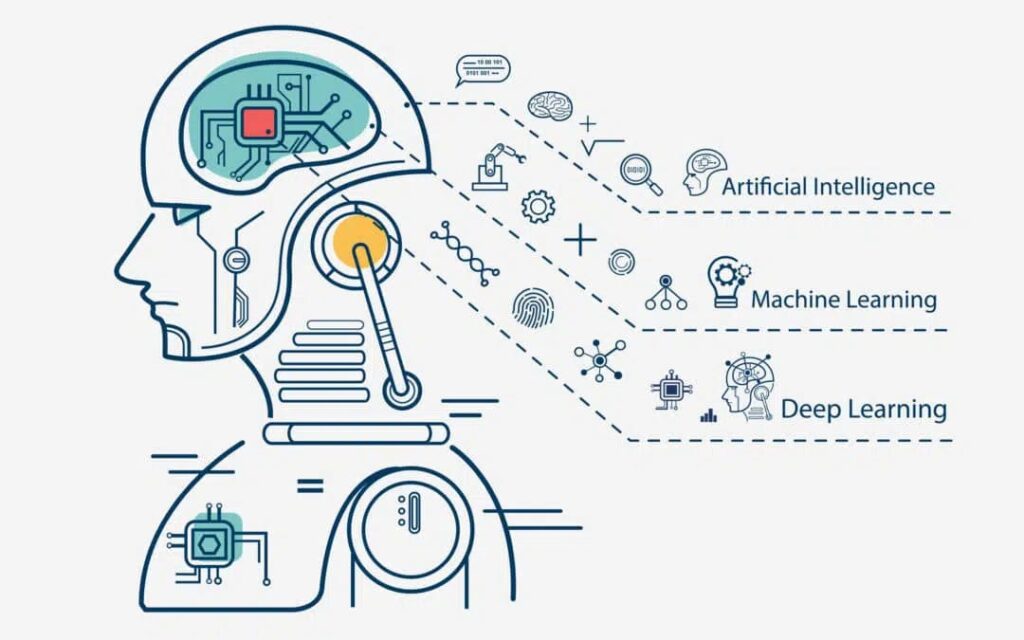
Although Golang has fewer ML libraries than Python, its ecosystem is steadily growing.
Popular Golang AI and ML Libraries
- Gorgonia – Tensor computation and automatic differentiation
- GoLearn – Traditional machine learning algorithms
- Gonum – Numerical computing and linear algebra
- GoML – Basic machine learning utilities
These libraries are often used for lightweight models, experimentation, or embedded AI use cases.
Real-Time AI Systems Built with Golang
Real-time decision-making systems demand speed and concurrency.
Common Real-Time AI Applications
- Fraud detection systems
- Recommendation engines
- Chatbots and conversational APIs
- Autonomous systems
- Streaming data analysis
Golang artificial intelligence systems can process thousands of events concurrently with predictable performance.
Golang in MLOps and AI Infrastructure
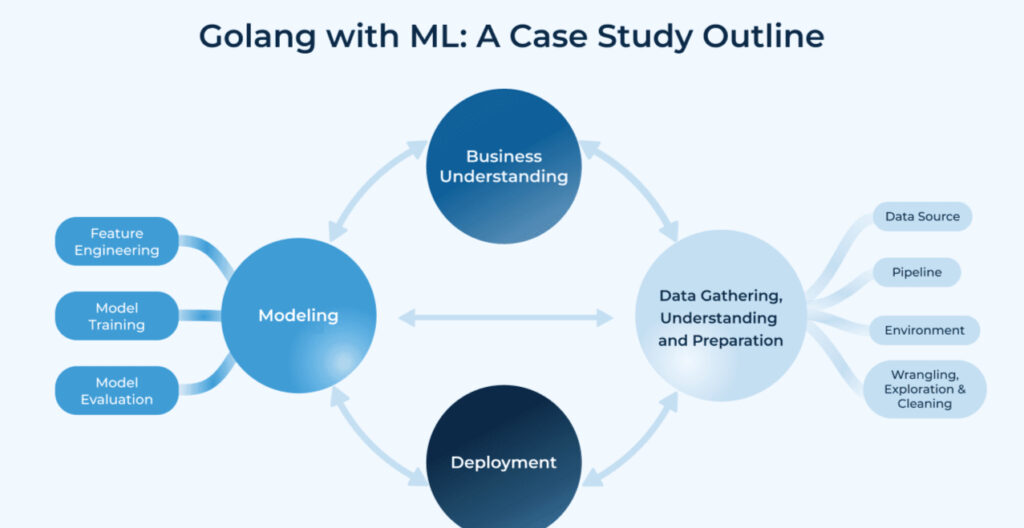
MLOps focuses on managing the lifecycle of machine learning models. Golang plays a critical role here.
MLOps Use Cases with Golang
- Model versioning services
- Feature stores
- Pipeline orchestration tools
- Monitoring and logging systems
- CI/CD automation for AI models
Many popular DevOps and cloud tools are written in Go, making it a natural fit for AI infrastructure.
Scalability Advantages of Golang Artificial Intelligence Systems
AI systems must scale horizontally to handle real-world workloads.
Key Scalability Benefits
- Lightweight goroutines reduce resource consumption
- Fast startup times for microservices
- Efficient memory management
- Easy load balancing with Go-based servers
These features make Golang ideal for AI workloads deployed across distributed environments.
Security Considerations in Golang AI Applications
AI systems often handle sensitive data. Golang offers strong security foundations.
Security Strengths
- Strong typing reduces runtime errors
- Built-in support for secure networking
- Excellent cryptography libraries
- Safer concurrency model
This makes Golang a strong choice for AI systems in finance, healthcare, and enterprise environments.
Golang vs Python in Artificial Intelligence
Understanding the difference helps teams choose the right tool.
Key Differences
- Python excels at experimentation and training
- Golang excels at deployment and scalability
- Python has richer ML ecosystems
- Golang has better performance under load
Most production systems combine both languages rather than choosing one exclusively.
Industry Adoption of Golang Artificial Intelligence
Several industries rely on Golang to support AI-powered services.
Industry Examples
- FinTech for fraud detection APIs
- E-commerce for recommendation services
- Cloud providers for AI infrastructure
- Cybersecurity platforms for threat detection
- Telecom systems for real-time analytics
These systems require reliability more than rapid prototyping, which aligns well with Go.
Best Practices for Building AI Systems with Golang
To build robust Golang artificial intelligence solutions, certain practices are recommended.
Proven Best Practices
- Separate training and inference pipelines
- Use Go for orchestration and serving
- Keep models language-agnostic
- Monitor inference latency closely
- Automate deployments with CI/CD
Following these principles improves maintainability and performance.
Challenges of Using Golang for Artificial Intelligence
Despite its strengths, Golang has limitations.
Key Challenges
- Smaller AI ecosystem than Python
- Limited deep learning tooling
- Less community support for advanced ML research
However, these challenges are less significant in production-focused AI systems.
MLOps and Production AI Using Golang
MLOps focuses on deploying, monitoring, and maintaining AI models. Go plays a crucial role in:
- CI/CD automation
- Model versioning
- Observability and monitoring
Production AI systems benefit greatly from Go’s stability.
Performance Optimization for AI in Go
Performance tuning in Golang artificial intelligence includes:
- Efficient memory usage
- Goroutine pooling
- Optimized I/O operations
These techniques ensure AI services remain responsive under heavy load.
Security and Reliability in AI Systems
Go’s static typing and strong tooling help build secure AI systems. Features include:
- Reduced runtime errors
- Built-in race detection
- Robust error handling
This makes Go suitable for mission-critical AI applications.
Future Scope of Golang Artificial Intelligence
As AI systems become more distributed and real-time, Golang artificial intelligence will continue to grow. Its adoption is expected to increase in:
- Edge AI systems
- Large-scale inference platforms
- Autonomous decision engines
Go’s alignment with cloud-native technologies positions it well for the future of AI engineering.
Conclusion
Golang artificial intelligence represents a shift toward production-first AI development. While Python remains dominant for experimentation, Go excels in scalability, performance, and reliability. Organizations building real-world AI systems increasingly rely on Go to deploy, serve, and manage intelligent applications efficiently. By combining Go’s engineering strengths with modern machine learning models, developers can create AI solutions that are both powerful and production-ready.
FAQ’s
Is Netflix using Golang?
Yes, Netflix uses Golang for building high-performance microservices, backend tools, and cloud infrastructure, valued for its scalability, concurrency, and efficiency.
Is Golang the new Python killer for AI?
No—Golang complements rather than replaces Python; Python dominates AI/ML for its rich ecosystems, while Go excels in scalable, high-performance backend systems supporting AI applications.
Why is Big Tech abandoning Golang?
Big tech isn’t abandoning Go, but some shift focus arises because specialized domains like AI/ML remain dominated by languages like Python and C++, where larger ecosystems and libraries exist; Go is still widely used for scalable infrastructure, cloud services, and high-performance networking.
What language is closest to Golang?
C is often considered the closest to Golang due to its simple syntax, low-level control, and emphasis on performance, while Java is also similar in terms of static typing and concurrency concepts.
Is Golang worth learning in 2026?
Yes—Golang remains valuable in 2026 for building scalable backend systems, cloud-native apps, microservices, and performance-critical infrastructure, especially with continued industry adoption and strong concurrency support.