

In the world of machine learning, Random Forest vs Decision Tree is one of the most frequent comparisons analysts, data scientists, and AI professionals encounter. Both models are powerful in their own ways—Decision Trees for their interpretability and simplicity, and Random Forests for their robustness and superior predictive accuracy.
The question is: When should you use one over the other?
This comprehensive guide explores every dimension of these models — theory, mathematics, practical examples, business use cases, and even Python code — to help you make the right choice.
Understanding Decision Tree
What Is a Decision Tree?
A Decision Tree is a supervised learning algorithm used for both classification and regression tasks. It represents data using a tree-like model of decisions and possible consequences.
Each internal node represents a feature (attribute), each branch represents a decision rule, and each leaf node represents the outcome.
How Decision Trees Work
- The algorithm splits the dataset into subsets based on the value of input features.
- The best split is chosen using metrics like:
- Gini Impurity (CART)
- Information Gain (ID3/C4.5)
- This process continues recursively until all samples are classified perfectly or stopping conditions are met.

Real-World Example of Decision Trees
Consider a telecom company predicting customer churn based on:
- Monthly Charges
- Contract Type
- Tenure
- Internet Service Type
A Decision Tree might first split on Contract Type, then on Monthly Charges, leading to interpretable decision paths like:
“If Contract = Month-to-Month and Monthly Charges > 70, then Customer is likely to churn.”
Understanding Random Forest
What Is a Random Forest?
A Random Forest is an ensemble learning technique that builds multiple Decision Trees and merges their results for improved accuracy and stability.
It operates on the principle of Bagging (Bootstrap Aggregation) — training each tree on random subsets of data and features.
How Random Forest Works
- Bootstrap Sampling: Random subsets of data are drawn (with replacement).
- Random Feature Selection: Each tree is trained using a random subset of features.
- Voting/Averaging: Predictions from all trees are combined:
- Majority vote (classification)
- Average (regression)
Real-World Example of Random Forest
A Random Forest used for loan approval prediction might build 200 different trees, each trained on slightly different samples of data. When combined, these models yield a highly stable and accurate prediction, reducing overfitting.
Random Forest vs Decision Tree: The Core Difference
| Feature | Decision Tree | Random Forest |
| Nature | Single model | Ensemble of multiple trees |
| Overfitting | High | Low |
| Accuracy | Moderate | High |
| Interpretability | High | Moderate |
| Computation Time | Fast | Slower |
| Bias-Variance Trade-off | High variance | Reduced variance |
| Robustness | Sensitive to data changes | Stable due to averaging |
In essence, Random Forest = Many Decision Trees + Randomness + Aggregation.
Mathematical Foundation Behind Both Models
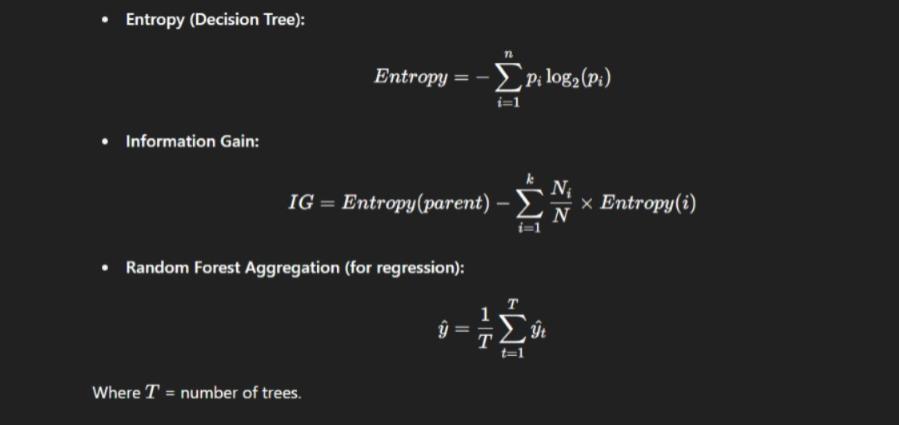
Pros and Cons: Random Forest vs Decision Tree
Decision Tree Advantages
- Easy to interpret and visualize.
- Requires little data preprocessing.
- Works for both categorical and continuous data.
Decision Tree Disadvantages
- Prone to overfitting.
- Unstable with small data variations.
Random Forest Advantages
- Excellent generalization and accuracy.
- Reduces overfitting through averaging.
- Handles missing values efficiently.
Random Forest Disadvantages
- Difficult to interpret.
- Requires more computational resources.
Hyperparameter Tuning for Random Forest and Decision Tree
| Parameter | Description | Impact |
| max_depth | Maximum depth of trees | Prevents overfitting |
| min_samples_split | Minimum samples for a split | Controls tree growth |
| n_estimators (RF) | Number of trees | More trees = better performance |
| max_features (RF) | Number of features per split | Adds randomness |
Example (Python):
from sklearn.ensemble import RandomForestClassifier
model = RandomForestClassifier(n_estimators=100, max_depth=8, random_state=42)
model.fit(X_train, y_train)
When to Use Random Forest vs Decision Tree
- Use Decision Tree for interpretability, quick insights, or small datasets.
- Use Random Forest for large, noisy datasets requiring accuracy and generalization.
Handling Overfitting: Why Random Forest Wins
Decision Trees can perfectly memorize training data, leading to poor test accuracy.
Random Forests prevent this by averaging predictions from multiple uncorrelated trees, minimizing variance and improving generalization.
Random Forest vs Decision Tree in Modern Machine Learning
While Decision Trees and Random Forests are classic algorithms, they have evolved significantly with advancements in computational power, distributed systems, and the rise of interpretability-driven AI. Understanding these deeper aspects helps data professionals make better architectural and operational decisions.
Advanced Performance Considerations
1. Computational Complexity
- Decision Tree Complexity:
- Training: O(n×m log n) where n = samples, m = features
- Space: Moderate, as only one model is stored
- Prediction: Very fast due to single path traversal
- Random Forest Complexity:
- Training: O(T×n×m log n), where T = number of trees
- Space: Higher (storing hundreds of trees)
- Prediction: Slower due to ensemble aggregation
While Decision Trees can train in seconds, Random Forests may take minutes or hours depending on n_estimators and data size.
2. Parallelization and Scalability
Random Forests, despite being computationally expensive, are highly parallelizable. Each tree can be trained independently, making it suitable for:
- Multi-core CPUs
- GPU-accelerated frameworks
- Distributed systems like Apache Spark MLlib or Dask
Decision Trees, being single models, are less suited for parallelization but ideal for real-time systems or resource-constrained environments.
Handling Imbalanced and High-Dimensional Data
1. Class Imbalance
When dealing with datasets where one class dominates (e.g., fraud detection), Random Forests can:
- Use class_weight = ‘balanced’
- Combine with SMOTE (Synthetic Minority Over-sampling Technique) for synthetic data generation
Decision Trees, however, may become biased toward majority classes unless tuned properly with weighted Gini or Entropy.
2. High-Dimensionality
Random Forests perform automatic feature selection due to random feature subsetting, making them robust in high-dimensional problems such as:
- Text classification (TF-IDF vectors)
- Genomic data analysis
- Sensor fusion tasks
Decision Trees tend to overfit or become unstable when dealing with thousands of correlated features.
Interpretability: Bridging the Black Box
One major criticism of Random Forests is their lack of transparency. However, several modern techniques have emerged to make them interpretable:
1. Feature Importance Analysis
Feature importance in Random Forests can be measured by:
- Mean Decrease in Gini Impurity
- Permutation Importance
- SHAP (SHapley Additive exPlanations) values for local interpretability
Example:
import shap
explainer = shap.TreeExplainer(model)
shap_values = explainer.shap_values(X_test)
shap.summary_plot(shap_values, X_test)
This visualization shows how each feature influences the prediction at a granular level — bridging the interpretability gap between Random Forest and Decision Tree.
2. Surrogate Modeling
A surrogate Decision Tree can be trained on the predictions of a Random Forest to approximate its decision boundaries.
This approach enables business stakeholders to interpret Random Forests through a simpler, human-readable model.
Advanced Variants and Hybrids
Researchers and data engineers have proposed several enhancements over traditional Random Forests and Decision Trees to handle modern data challenges.
1. Extra Trees (Extremely Randomized Trees)
- Introduced randomness not just in feature selection but also in split thresholds
- Faster training
- Less overfitting
- Slightly less accurate than traditional Random Forests in some datasets
2. Rotation Forests
Combines Principal Component Analysis (PCA) with Random Forest to rotate feature space, enhancing diversity between trees and improving classification accuracy.
3. Gradient Boosted Decision Trees (GBDTs)
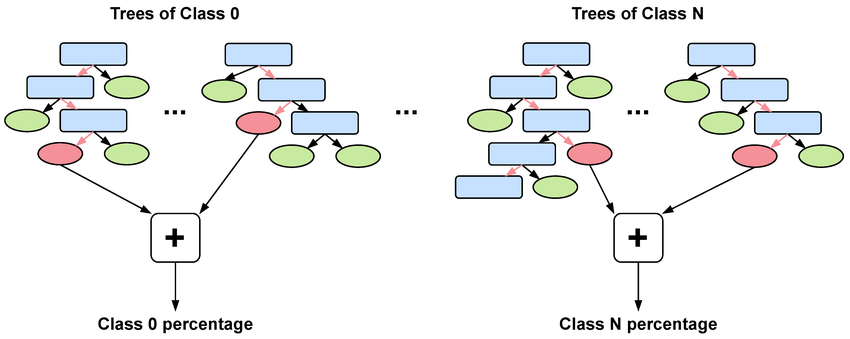
Unlike Random Forests that average independent trees, GBDTs (like XGBoost, LightGBM, CatBoost) build trees sequentially — each new tree corrects errors of the previous one.
Key difference:
- Random Forest: Parallel trees, bagging
- GBDT: Sequential trees, boosting
4. Oblique Decision Trees
Use linear combinations of features at each split instead of single features. These trees handle correlated features better and improve decision boundaries in high-dimensional spaces.
Statistical Generalization and Bias-Variance Trade-off
Both algorithms address the bias-variance trade-off differently:
| Model | Bias | Variance | Error Behavior |
| Decision Tree | Low bias | High variance | Overfits on training data |
| Random Forest | Slightly higher bias | Low variance | Stable predictions |
The ensemble averaging in Random Forest reduces variance substantially while maintaining a low bias, making it more robust across unseen data.
Real-World Applications Beyond Traditional Machine Learning
1. Healthcare
- Decision Trees help clinicians trace logical pathways to diagnosis.
- Random Forests power high-accuracy models for predicting disease risks (e.g., diabetes or heart disease).
2. Climate and Environmental Science
Random Forests handle non-linear, noisy datasets, such as predicting air quality or rainfall based on multiple environmental variables.
3. Finance
Decision Trees are used for credit rule creation, while Random Forests handle fraud detection, loan default prediction, and algorithmic trading signals.
4. Retail
E-commerce platforms use Random Forests for recommendation systems, customer segmentation, and dynamic pricing models.
5. Cybersecurity
Random Forests identify anomalies in real-time, detecting malicious network behavior and intrusion attempts.
Advanced Tuning and Optimization Strategies
1. Hyperparameter Optimization Techniques
Manual tuning is inefficient for large models. Modern optimization frameworks like:
- Optuna
- Hyperopt
- Bayesian Optimization
automatically search the best combination of hyperparameters.
Example (using Optuna):
import optuna
def objective(trial):
n_estimators = trial.suggest_int('n_estimators', 100, 1000)
max_depth = trial.suggest_int('max_depth', 3, 20)
model = RandomForestClassifier(n_estimators=n_estimators, max_depth=max_depth)
model.fit(X_train, y_train)
return model.score(X_valid, y_valid)
2. Out-of-Bag (OOB) Error Estimation
Random Forests provide an internal cross-validation metric — OOB error — calculated on data not used in bootstrap samples, saving computational cost.

Model Interpretability vs Predictive Power Trade-off
In enterprise AI pipelines, this trade-off is crucial:
- Decision Tree: Ideal for explainable AI requirements (e.g., banking compliance)
- Random Forest: Ideal for high-stakes prediction systems where performance matters most
Organizations often use both:
- Decision Tree for decision auditability
- Random Forest for operational prediction accuracy
Handling Missing and Noisy Data
Random Forest inherently manages missing values by:
- Using surrogate splits
- Imputing missing features based on majority class
- Averaging predictions across trees
Decision Trees require preprocessing, but modern implementations (like in scikit-learn 1.4+) can handle NaNs directly.
Research and Emerging Trends (2024–2030)
1. Federated Random Forests
- Enable privacy-preserving learning by training distributed Random Forests across devices without sharing raw data.
- Used in healthcare, finance, and IoT.
2. Quantum Decision Forests
- Quantum computing-based variants that drastically reduce tree-building time and improve decision boundary exploration.
3. Explainable Random Forests (XRF)
- New frameworks integrating rule extraction and SHAP explanations to make ensemble models fully interpretable.
4. Hybrid Deep Forest Models
- Combine neural networks and forest algorithms, where Random Forest outputs feed into deep layers for nonlinear representation learning.
5. AutoML Integration
- Automated Machine Learning (AutoML) platforms (like Google Cloud AutoML and H2O AutoML) increasingly use Random Forests as baseline models due to their balance between accuracy and interpretability.
Comparative Summary: Beyond Traditional Metrics
| Dimension | Decision Tree | Random Forest |
| Speed (Training) | Very fast | Moderate |
| Speed (Prediction) | Instant | Slower |
| Interpretability | Excellent | Moderate |
| Robustness | Poor under noise | Strong |
| Scalability | Limited | High |
| Feature Correlation Handling | Weak | Moderate |
| Data Imbalance Handling | Weak | Strong |
| Suitability for Real-Time | High | Low |
| Model Deployment Size | Lightweight | Heavy |
| Explainability in Regulated Industries | Excellent | Limited |
Feature Importance Comparison
Both models offer feature importance, but Random Forest averages importance across all trees, providing more reliable insight.
Example output (in Python):
import pandas as pd
importance = pd.Series(model.feature_importances_, index=features)
importance.sort_values(ascending=False)
Real-Time Example: Predicting Customer Churn
Dataset Features:
- Tenure
- Monthly Charges
- Internet Service
- Payment Method
Decision Tree Accuracy: ~82%
Random Forest Accuracy: ~91%
This clearly demonstrates how Random Forests outperform single trees in generalization and stability.
Visualization Comparison
- Decision Tree: Tree diagram with feature splits.
- Random Forest: Aggregated forest representation — not visually simple but statistically robust.
Key Metrics for Evaluation
- Accuracy
- Precision / Recall / F1 Score
- ROC-AUC
- Confusion Matrix
Use:
from sklearn.metrics import classification_report
print(classification_report(y_test, y_pred))
Integration with Python (Code Snippets)
Decision Tree Example:
from sklearn.tree import DecisionTreeClassifier
clf = DecisionTreeClassifier(max_depth=5)
clf.fit(X_train, y_train)
Random Forest Example:
from sklearn.ensemble import RandomForestClassifier
rf = RandomForestClassifier(n_estimators=200)
rf.fit(X_train, y_train)
Common Mistakes to Avoid
- Not tuning hyperparameters.
- Using Random Forest with too few trees.
- Ignoring feature scaling.
- Misinterpreting feature importance.
Random Forest and Decision Tree in Business Applications
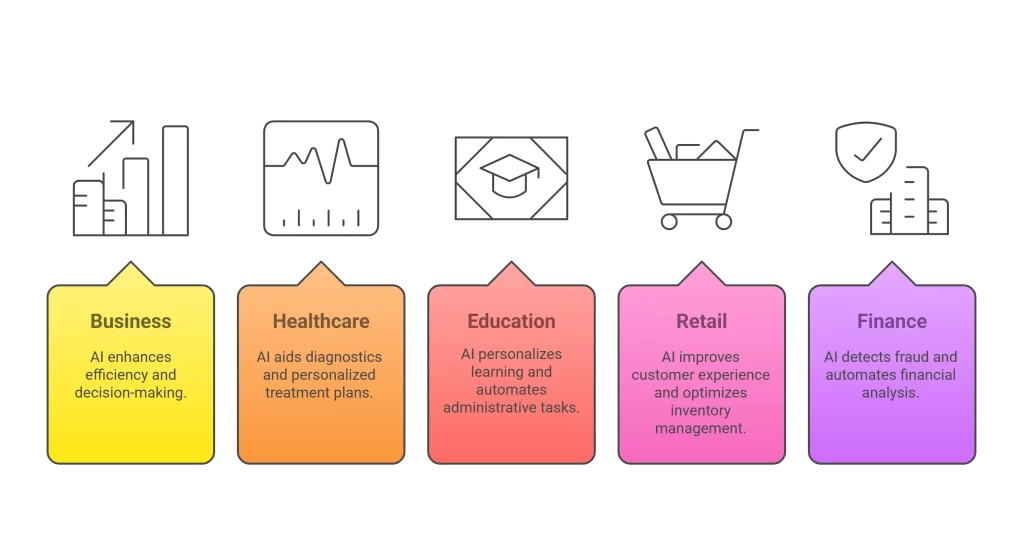
- Finance: Fraud detection, credit scoring
- Healthcare: Disease prediction, patient risk modeling
- Retail: Customer segmentation, recommendation systems
- Manufacturing: Defect prediction and quality analysis
Advanced Concepts: Ensemble Learning and Bagging
Ensemble Learning combines multiple weak learners to form a strong learner.
Bagging (Bootstrap Aggregation) ensures randomness, diversity, and reduced variance — core to Random Forest success.
External Tools and Libraries
- Scikit-learn (Python)
- H2O.ai
- TensorFlow Decision Forests
- XGBoost (for gradient-boosted trees)
Conclusion
In the debate of Random Forest vs Decision Tree, both algorithms play vital roles depending on context.
- If interpretability and simplicity matter, Decision Tree wins.
- If prediction accuracy and robustness are the goal, Random Forest is unbeatable.
In real-world machine learning pipelines, both are often complementary — Decision Trees for exploration, Random Forests for deployment.
FAQ’s
Which is better, random forest or decision tree?
Random Forest is generally better than a Decision Tree because it combines multiple trees to improve accuracy and reduce overfitting, while a single Decision Tree is more interpretable but prone to high variance.
What are machine learning algorithms with examples?
Machine learning algorithms are computational methods that enable systems to learn from data and make predictions. Examples include Linear Regression (for prediction), Decision Trees (for classification), K-Means (for clustering), and Neural Networks (for deep learning tasks).
What is the most powerful machine learning model?
The most powerful machine learning model today is generally considered to be deep neural networks, especially transformer-based models like GPT and BERT, which excel in complex tasks such as natural language processing, image recognition, and generative AI.
Which algorithm is better than random forest?
Algorithms like Gradient Boosting Machines (GBM), XGBoost, or LightGBM often outperform Random Forests in accuracy and efficiency, especially when the data is well-tuned and the model parameters are optimized.
Why is XGBoost better than random forest?
XGBoost is better than Random Forest because it uses gradient boosting, which builds trees sequentially to correct previous errors, resulting in higher accuracy, faster performance, and better handling of overfitting through regularization.