When building machine learning models, one of the biggest challenges is finding the best parameters to minimize prediction errors. This is where gradient descent becomes a core optimization algorithm.
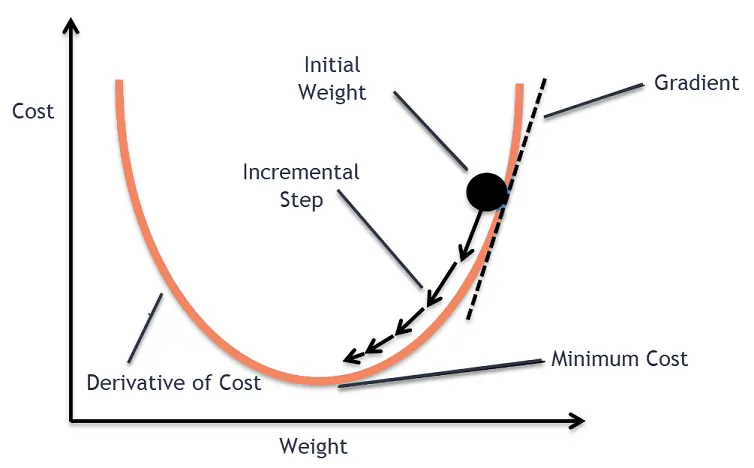
Instead of randomly guessing model weights, gradient descent systematically moves toward the minimum of the cost function, adjusting parameters to achieve better performance.
Think of it like hiking down a mountain in the fog — you can’t see the entire path, but by taking careful steps in the steepest downward direction, you eventually reach the valley.
Why Gradient Descent Matters in Machine Learning
Gradient descent is the backbone of many algorithms, from linear regression to deep neural networks. It’s not just a mathematical trick — it’s a practical method for:
- Training models efficiently even with massive datasets.
- Minimizing loss functions to improve accuracy.
- Adapting weights automatically without human intervention.
- Scaling algorithms to work in high-dimensional spaces.
Example:
In image recognition, models need to adjust millions of parameters. Gradient descent automates this, making the learning process feasible and efficient.
How Gradient Descent Works – Step-by-Step
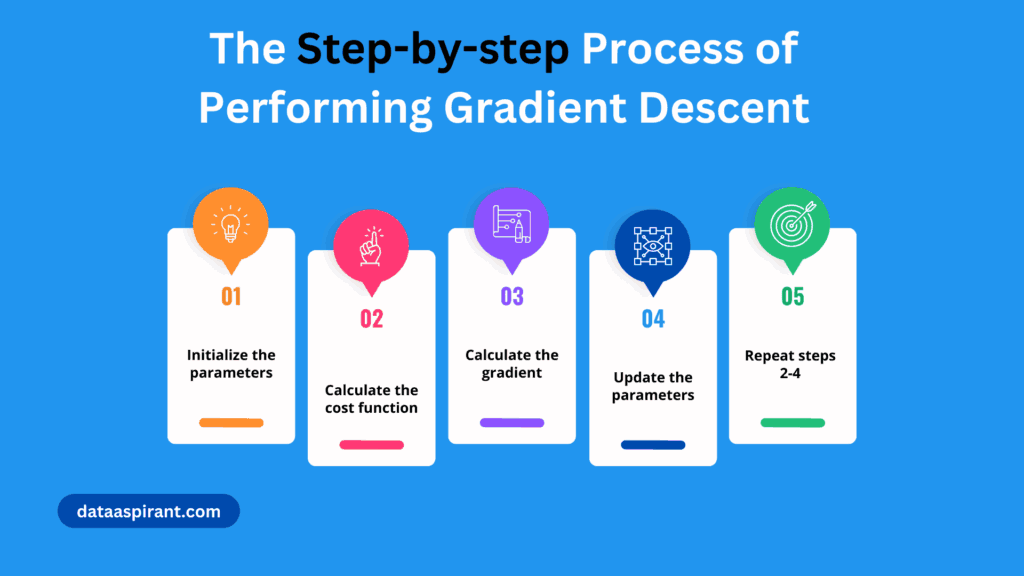
Here’s a simple breakdown:
- Initialize Parameters: Start with random weights.
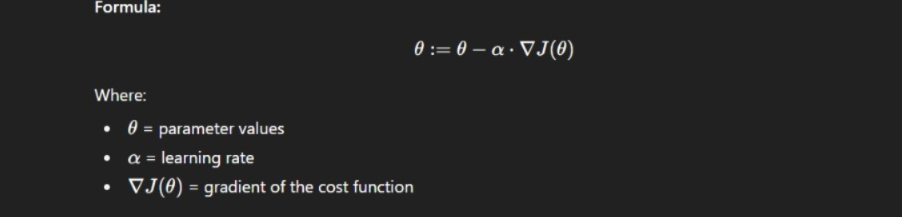
- Compute the Gradient: Calculate how much the cost function changes for each parameter.
- Update Parameters: Move in the opposite direction of the gradient (downhill).
- Repeat: Keep updating until the model converges to the optimal solution.
Key Variants of Gradient Descent
Gradient descent comes in multiple flavors, each with pros and cons:
A. Batch Gradient Descent
- Uses the entire dataset to compute gradients.
- Accurate but slow for large datasets.
B. Stochastic Gradient Descent (SGD)
- Updates weights after each training example.
- Faster but noisier convergence.
C. Mini-Batch Gradient Descent
- Compromise between batch and SGD.
- Common in deep learning.
D. Momentum-based Gradient Descent
- Adds momentum to speed up convergence and avoid local minima.
E. Adaptive Methods (Adam, RMSProp, Adagrad)
- Adjust learning rates dynamically for each parameter.
Mathematical Foundation of Gradient Descent
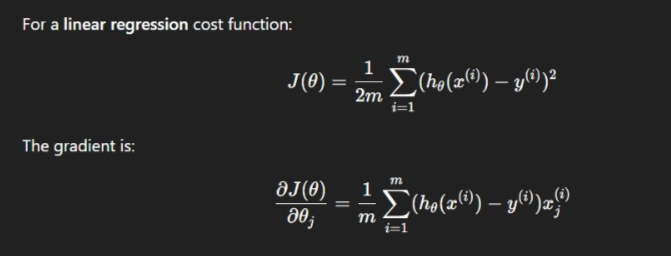
Gradient descent is rooted in calculus and optimization theory. The gradient is the vector of partial derivatives that points in the direction of the steepest ascent. To minimize a function, we move against this direction.
Real-World Examples and Use Cases
Gradient descent is everywhere in machine learning:
- Natural Language Processing (NLP): Optimizing embeddings in Word2Vec or BERT.
- Computer Vision: Training convolutional neural networks for image classification.
- Recommender Systems: Adjusting weights for user-item interaction predictions.
- Financial Forecasting: Optimizing time-series models.
Example: In self-driving cars, neural networks trained with gradient descent detect pedestrians and traffic signals by minimizing classification errors.
Challenges and Limitations
Even though gradient descent is powerful, it’s not perfect:
- Local Minima: Can get stuck in non-optimal points.
- Learning Rate Selection: Too high causes overshooting; too low causes slow convergence.
- Feature Scaling Issues: Requires normalization for faster convergence.
- Computational Cost: Large datasets require significant processing power.
Tips for Improving Gradient Descent Performance
To get the most from gradient descent:
- Normalize data before training.
- Choose a suitable learning rate — try learning rate schedules.
- Use mini-batches for faster computation.
- Add momentum to avoid local minima.
- Experiment with adaptive optimizers like Adam.
Visualizing Gradient Descent
Is one of the most effective ways to understand how this optimization algorithm works in practice. By plotting the cost function against the model parameters, we can observe how the algorithm iteratively moves towards the minimum point. In a 2D view, this often appears as a smooth curve where the gradient descent steps take the parameter values downhill, reducing the error at each iteration. In higher dimensions, contour plots or surface plots are used to show the optimization path, often visualized as a zig-zagging or spiraling trajectory towards the optimal point.
These visualizations make it easier to grasp the effects of the learning rate—too high, and the algorithm overshoots; too low, and it converges slowly. Real-time animations, available through tools like Matplotlib in Python, can help track each step and reveal whether the algorithm is stuck in local minima or progressing steadily to the global minimum.
A contour plot or 3D surface plot is often used to visualize how parameters move toward the optimum.
For example, in Python (Matplotlib + NumPy), you can animate the descent to see how weights adjust over iterations.
Image Alt Text Example:
“Visualization of gradient descent optimization process over a cost function surface.”
External Tools and Resources for Learning Gradient Descent
- TensorFlow Optimizers Documentation
- PyTorch Optim Module
- Gradient Descent Visualization Tool
TensorFlow Playground, Google Colab, and Kaggle Notebooks provide interactive environments to experiment with gradient descent and visualize its optimization process. Online courses, tutorials, and documentation from platforms such as Coursera, Analytics Vidhya, and Scikit-learn further help in building a deeper theoretical and practical understanding.
Final Thoughts
Gradient descent is the workhorse of machine learning optimization.
From simple regression to cutting-edge deep learning models, it enables efficient training and accurate predictions.
By mastering gradient descent — understanding its math, variants, and real-world applications — you gain a solid foundation for building smarter and faster AI systems.


