

In the modern research landscape, analyzing complex relationships between variables is more important than ever. Traditional methods like correlation and regression provide insights into direct relationships but fail to capture multi-layered and latent structures in data.
This is where structural equation modeling (SEM) steps in. As an advanced statistical technique, SEM combines factor analysis and multiple regression into a single framework, allowing researchers to test hypotheses involving both observed and latent variables simultaneously.
What is Structural Equation Modeling?
Structural Equation Modeling (SEM) is a multivariate statistical analysis technique that enables researchers to examine complex relationships between observed variables (directly measured data) and latent variables (hidden constructs that are not directly measured but inferred).
For example:
- In psychology, SEM can be used to study how stress (latent variable) impacts sleep patterns, productivity, and mental health (observed variables).
- In marketing, SEM helps analyze how brand loyalty (latent variable) influences repeat purchase behavior and customer satisfaction.
Why Structural Equation Modeling is Important
Structural Equation Modeling is vital for both academic research and business applications because:
- It allows testing complex hypotheses.
- It integrates measurement models and structural models in one framework.
- It accounts for measurement errors, unlike regression.
- It supports latent constructs (like intelligence, satisfaction, loyalty).
- It provides powerful model fit indices (CFI, RMSEA, TLI, etc.).
Historical Background of SEM
Structural Equation Modeling traces back to the 1920s and 1930s:
- Sewall Wright (1921) introduced path analysis for studying genetic influences.
- Karl Jöreskog (1970s) developed confirmatory factor analysis (CFA), which became a cornerstone of SEM.
- With advances in computing power in the 1980s and 1990s, SEM became widely accessible through software like LISREL, AMOS, and Mplus.
Today, SEM is widely applied across psychology, sociology, education, marketing, economics, and machine learning.
Key Concepts in Structural Equation Modeling
- Latent Variables – Hidden constructs (e.g., intelligence, satisfaction, motivation).
- Observed Variables – Measurable items (e.g., test scores, survey responses).
- Path Diagrams – Visual representation of relationships.
- Measurement Error – SEM acknowledges error terms in observed data.
Steps in Structural Equation Modeling
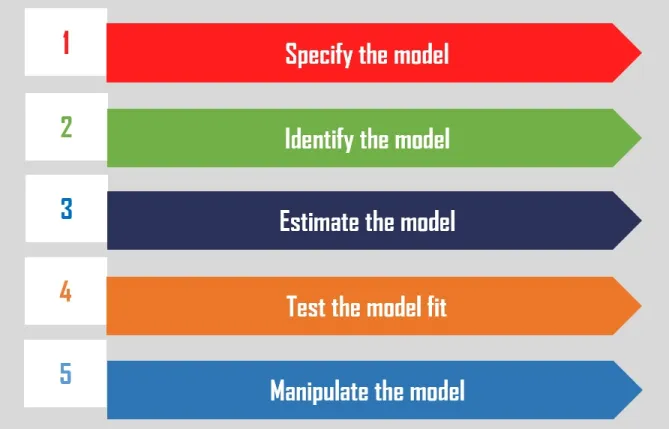
- Model Specification – Define the hypothesized model.
- Model Identification – Ensure there’s enough data to estimate parameters.
- Model Estimation – Use statistical techniques like Maximum Likelihood Estimation.
- Model Evaluation – Test goodness-of-fit indices (Chi-square, RMSEA, CFI).
- Model Modification – Adjust based on modification indices if needed.
Statistical Foundations of SEM
SEM combines:
- Confirmatory Factor Analysis (CFA) → For latent variable measurement.
- Path Analysis → For structural relationships.
- Regression Analysis → To test hypotheses.
SEM requires assumptions: multivariate normality, large sample sizes, and linearity.
Types of Structural Equation Modeling
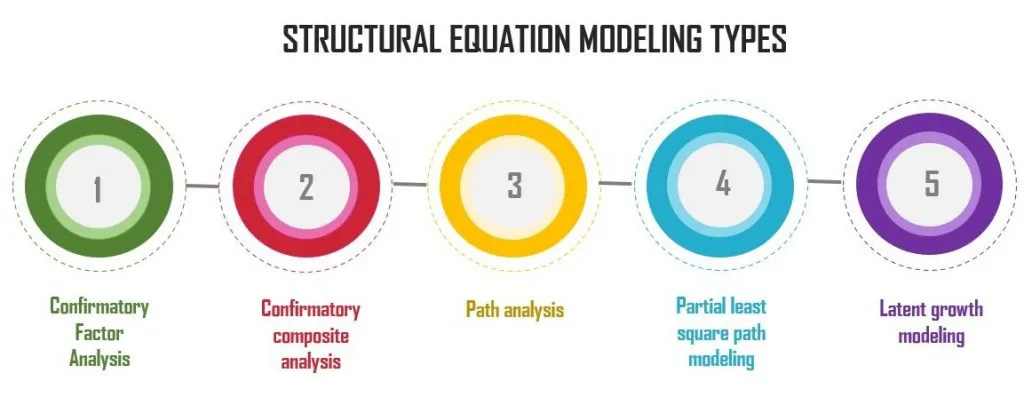
- Confirmatory Factor Analysis (CFA) – Validates measurement models.
- Path Analysis – Examines direct/indirect causal effects.
- Latent Growth Models – Studies changes over time.
- Multi-Group SEM – Compares groups (e.g., male vs female).
- Bayesian SEM – Uses Bayesian inference for estimation.
Assumptions of SEM
- Adequate sample size (often >200).
- Multivariate normality.
- Linearity in relationships.
- No multicollinearity.
- Model identification must be possible.
Data Preprocessing for SEM
- Handle Missing Data: Use imputation techniques.
- Check Normality: Apply transformations if needed.
- Outlier Detection: Remove or adjust.
- Standardization: Normalize data for better interpretation.
- Reliability & Validity Testing: Ensure construct validity.
Advantages of Structural Equation Modeling
- Handles Complex Relationships: SEM can analyze multiple dependent and independent variables simultaneously.
- Latent Variables: It accounts for unobservable constructs like intelligence, customer satisfaction, or motivation.
- Error Control: Unlike regression, SEM incorporates measurement errors into the model.
- Theory Testing & Building: It helps researchers test existing theories or build new ones with empirical evidence.
- Model Comparisons: SEM allows comparing alternative models to see which best fits the data.
Limitations of SEM
- Requires large sample sizes for accurate estimation.
- Complexity may cause interpretation difficulties for beginners.
- Strong reliance on assumptions like multivariate normality.
- Model modifications can sometimes lead to overfitting.
- Software outputs are often misinterpreted without proper training.
Popular SEM Software Tools
- AMOS (SPSS add-on) – Beginner-friendly, visual drag-and-drop interface.
- LISREL – One of the earliest SEM programs, highly detailed.
- Mplus – Flexible, handles complex models with multilevel data.
- R (lavaan package) – Free, open-source, and widely used in research.
- SmartPLS – Best for Partial Least Squares SEM.
Steps to Conduct SEM
- Define the Model – Based on theory, identify latent and observed variables.
- Specify Relationships – Draw hypothesized paths (direct & indirect effects).
- Collect Data – Use surveys, experiments, or databases.
- Test the Model – Estimate parameters using Maximum Likelihood Estimation (MLE).
- Assess Model Fit – Use fit indices like CFI, RMSEA, TLI.
- Modify if Needed – Refine paths or variables to improve fit.
- Interpret Results – Explain theoretical and practical implications.
Types of Fit Indices in SEM
- Absolute Fit Indices: Chi-Square, GFI (Goodness of Fit Index).
- Incremental Fit Indices: CFI (Comparative Fit Index), TLI (Tucker Lewis Index).
- Parsimonious Fit Indices: AIC (Akaike Information Criterion).
- Residuals Based: RMSEA (Root Mean Square Error of Approximation).
Real-Life Applications of SEM
- Education: Measuring latent constructs like learning outcomes or teacher effectiveness.
- Marketing: Understanding customer loyalty, brand perception, purchase intent.
- Healthcare: Modeling patient satisfaction, treatment adherence, mental health outcomes.
- Social Sciences: Exploring relationships between socioeconomic status and behavior.
- Business & HR: Employee engagement, performance modeling, and organizational behavior studies.
Historical Context of SEM
- SEM evolved from factor analysis (Charles Spearman, early 1900s) and path analysis (Sewall Wright, 1920s).
- In the 1970s, LISREL introduced the first SEM software.
- Since then, SEM has become a gold standard for hypothesis testing in social sciences, psychology, and management research.
Future Trends of SEM
- Bayesian SEM: Integration of Bayesian statistics for better handling of small samples.
- Machine Learning + SEM: Hybrid models improving prediction and interpretability.
- Big Data SEM: Applying SEM frameworks to large-scale datasets.
- Multilevel SEM: Analyzing hierarchical data (e.g., students within schools).
- Longitudinal SEM: Studying changes over time in psychological or social phenomena.
Applications of Structural Equation Modeling in Real Life
- Psychology – Understanding the relationship between anxiety, self-esteem, and performance.
- Marketing – Analyzing how brand perception influences buying decisions.
- Education – Evaluating how teaching style, motivation, and peer influence affect learning.
- Healthcare – Studying how lifestyle, treatment adherence, and mental health impact recovery.
- Finance – Modeling investor confidence, risk perception, and stock performance.
Advantages of SEM
- Handles multiple dependent variables.
- Accounts for measurement errors.
- Tests both direct and indirect effects.
- Combines regression and factor analysis.
- Strong visual representation (path diagrams).
Limitations of SEM
- Requires large datasets.
- Complex to understand for beginners.
- Sensitive to assumption violations.
- Overfitting risk if not used carefully.
SEM Software and Tools
- AMOS (SPSS)
- LISREL
- Mplus
- R (lavaan package)
- SmartPLS
Real-Time Examples of Structural Equation Modeling
- Employee Productivity Study – Latent variable motivation measured through surveys affects job performance.
- E-commerce Analysis – Customer satisfaction → loyalty → repeat purchases.
- Public Policy – Social trust influences government satisfaction and civic participation.
Best Practices in SEM
- Clearly define hypotheses.
- Ensure data meets assumptions.
- Use multiple fit indices for evaluation.
- Avoid overfitting by cross-validation.
- Report results transparently.
Challenges and Common Mistakes in SEM
- Ignoring sample size requirements.
- Misinterpreting model fit indices.
- Treating SEM as purely confirmatory without theory.
- Overcomplicating models unnecessarily.
Structural Equation Modeling vs Regression Analysis
- Regression → Direct relationships only.
- SEM → Handles latent constructs, indirect effects, and measurement errors.
Future of Structural Equation Modeling in Data Science and AI
- Integration with Machine Learning – SEM with deep learning for hybrid models.
- Bayesian SEM Expansion – More robust inference.
- Real-Time SEM – Applying SEM in streaming big data environments.
- AI-Powered SEM Tools – Automated model building and validation.
Path Analysis vs. SEM
- Path Analysis
- Only involves observed variables.
- Useful for modeling direct and indirect effects between measured variables.
- Only involves observed variables.
- SEM
- Involves latent variables in addition to observed variables.
- Can handle measurement error more effectively.
- Involves latent variables in addition to observed variables.
Partial Least Squares SEM (PLS-SEM)
- When to Use:
- Small sample sizes
- Non-normal fsta
- Exploratory studies
- Small sample sizes
- Advantages:
- Easier to apply than covariance-based SEM (CB-SEM).
- Widely used in business, marketing, and management research.
- Easier to apply than covariance-based SEM (CB-SEM).
- Example:
A startup with only 60 customer survey responses can still use PLS-SEM to test hypotheses about how customer satisfaction influences loyalty.
Multilevel SEM (MSEM)
- Purpose:
Models data with a hierarchical structure. - Example:
- Students (Level 1) nested within Classrooms (Level 2).
- SEM can estimate within-group effects (student-level factors) and between-group effects (teacher or school-level factors).
- Students (Level 1) nested within Classrooms (Level 2).
- Applications:
- Education research
- Organizational psychology
- Public health studies
- Education research
Longitudinal SEM
- What It Does:
- Studies relationships between variables over time.
- Tests for causal relationships beyond cross-sectional data.
- Studies relationships between variables over time.
- Example:
A health study measuring stress and sleep quality across 3 years can model how stress impacts sleep over time using longitudinal SEM.
Bayesian SEM
- Why Important:
- Works well with small samples.
- Handles complex models that traditional SEM struggles with.
- Provides probability distributions for parameter estimates instead of just point estimates.
- Works well with small samples.
- Real-World Use:
Bayesian SEM is being integrated with AI-powered predictive analytics in healthcare to forecast disease risk patterns.
Fit Indices in SEM (Model Evaluation)
- SEM models need fit indices to test how well the model matches the data:
- Chi-Square Test (χ²): Measures discrepancy between observed and model covariance.
- CFI (Comparative Fit Index): Should be > 0.90 for a good fit.
- TLI (Tucker-Lewis Index): Acceptable if > 0.90.
- RMSEA (Root Mean Square Error of Approximation): Should be < 0.08.
- SRMR (Standardized Root Mean Square Residual): Should be < 0.08.
- Chi-Square Test (χ²): Measures discrepancy between observed and model covariance.
SEM in Machine Learning & AI
- SEM is now being integrated with machine learning models for more robust predictions:
- SEM + Neural Networks → Used in behavioral science to combine theoretical causal models with data-driven AI predictions.
- SEM in Natural Language Processing (NLP): Analyzing sentiment while accounting for latent psychological constructs.
- SEM for Big Data: Scaling SEM with cloud-based computation to handle millions of records in health, marketing, and social media analytics.
- SEM + Neural Networks → Used in behavioral science to combine theoretical causal models with data-driven AI predictions.
Common Challenges in SEM
- Model Identification:
- A model must have enough information to estimate parameters.
- Under-identified models cannot be tested.
- A model must have enough information to estimate parameters.
- Sample Size Requirements:
- SEM often needs large samples (200+ observations for CB-SEM).
- PLS-SEM is an exception with smaller sample needs.
- SEM often needs large samples (200+ observations for CB-SEM).
- Overfitting:
- Adding too many parameters may create a model that fits the sample data but fails in new data.
- Adding too many parameters may create a model that fits the sample data but fails in new data.
Real-World Examples of SEM Applications
Education Research
Modeling how teaching style (latent variable) affects student motivation and performance.
Healthcare
Understanding how mental health, exercise, and social support interact to predict well-being.
Marketing
Testing how brand trust influences customer loyalty through mediating factors like satisfaction.
Social Sciences
Studying complex constructs like cultural identity, stress, or job burnout using latent variables.
Conclusion
Structural Equation Modeling has evolved into a cornerstone of modern data analysis, bridging theory and empirical research. From psychology and education to marketing and healthcare, SEM empowers researchers to uncover hidden relationships, account for errors, and build reliable models.As data-driven decision-making grows across industries, SEM will remain a critical tool for researchers, analysts, and data scientists, offering a structured approach to modeling complex systems.
FAQ’s
What is the purpose of structural equation modeling?
The purpose of Structural Equation Modeling (SEM) is to analyze complex relationships between observed and latent variables by combining factor analysis and regression. It helps researchers test hypotheses, validate theories, and understand direct and indirect effects within data.
Why do researchers use SEM?
Researchers use Structural Equation Modeling (SEM) because it allows them to test complex relationships between multiple variables at once, including both direct and indirect effects. SEM is especially valuable for validating theoretical models, measuring latent constructs, and providing deeper insights than traditional regression methods.
What are the steps of SEM?
The steps of Structural Equation Modeling (SEM) include specifying the model, identifying parameters, estimating relationships, testing model fit, and interpreting results to validate or refine the theoretical framework.
How can I use Structural Equations Model (SEM) approach to panel data?
You can apply SEM to panel data by modeling both cross-sectional and longitudinal relationships, capturing latent variables, and testing dynamic effects over time to analyze stability, change, and causal pathways across repeated measures.


Your blog is a beacon of light in the often murky waters of online content. Your thoughtful analysis and insightful commentary never fail to leave a lasting impression. Keep up the amazing work!