
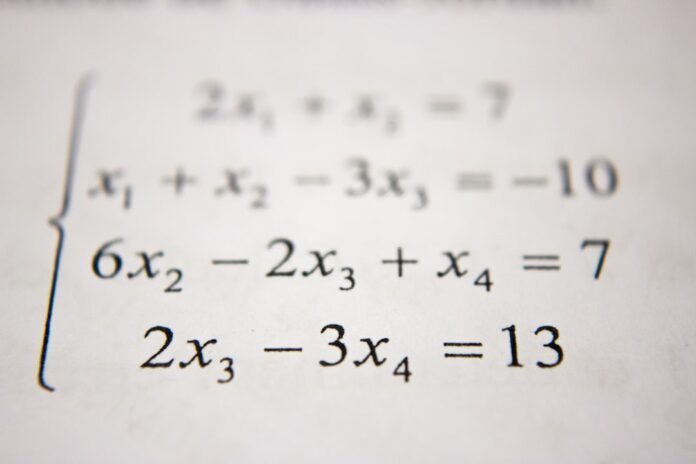
In linear algebra, solving systems of linear equations is a fundamental task with applications across science, engineering, and data analysis. One of the most reliable and systematic methods for solving these systems is Gaussian elimination. However, performing the calculations by hand can be tedious and time-consuming, especially for large systems. That’s where a Gaussian elimination calculator becomes incredibly useful.
What Is Gaussian Elimination?
Before diving into how a Gaussian elimination calculator works, it’s important to understand the method itself. Gaussian elimination is an algorithm used to solve systems of linear equations. It transforms a matrix into a simpler form—known as row echelon form—through a series of operations: row swapping, multiplying a row by a non-zero scalar, and adding or subtracting multiples of one row from another.
The process typically follows these steps:
- Form the augmented matrix from the system of equations.
- Use row operations to convert the matrix into upper triangular (row echelon) form.
- Back-substitute to find the values of the variables.
This step-by-step approach is guaranteed to produce a solution for any system that has one, and it is also the basis for more advanced methods used in numerical computing.
What Is a Gaussian Elimination Calculator?
A Gaussian elimination calculator is an online or software-based tool that automates the process of solving systems of equations using Gaussian elimination. Instead of manually performing each step, users simply input the coefficients of the equations into the calculator. The tool then performs all the necessary row operations to reduce the matrix and find the solution.
These calculators are especially valuable for students and professionals who need quick, accurate results without the risk of arithmetic errors. Many calculators also display the intermediate steps, which helps users understand the process better.
Features of a Good Gaussian Elimination Calculator
When choosing a Gaussian elimination calculator, here are some useful features to look for:
- User-Friendly Interface: Simple input fields for entering matrices or equations.
- Step-by-Step Solutions: The best calculators show each row operation used during the process.
- Support for Augmented Matrices: Handles both coefficients and constants in the system.
- Fractions and Decimals: Ability to work with fractional numbers for more precise answers.
- Multiple Variable Support: Can handle large systems (e.g., 3×3, 4×4, or even larger matrices).
Some advanced tools may also include options to compute determinant, inverse matrices, and reduced row echelon form (RREF), which are closely related to Gaussian elimination.
How to Use a Gaussian Elimination Calculator
Using a Gaussian elimination calculator typically involves the following steps:
- Input the Matrix: Enter the coefficients and constants from your system of equations.
- Choose the Operation: Select “Gaussian Elimination” from the available methods.
- View the Output: The calculator displays the row echelon form and the final solution.
- Analyze the Steps (Optional): Many tools allow users to review each operation for learning purposes.

For example, to solve the system:
2x+3y−z=5
4x+y+2z=6
−2x+5y−3z=−4
You would input the corresponding augmented matrix and let the Gaussian elimination calculator process it. Within seconds, it provides the values of x, y, and z.
Why Use Gaussian Elimination?
Gaussian elimination remains one of the most efficient and widely used methods for solving systems of linear equations. Its systematic approach ensures that any solvable linear system—whether simple or complex—can be reduced to a form that makes the solution straightforward to find.
Here are several key reasons why Gaussian elimination is so valuable:
1. Universality and Reliability
Gaussian elimination can handle any consistent system of linear equations, regardless of the number of variables. It is a general-purpose algorithm applicable to everything from 2×2 systems in school exercises to massive datasets in machine learning and engineering simulations.
2. Foundation for Advanced Algorithms
Many advanced numerical methods, such as LU decomposition, matrix inversion, and linear regression models, are derived from or based on Gaussian elimination principles. Mastering this method provides a foundation for understanding more complex computational techniques.
3. Computational Efficiency
While manual elimination may seem lengthy, the algorithmic version used by computers is extremely fast. Modern Gaussian elimination implementations use optimized matrix operations to solve thousands of equations in milliseconds—making it vital for large-scale scientific and engineering computations.
4. Step-by-Step Clarity
Unlike some “black-box” methods, Gaussian elimination provides a transparent, stepwise process that shows how each variable is eliminated. This makes it not only a problem-solving technique but also a valuable teaching tool for developing mathematical intuition.
5. Practical Applications Across Fields
Gaussian elimination is used in:
- Data science – for solving linear regression problems.
- Engineering – in circuit analysis and structural modeling.
- Economics – to model input-output systems.
- Computer graphics – for 3D transformations and rendering.
Whether for theoretical understanding or computational power, Gaussian elimination remains indispensable in linear algebra.
The Elimination Process
The core idea behind Gaussian elimination is to simplify a complex system of linear equations into a form that is easy to solve. This is achieved by systematically eliminating variables from each equation using basic row operations.
The elimination process generally involves three key phases:
1. Forward Elimination
In this stage, the algorithm works from the top-left of the matrix downward, using each row to eliminate the variable below it. The goal is to create zeros beneath the main diagonal, transforming the system into an upper triangular (row echelon) form.
For example, if you start with a system of three equations, the first equation is used to eliminate the variable x1 from the second and third equations, then the second equation eliminates x2 from the third, and so on.
2. Pivoting (Optional but Important)
When a pivot element (a leading coefficient) is zero or very small, it can cause numerical instability. Partial pivoting swaps rows to ensure the pivot element is the largest possible value in that column, improving accuracy and avoiding division by zero.
3. Back Substitution
Once the upper triangular matrix is obtained, you solve the last equation for its single variable, then substitute that value upward into the preceding equations. This step-by-step process continues until all variables are found.
For instance:
If the last row of the matrix gives z=2, you substitute z into the second equation to find y, then both y and z into the first to find x.
Beyond Basic Gaussian Elimination
While Gaussian elimination is often introduced in classrooms as a manual procedure for solving small systems, its true power lies in its computational and theoretical versatility. Modern applications extend far beyond hand calculations — influencing everything from machine learning algorithms to engineering simulations and financial forecasting. Let’s explore how this seemingly simple technique evolves into a backbone for advanced analytics and numerical computation.
Gaussian Elimination in Computational Mathematics
In computational environments, Gaussian elimination forms the foundation of matrix factorization techniques such as LU decomposition (Lower-Upper decomposition). In this approach, a matrix A is decomposed into a lower triangular matrix L and an upper triangular matrix U, allowing for faster and more efficient solutions to systems of equations. This decomposition enables repeated computations with different constant vectors — a common need in scientific computing and data modeling.
Software tools like MATLAB, NumPy (Python), and R implement optimized Gaussian elimination routines using vectorized operations and floating-point precision adjustments, ensuring accurate results even for massive datasets.
Numerical Stability and Precision Handling
A key challenge in applying Gaussian elimination to real-world data is numerical instability. When matrices contain very large or very small coefficients, rounding errors can accumulate and distort results.
To mitigate this, computational algorithms introduce techniques like:
- Partial Pivoting: Swapping rows to position the largest element as the pivot, improving numerical stability.
- Scaled Pivoting: Adjusting pivot selection based on the magnitude of coefficients, preventing loss of significance.
- Iterative Refinement: Recalculating solutions iteratively to enhance precision, especially in floating-point arithmetic.
These refinements make modern Gaussian elimination implementations robust enough for critical engineering and scientific calculations.
Applications in Machine Learning and Data Science
Gaussian elimination plays a silent yet powerful role in data science and AI. In linear regression, for instance, solving the normal equations (XTX)β=XTy involves applying Gaussian elimination or LU decomposition to compute the parameter vector β.
It’s also used in dimensionality reduction, neural network optimization, and data fitting. Many machine learning libraries (like TensorFlow or PyTorch) internally rely on linear algebra solvers derived from Gaussian elimination principles.
Engineering and Scientific Applications
In civil and mechanical engineering, Gaussian elimination is used to solve equilibrium equations for structures, circuits, and systems modeled by linear relations.
In physics, it’s essential for computational modeling of heat transfer, electromagnetism, and quantum mechanics, where thousands of linear equations must be solved simultaneously.
For economists and financial analysts, the method is used to analyze multi-variable systems such as input-output models, risk factor correlations, and portfolio optimization — where the relationships between variables are best expressed in linear equations.
The Role of Gaussian Elimination in Modern Computing
Gaussian elimination also underpins matrix inversion and determinant calculation, two critical operations in computer graphics, robotics, and simulation modeling.
In 3D graphics, for example, transformations like rotation, scaling, and projection depend on matrix operations derived from Gaussian elimination algorithms.
Furthermore, parallel computing and GPU-accelerated linear algebra libraries (like BLAS and LAPACK) now employ highly optimized versions of Gaussian elimination that process millions of elements simultaneously, reducing computation time dramatically.
Benefits of Using a Gaussian Elimination Calculator
- Time-Saving: No manual row operations required.
- Error Reduction: Minimizes the chance of arithmetic mistakes.
- Educational Value: Step-by-step breakdown enhances learning and comprehension.
- Accessibility: Most calculators are free and available online.
Conclusion
A Gaussian elimination calculator is an invaluable tool for anyone working with systems of linear equations. Whether you’re a student trying to learn the method, a teacher preparing solutions, or a professional in need of quick computations, this tool simplifies and accelerates the problem-solving process. By combining automation with step-by-step transparency, it makes linear algebra more approachable and efficient for everyone.
FAQ’s
How to solve equations using Gaussian elimination?
To solve equations using Gaussian elimination, you convert the system into an augmented matrix, then apply row operations to reduce it to row-echelon form, and finally use back-substitution to find the values of the variables.
What is a Gaussian elimination calculator?
A Gaussian elimination calculator is an online tool that automates the process of solving systems of linear equations by performing matrix row operations to find the variable values quickly and accurately.
In what Gauss elimination method for solving a system of linear algebraic equations triangulation leads to?
In the Gauss elimination method, triangulation leads to an upper triangular matrix, where all elements below the main diagonal are zero, making it easier to solve the system using back-substitution.
What are the three rules of Gaussian elimination?
The three rules of Gaussian elimination are:
Row Swapping – You can interchange any two rows of the matrix.
Row Multiplication – You can multiply a row by a non-zero constant.
Row Addition/Subtraction – You can add or subtract a multiple of one row to another to eliminate variables.
What are the 4 methods of solving simultaneous equations?
The four main methods of solving simultaneous equations are:
Substitution Method – Solve one equation for a variable and substitute it into the other.
Elimination Method – Add or subtract equations to eliminate one variable.
Graphical Method – Plot both equations on a graph; the intersection point gives the solution.
Matrix (or Gaussian Elimination) Method – Represent equations as matrices and use row operations to find variable values.