

Data analysis rarely involves working with a single dataset. In real-world projects, data is often distributed across multiple tables, files, or databases. To perform meaningful analysis, these datasets must be combined correctly and efficiently.
This is where dataframe merge pandas becomes a foundational skill for data analysts, data scientists, and machine learning engineers. Pandas provides flexible and powerful tools that allow structured datasets to be merged in ways similar to SQL joins.
Rather than treating datasets as isolated entities, merging enables analysts to create richer views of information by connecting related data points across sources.
Why DataFrame Merging Is Essential in Data Analysis
Most real-world data problems involve relationships between entities. Customers place orders, employees belong to departments, and products are linked to suppliers. Each of these relationships is often stored separately.
Without merging:
- Analysis remains incomplete
- Insights become fragmented
- Data-driven decisions lack context
With proper merging:
- Data becomes relational
- Patterns emerge across tables
- Analysis becomes scalable
This makes dataframe merge pandas an essential operation in nearly every analytics pipeline.
Understanding the Concept Behind DataFrame Merge Pandas
At its core, merging is the process of combining rows from two DataFrames based on one or more common keys. These keys act as the relationship between datasets.
Pandas merging works similarly to relational databases:
- Rows are matched based on keys
- Columns are combined horizontally
- Missing values appear where matches do not exist
The flexibility of pandas allows merging on:
- Column names
- Index values
- Multiple keys simultaneously
This makes it adaptable to both structured and semi-structured datasets.
The Merge Function Syntax Explained
The primary function used is:
pd.merge(left, right, how='inner', on=None)
Key parameters include:
- left: First DataFrame
- right: Second DataFrame
- how: Type of merge
- on: Column(s) to merge on
Optional parameters allow merging on indexes, handling suffixes, and controlling data alignment.
Understanding this syntax is critical to mastering dataframe merge pandas effectively.
Types of Joins in Pandas Merge
Pandas supports multiple merge strategies, each serving a different analytical purpose.
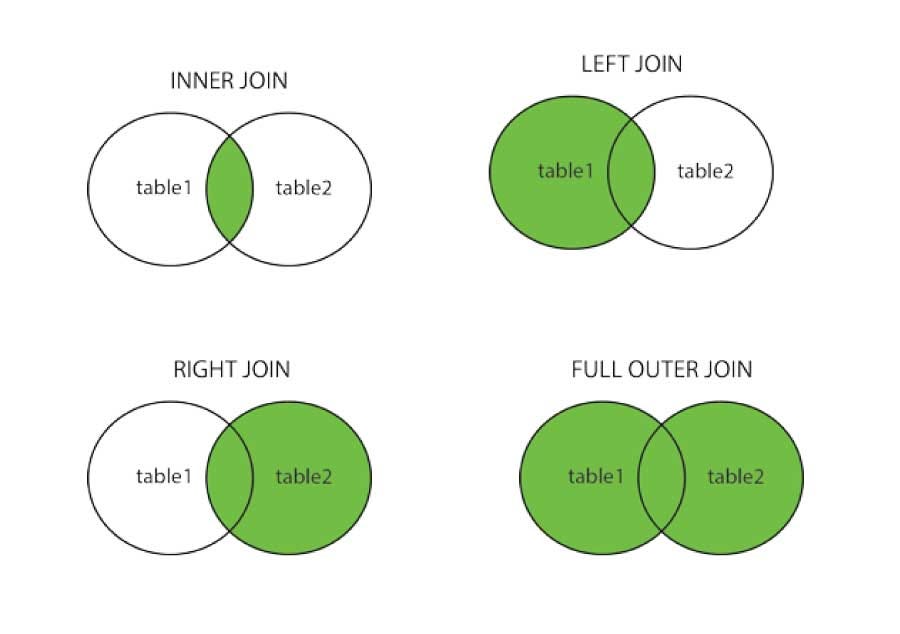
The most common join types are:
- Inner merge
- Left merge
- Right merge
- Outer merge
Each join type determines which records are preserved after the merge.
Inner Merge with Practical Example
An inner merge returns only rows where the merge key exists in both DataFrames.
Example scenario:
- One table contains customer details
- Another table contains customer purchases
Only customers who appear in both tables will be included.
This is useful when:
- You need complete records
- Missing data should be excluded
- Data quality is critical
Inner merges are often used in financial reporting and transactional analysis.
Left Merge and Its Real-World Usage
A left merge keeps all records from the left DataFrame while matching records from the right DataFrame where possible.
This is commonly used when:
- One dataset is the primary source
- Secondary data may be incomplete
- Missing values are acceptable
For example, merging a customer list with optional survey responses ensures that no customers are lost in analysis.
Right Merge for Directional Data Analysis
A right merge functions similarly to a left merge but prioritizes the right DataFrame.
It is useful when:
- The right dataset is the authoritative source
- You want to retain all records from the right side
While less common than left merges, right merges can be useful in validation workflows.
Outer Merge for Complete Data Coverage
An outer merge retains all records from both DataFrames, filling missing values where no match exists.
This approach is valuable when:
- Data completeness matters more than precision
- You want to analyze unmatched records
- Exploratory analysis is the goal
Outer merges are often used during early-stage data exploration.
Merging on Single Columns
Most merges are performed on a single key column such as:
- Customer ID
- Product ID
- Employee ID
Using a single column keeps merges simple and efficient.
Best practices include:
- Ensuring consistent data types
- Removing leading or trailing spaces
- Validating uniqueness where required
Clean keys lead to accurate merges.
Merging on Multiple Columns
In some cases, a single column is not sufficient to uniquely identify records.
Examples include:
- Date and location combinations
- Product and supplier pairs
Pandas allows merging on multiple columns by passing a list to the on parameter.
This approach improves accuracy when relationships are composite in nature.
Handling Duplicate Columns After Merge
When merging DataFrames with overlapping column names, pandas automatically adds suffixes.
For example:
- _x for left DataFrame
- _y for right DataFrame
While functional, this can reduce readability.
Best practices include:
- Renaming columns before merge
- Using custom suffixes
- Dropping unnecessary duplicates
Clean column management improves downstream analysis.
Index-Based Merging in Pandas
Instead of merging on columns, pandas also supports index-based merges.
This is useful when:
- DataFrames share a logical index
- Index values represent unique identifiers
Index-based merging is often faster and cleaner when working with time series or hierarchical data.
DataFrame Merge Pandas vs Join vs Concat
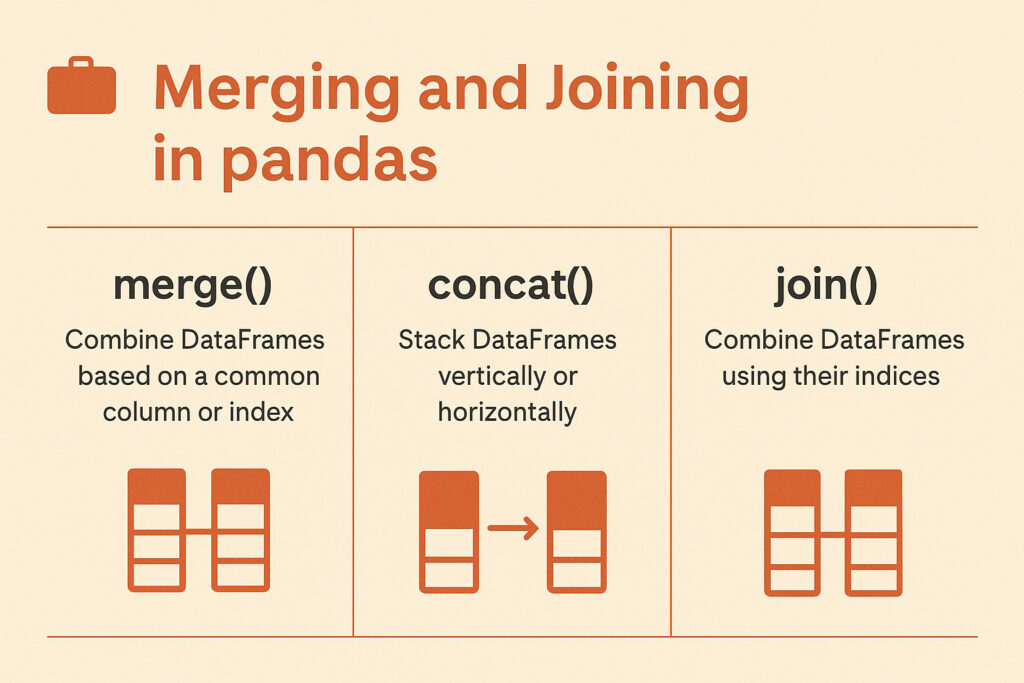
Pandas offers multiple ways to combine data, and understanding the differences is important.
- Merge focuses on relational joins
- Join is index-based and simpler
- Concat stacks data vertically or horizontally
Dataframe merge pandas is the best choice when:
- Relationships exist between datasets
- SQL-like joins are required
- Keys define data structure
Handling One-to-Many and Many-to-Many Relationships
In real-world datasets, relationships are rarely one-to-one. Understanding how dataframe merge pandas behaves in these scenarios is critical to avoid unexpected data duplication.
One-to-Many Merge
This occurs when a single key in one DataFrame maps to multiple rows in another.
Example use cases:
- A customer with multiple orders
- A product listed in several warehouses
Result:
- The single row is duplicated to match each related row
This is expected behavior and often desired, but analysts must be aware of row multiplication to prevent inflated metrics.
Many-to-Many Merge
When both DataFrames contain duplicate keys, pandas creates a Cartesian-style expansion for those keys.
This can:
- Increase row count dramatically
- Impact performance
- Lead to incorrect aggregations
Best practice:
- Validate uniqueness before merging
- Aggregate or deduplicate data where necessary
Using Indicator Parameter to Audit Merge Results
Pandas provides an indicator parameter that helps audit merge behavior.
When enabled, an additional column shows:
- Rows matched in both DataFrames
- Rows present only in the left DataFrame
- Rows present only in the right DataFrame
This is extremely useful when:
- Debugging merge logic
- Identifying missing records
- Performing data reconciliation
This technique improves trust and transparency in merged datasets.
Dealing with Missing Values After Merge
Missing values commonly appear after merges due to unmatched keys.
Strategies to handle them include:
- Filling missing values using default logic
- Dropping rows with excessive nulls
- Flagging incomplete records for review
Rather than immediately removing nulls, it is often better to analyze why they exist, as they may reveal gaps in upstream data pipelines.
Cross-Database Merge Scenarios
In enterprise systems, data often comes from multiple sources:
- SQL databases
- CSV exports
- APIs
- Cloud storage
Using dataframe merge pandas allows you to:
- Normalize schemas
- Combine cross-platform data
- Perform centralized analysis
This makes pandas a bridge between heterogeneous data environments.
DataFrame Merge Pandas in ETL Pipelines
Merging is a key transformation step in ETL workflows.
Typical ETL flow:
- Extract data from sources
- Clean and normalize fields
- Merge related datasets
- Load into analytics or reporting systems
In production pipelines, merges must be:
- Repeatable
- Well-documented
- Performance-optimized
Proper merge logic ensures consistency across daily or real-time data loads.
Time-Based Merging with Date Columns
Many datasets include time dimensions.
Examples:
- Sales by date
- User activity logs
- Sensor readings
Time-based merging requires:
- Consistent datetime formats
- Proper timezone handling
- Sorting before merge when necessary
Mistakes in time alignment can lead to misleading trend analysis.
Avoiding Data Leakage in Analytical Merges
When preparing data for machine learning, improper merging can introduce future information into training data.
Common risks include:
- Merging labels before train-test split
- Using aggregated future data
Best practice:
- Perform merges after splitting datasets
- Maintain strict temporal boundaries
This ensures model performance remains realistic and trustworthy.
Comparing SQL Joins and Pandas Merge Semantics
Although pandas merge resembles SQL joins, subtle differences exist.
Key distinctions:
- Pandas operates in-memory
- Indexes play a larger role
- Data types must align exactly
Understanding these differences helps analysts transition smoothly between SQL and Python-based workflows.
Scalability Considerations for Large Datasets
As data grows, merge operations can become resource-intensive.
Optimization techniques include:
- Chunk-based processing
- Pre-filtering datasets
- Using categorical data types
For extremely large data, combining pandas with distributed frameworks may be necessary.
Testing and Validation After Merging
Never assume a merge worked as expected.
Validation steps should include:
- Comparing row counts before and after merge
- Checking key uniqueness
- Sampling merged rows manually
These checks help catch logical errors early and maintain analytical accuracy.
When Not to Use DataFrame Merge Pandas
Although powerful, pandas merging is not always ideal.
Avoid using it when:
- Data does not share logical keys
- Datasets are extremely large
- Simple concatenation is sufficient
Choosing the right data operation improves both clarity and performance.
Strategic Importance of Merging in Data-Driven Organizations
In modern organizations, decisions rely on connected data.
Effective merging:
- Breaks data silos
- Enables holistic insights
- Supports advanced analytics
Mastery of dataframe merge pandas is not just a technical skill but a strategic capability for data professionals.
Real-Time Business Use Cases
Data merging is used across industries.
Examples include:
- E-commerce platforms combining orders and customers
- Healthcare systems linking patients and medical records
- Financial institutions merging transactions and accounts
- Marketing teams joining campaign data with leads
Each use case depends heavily on accurate merging for reliable insights.
Common Errors and How to Fix Them
Some common issues include:
- Mismatched data types
- Duplicate keys
- Unexpected missing values
Solutions involve:
- Data cleaning before merge
- Validating keys
- Inspecting merge results
Proactive checks prevent costly analytical errors.
Performance Optimization Tips
For large datasets:
- Use indexes wisely
- Reduce unnecessary columns
- Filter data before merging
Efficient merging improves runtime and memory usage, especially in production pipelines.
Best Practices for Clean Merging
Follow these guidelines:
- Always inspect merged output
- Validate row counts
- Document merge logic
These habits ensure reproducibility and trust in analytical results.
Visual Representation of Merge Operations
Including diagrams or tables that illustrate:
- Inner vs outer joins
- Key matching logic
Conclusion and Key Takeaways
Mastering dataframe merge pandas is a crucial step in becoming proficient with data analysis using Python. It enables structured thinking, relational insights, and scalable workflows.
Key takeaways:
- Choose the correct merge type
- Clean keys before merging
- Validate results after every merge
When used correctly, pandas merging transforms raw datasets into meaningful, connected insights that drive real-world decisions.
FAQ’s
What is the difference between merge(), join(), and concat()?
merge() combines DataFrames based on common columns or keys, join() merges DataFrames using index-based alignment, and concat() stacks DataFrames along rows or columns without matching keys.
What are the different types of merges (joins), and when should I use each?
Pandas supports inner, left, right, and outer joins—use inner for common records, left/right to preserve one DataFrame’s data, and outer to keep all records from both DataFrames.
How do I merge DataFrames on a specific column?
Use Pandas’ merge() function and specify the column name with on, for example: pd.merge(df1, df2, on='column_name').
What if the columns I want to merge on have different names in each DataFrame?
You can use merge() with left_on and right_on to specify different column names from each DataFrame, allowing accurate alignment during the merge.
How do I handle duplicate column names in the merged result?
You can handle duplicate column names by using the suffixes parameter in merge() to automatically append custom suffixes to overlapping columns and avoid naming conflicts.