Understanding Why Data Interpretation Matters
Data is everywhere. Organizations rely on data to guide decisions related to pricing, hiring, public policy, healthcare, and education. However, data alone does not guarantee insight. The way data is summarized and presented plays a crucial role in shaping understanding.
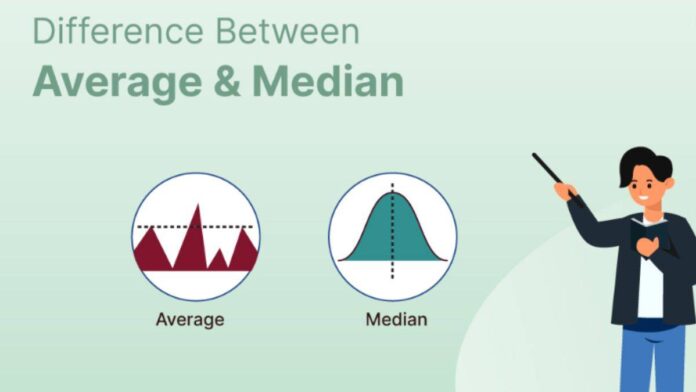
One of the most common mistakes in data analysis is choosing the wrong measure to represent a dataset. This is where confusion often arises between average and median.
Measures of Central Tendency in Statistics
Measures of central tendency summarize data using a single representative value.
The most commonly used measures include:
- Average
- Median
- Mode
Each measure serves a different purpose and provides a different perspective on the data. Selecting the right one depends on the data distribution and the analysis goal.
What Is an Average
The average, also known as the arithmetic mean, represents the sum of all values divided by the total number of observations.
It is widely used because of its simplicity and familiarity.
How the Average Is Calculated
To calculate the average:
- Add all numerical values
- Divide the sum by the count of values
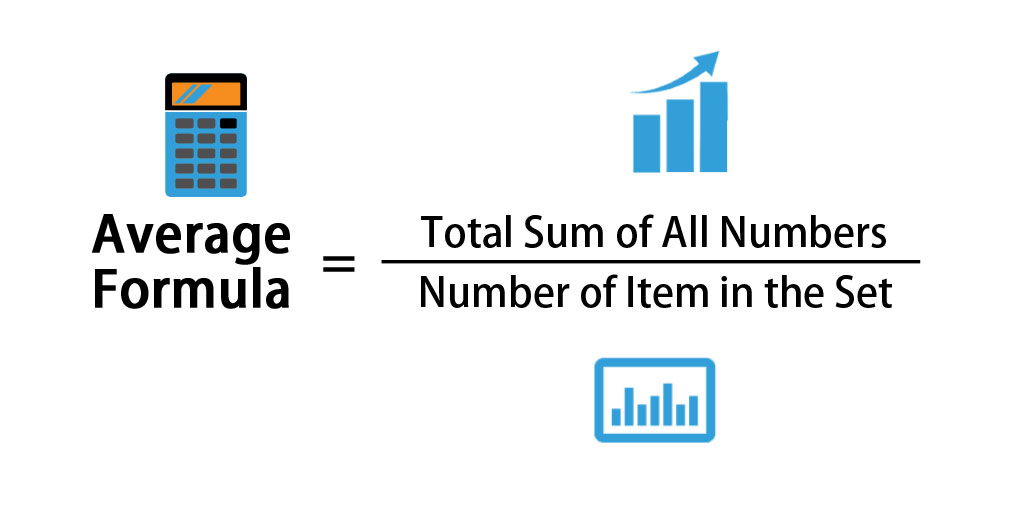
For example, if five people earn salaries of 20, 30, 40, 50, and 60 units, the average salary is the sum divided by five.
Strengths of Using an Average
The average is useful because:
- It uses all data points
- It is mathematically convenient
- It works well for symmetric distributions
- It supports further statistical calculations
In controlled datasets with minimal outliers, the average provides a clear and accurate summary.
Limitations of the Average
Despite its popularity, the average has notable weaknesses.
Key limitations include:
- Highly sensitive to extreme values
- Can misrepresent skewed data
- Often misleading in income and wealth data
A single extreme value can distort the average significantly.
What Is a Median
The median represents the middle value of a dataset when the values are arranged in ascending or descending order.
If the dataset contains an even number of values, the median is calculated as the average of the two middle values.
How the Median Is Calculated
To calculate the median:
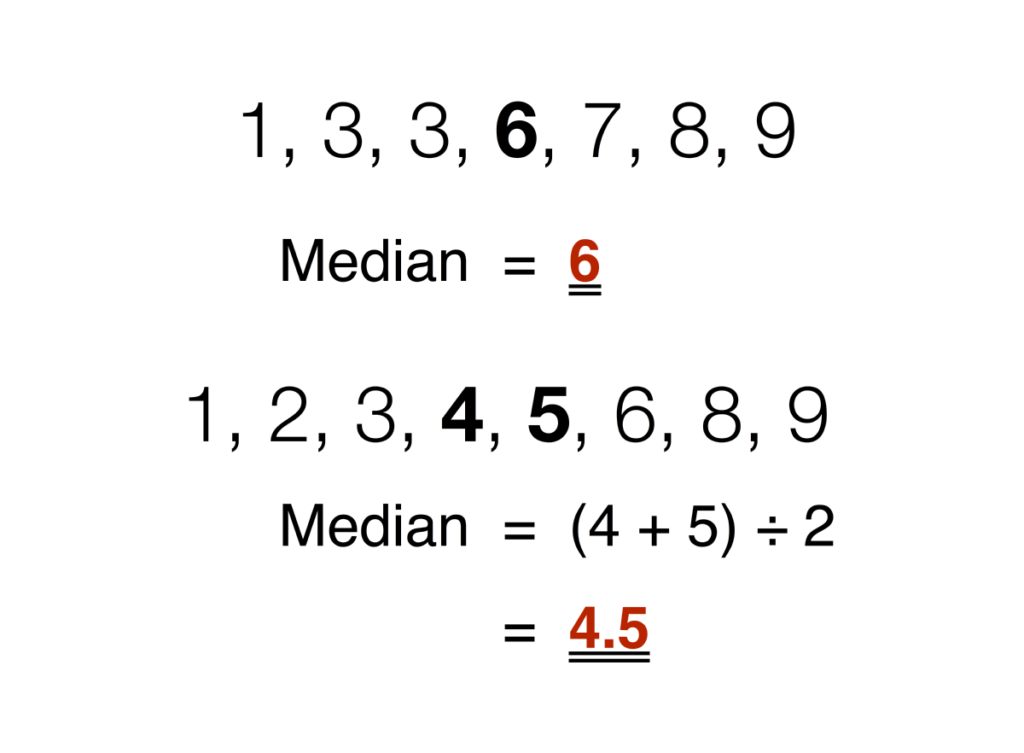
- Sort the dataset
- Identify the central value
- If two central values exist, compute their midpoint
The median focuses on position rather than magnitude.
Strengths of Using a Median
The median is powerful because:
- It is resistant to outliers
- It reflects the typical experience
- It works well for skewed distributions
- It provides a realistic summary in social data
For many real-world datasets, the median gives a more accurate picture.
Limitations of the Median
The median also has drawbacks:
- It ignores most data values
- It cannot be used easily in advanced calculations
- It lacks sensitivity to small changes
Despite this, its robustness makes it invaluable.
Average vs Median in Symmetric Distributions
In symmetric distributions, data is evenly spread around the center.
In such cases:
- Average and median are equal
- Either measure represents the data well
- Choice has minimal impact
Examples include standardized test scores with balanced performance.
Average vs Median in Skewed Distributions
In skewed distributions, values cluster toward one side.
In these cases:
- The average is pulled toward extremes
- The median remains stable
- The difference signals skewness
Income, property prices, and healthcare costs often follow this pattern.
Average vs Median in Public Policy and Government Statistics
Government agencies rely heavily on summary statistics to communicate economic and social conditions. Choosing between average and median directly impacts how policies are perceived by the public.
In income reporting, the average income can increase even when most citizens experience stagnation. This occurs because high-income earners disproportionately influence the calculation. As a result, policymakers prefer the median income when evaluating living standards and wage growth.
In demographic studies, the median age provides a more realistic understanding of population structure. A small group of extremely old individuals can inflate the average age, while the median accurately reflects the typical citizen.
Why Median Is Often Preferred in Social Science Research
Social science data frequently includes inequality, irregular distributions, and extreme observations. These characteristics make the average unreliable.
The median is preferred because:
- It reflects the typical experience of individuals
- It reduces distortion from extreme cases
- It aligns better with real-world inequality
Studies in sociology, economics, and public health often rely on median values to maintain interpretability and fairness.
Average vs Median in Healthcare Analytics
Healthcare data is inherently skewed. Treatment costs, hospital stays, and recovery times vary dramatically among patients.
Average hospital costs are often inflated by a small number of complex cases. The median cost better represents what most patients actually experience.
In clinical trials, median survival time is frequently reported instead of average survival time. This ensures that a few exceptionally long or short outcomes do not distort conclusions.
Using Average and Median Together for Better Insight
Rather than choosing one measure exclusively, combining both provides deeper understanding.
When average and median are close:
- The distribution is likely symmetric
- Data variability is limited
When the average is much higher than the median:
- Data is right-skewed
- Outliers are present
This comparison helps analysts quickly assess data structure before deeper analysis.
Average vs Median in Salary Benchmarking
Companies use salary benchmarking to remain competitive and fair.
Average salaries can appear attractive but may mislead job candidates. Median salaries provide a more honest representation of what most employees earn.
Human resource departments increasingly report both values to balance transparency and competitiveness.
Role of Average vs Median in Risk Analysis
Risk analysis often focuses on extreme outcomes.
While averages summarize expected outcomes, medians highlight typical scenarios. In financial risk modeling, the median outcome helps decision-makers understand what is most likely to happen rather than what could happen in extreme cases.
This distinction is critical in insurance, investment planning, and operational risk management.
Impact of Outliers on Average vs Median
Outliers have a dramatic impact on averages but minimal effect on medians.
Examples of outliers include:
- Extremely high incomes
- Rare medical expenses
- Exceptional performance metrics
Removing or adjusting outliers may stabilize averages, but medians remain consistent regardless of extreme values.
Average vs Median in Sports Analytics
Sports statistics often include exceptional performances.
A single extraordinary game can inflate a player’s average score. The median performance reflects consistency over time.
Coaches and analysts rely on medians to evaluate reliability rather than occasional excellence.
Data Visualization Techniques for Comparing Average and Median
Visual tools improve understanding of these measures.
Common techniques include:
- Histograms showing distribution shape
- Box plots displaying median and quartiles
- Density plots highlighting skewness
Visual comparison reveals why one measure is more appropriate than the other.
Statistical Misinterpretation in Media Reports
Media headlines frequently use averages to create impact.
Examples include average income, average rent, or average fuel costs. These figures can exaggerate trends and mislead readers.
Educating audiences on the difference between average vs median improves statistical literacy and critical thinking.
Teaching Average vs Median in Data Education
Educators emphasize real-world datasets to demonstrate the difference.
Teaching strategies include:
- Using income datasets
- Comparing test scores
- Visualizing skewed distributions
Practical examples help learners grasp abstract statistical concepts.
Average vs Median in Customer Analytics
Customer spending behavior is highly skewed.
A few high-value customers can inflate average purchase value. The median transaction value reflects typical customer behavior and supports more accurate segmentation and pricing strategies.
Businesses increasingly rely on median-based metrics for customer insights.
When Not to Use Either Measure Alone
Some datasets require additional measures beyond average and median.
These include:
- Highly irregular distributions
- Multimodal datasets
- Small sample sizes
In such cases, quartiles, percentiles, or full distribution analysis provides better insight.
Advanced Statistical Alternatives to Average and Median
Beyond basic measures, analysts use:
- Trimmed means
- Winsorized means
- Geometric means
These alternatives balance sensitivity and robustness when average vs median alone is insufficient.
Average vs Median in Big Data Environments
Big data introduces scale and complexity.
Computing averages is computationally efficient, while medians require sorting or approximation algorithms.
Despite technical challenges, median-based metrics remain critical for fairness and accuracy in large-scale analytics.
Real-World Examples in Income Data
Consider a company where most employees earn moderate salaries, but a few executives earn extremely high compensation.
The average salary appears high, but most employees earn far less.
The median salary reflects the experience of the typical worker, making it a better indicator.
Average vs Median in Real Estate Prices
Housing markets often contain luxury properties alongside affordable homes.
The average home price can be inflated by high-end properties.
The median price better represents what most buyers actually pay.
Average vs Median in Education Statistics
Test scores, graduation rates, and class performance often include outliers.
A few high achievers can raise the average score.
The median score better reflects the performance of the typical student.
Average vs Median in Business Decision-Making
Businesses rely on accurate metrics to make strategic decisions.
Examples include:
- Customer spending analysis
- Employee performance evaluation
- Revenue reporting
Using the wrong measure can lead to flawed conclusions and poor strategy.
When the Average Can Be Misleading
The average can mislead when:
- Data contains extreme outliers
- Distributions are heavily skewed
- Social or economic inequality exists
Media headlines often misuse averages, leading to misinterpretation.
When the Median Provides Better Insight
The median is preferred when:
- Outliers dominate the dataset
- Typical experience matters
- Data reflects human outcomes
Government agencies often use median income for this reason.
Choosing the Right Measure for Data Analysis
To decide between average vs median, consider:
- Distribution shape
- Presence of outliers
- Purpose of analysis
- Audience understanding
A thoughtful choice improves clarity and trust.
Average vs Median in Machine Learning
In machine learning:
- Average is used in loss functions
- Median supports robust statistics
- Median absolute deviation improves outlier handling
Choosing the correct measure improves model performance.
Average vs Median in Reporting and Media
Public reports often emphasize averages because they sound impressive.
However, ethical reporting requires clarity.
Using the median avoids exaggeration and improves transparency.
Common Mistakes Analysts Make
Frequent errors include:
- Blindly reporting averages
- Ignoring distribution shape
- Failing to explain chosen metrics
These mistakes reduce credibility.
Best Practices for Using Central Tendency
Recommended practices include:
- Always visualize data first
- Report both measures when possible
- Explain why one is chosen
- Consider audience context
Clear communication is as important as accuracy.
Final Thoughts and Key Takeaways
Understanding average vs median is essential for meaningful data interpretation. While the average offers mathematical convenience, it often fails to represent real-world experience in skewed datasets. The median provides a more resilient and honest summary in many practical scenarios.
Choosing the right measure leads to better insights, more accurate reporting, and smarter decision-making across analytics, business, and policy.
FAQ’s
What is the difference between average and median?
give me What is the difference between average and median? question answer for my Blog Average vs Median Explained: A Powerful Guide to Smarter Data Interpretation in 1-2 line answer
What is better, medium or average?
The median is often better when data has outliers or is skewed, while the average works well for evenly distributed data without extreme values.
Why do people use average instead of median?
People use the average because it is easy to calculate, widely understood, and uses all data values, making it convenient for general comparisons and reporting.
Is it better to use average or median income?
Median income is usually better because it is not affected by extremely high incomes, giving a more accurate picture of what a typical person earns.
What does it mean if the median is lower than the average?
It means the data is right-skewed, where a few very high values pull the average upward above the median.


