
Automation and AI are no longer side projects. In 2026, they’re reshaping how work is planned, executed, and measured—changing roles, workflows, and the skills that matter most.
The future of work isn’t a distant concept. It’s already visible in everyday routines: emails drafted in seconds, meetings summarized automatically, customer issues triaged by models, and repetitive processes quietly handled in the background. For many organizations, the question is no longer whether to adopt AI and automation—but how to do it responsibly while improving quality, speed, and employee experience.
This blog explores what’s changing in the modern workplace, what’s next, and how individuals and organizations can prepare.
The big shift: from automation to augmentation
Automation has existed for decades—rules, scripts, macros, and workflow tools. What changed is capability.
AI systems can now handle work that used to require human judgment: summarizing, classifying, drafting, extracting insights, generating options, and handling messy natural language. That means the new model isn’t just “automate tasks,” it’s “augment people.”
In practice, many workflows are splitting into two layers:
- The AI layer: drafts, suggestions, triage, summaries, pattern detection
- The human layer: context, judgment, accountability, relationship-building, and final decisions
The organizations moving fastest are redesigning processes around that split.
Everyday productivity is rising—especially in knowledge work
AI is changing the baseline speed of work.
Common examples across roles:
- Writing: first drafts of emails, proposals, briefs, reports, and policy documents
- Communication: rewriting for tone, clarity, and audience
- Research: summarizing sources, comparing competitors, scanning large document sets
- Analysis: explaining datasets, generating hypotheses, drafting narratives from results
- Support operations: categorizing tickets, suggesting responses, routing issues
The biggest benefit is not that AI replaces people—it reduces the “activation energy” of starting and moving tasks forward. Work that took hours to get into shape can now be shareable in minutes.
What’s new in 2026: “always-on assistance”
Many teams now treat AI like a baseline service:
- Summaries after meetings and long threads
- Automatic next-step suggestions
- Drafts pre-filled from context (previous docs, prior decisions, customer history)
This is why keeping information organized matters more than ever—AI performs best when it can reliably access context.
Workflows are being rebuilt around AI-native steps
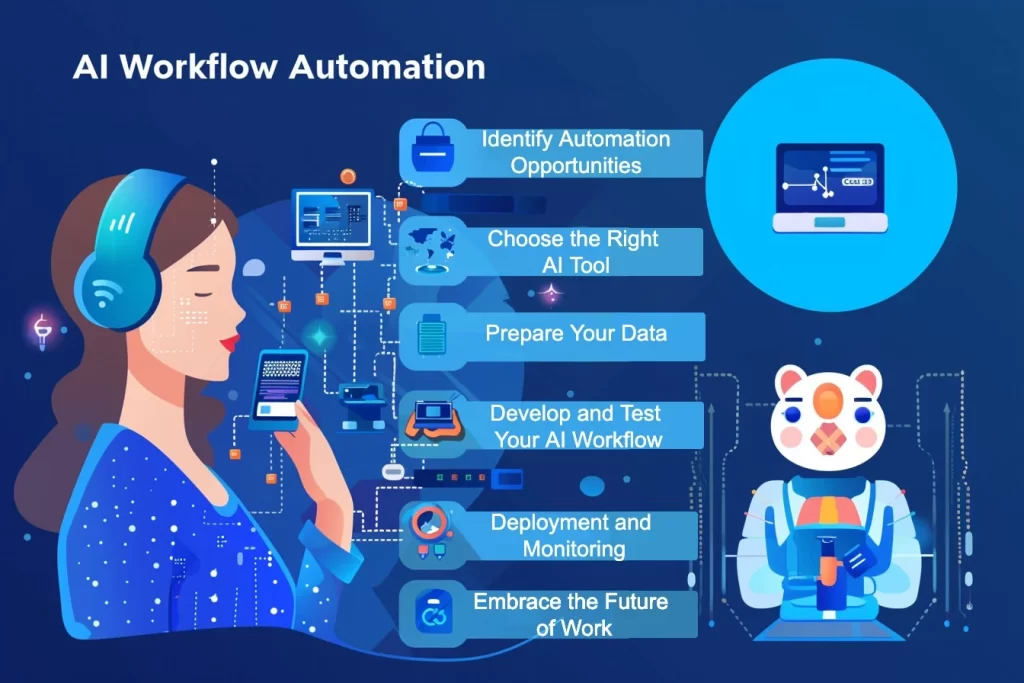
In 2026, teams are standardizing how they use AI inside workflows. A common pattern looks like:
- Define the brief (goal, audience, constraints, success criteria)
- Generate options (AI drafts 2–4 approaches)
- Select and refine (human chooses and edits)
- Validate (facts, numbers, risks, dependencies)
- Publish and track (store decisions and artifacts in a system of record)
This shift is subtle but important: performance depends less on individual heroics and more on clear templates, consistent standards, and good information hygiene.
Examples of AI-native workflows (real workplace patterns)
- HR: job description draft → interview rubric → outreach email → onboarding checklist
- Sales: meeting transcript → opportunity summary → follow-up email → proposal draft
- Product: feedback clustering → insights summary → PRD outline → release notes
- Support: issue classification → suggested responses → escalation routing → FAQ updates
Roles are evolving: some tasks shrink, new responsibilities grow
As AI takes over routine drafting and summarization, job content changes.
Tasks shrinking in many workplaces:
- Manual status updates and meeting notes
- First-pass documentation and repetitive reporting
- Basic content variations (copy tweaks, FAQ expansions)
- Simple research compilation
Responsibilities growing:
- Framing: defining the right problem and success metrics
- Review: checking outputs for correctness, compliance, and risk
- Systems thinking: improving workflows and reducing handoff friction
- Domain judgment: knowing what’s plausible, safe, and strategically aligned
- Stakeholder alignment: ensuring decisions are understood and adopted
This is why “AI literacy” in 2026 isn’t about learning fancy prompts—it’s about learning how to supervise, validate, and operationalize AI outputs.
New roles and job patterns emerging
Many organizations are adding responsibilities such as:
- AI workflow owner (who designs how AI is used in a process)
- Model risk reviewer (who checks failure modes and compliance)
- Knowledge curator (who keeps the source of truth clean and usable)
Even when these are not formal titles, the work exists.
The skills that matter most are shifting
When AI can generate competent drafts instantly, the market rewards what differentiates quality.
High-value skills in the AI-shaped workplace include:
- Clear thinking: turning ambiguity into crisp decisions
- Taste: producing work that is not only correct, but excellent and on-brand
- Verification: spotting subtle errors, missing context, and weak logic
- Decision-making: choosing tradeoffs under uncertainty
- Data judgment: interpreting signals without over-trusting model output
A useful principle: AI increases the supply of content; humans protect the quality of outcomes.
A practical “AI-ready” skill stack
To work effectively with AI, many people build these habits:
- Writing better briefs (clear inputs)
- Asking for alternatives (not just answers)
- Checking assumptions and edge cases
- Keeping notes structured and searchable
- Knowing when not to use AI (sensitive or high-risk decisions)
Leaders face a new challenge: scale without losing trust
AI and automation make organizations faster—but they also create new risks that must be actively managed.
Common workplace risks include:
- “Polished wrong” outputs that look credible
- Privacy and data leakage through careless input sharing
- Over-automation that breaks on edge cases
- Inconsistent customer experiences if AI responses vary widely
- Cultural drift if teams rely on generic AI language
The best mitigation is operational, not philosophical:
- Define what requires human review (high stakes, legal, financial, people decisions)
- Set clear data handling rules
- Use traceability (sources, links, decision logs) for important claims
- Establish quality standards (tone, accuracy, inclusivity, brand)
- Train teams on validation habits, not just tool usage
A simple governance model that works
Many teams use a 3-tier approach:
- Low risk: AI can publish with light review (internal drafts, brainstorming)
- Medium risk: AI assists but needs human approval (customer-facing content)
- High risk: AI can support research, but humans decide and write the final (legal, finance, performance, policy)
The missing ingredient: change management
Even great AI tools fail when people don’t trust them or don’t know how to use them. Strong rollouts often include:
- A small pilot team to refine the workflow before scaling
- Clear success metrics (time saved, quality improvements, lower rework)
- Shared examples of “good use” and “bad use”
- Training that focuses on validation, not just features
What the modern workplace looks like in 2026
Across industries, “normal work” increasingly includes:
- Automated summaries and action items after meetings
- AI-assisted drafting as the default first step
- Faster iteration cycles because options are cheap to generate
- More asynchronous collaboration, fewer status meetings
- Greater emphasis on maintaining a clean source of truth so AI has good context
In other words: less time producing raw material, more time choosing direction and ensuring quality.
How automation is reshaping operations
Automation is also changing back-office and operational work:
- Finance: faster reconciliation and anomaly detection
- Ops: automated workflows and handoffs across tools
- IT: quicker troubleshooting and knowledge retrieval
This can reduce repetitive work, but it also increases the need for monitoring and strong exception-handling.
The hidden impact: performance, hiring, and career paths
AI is also reshaping how organizations evaluate people and how careers develop.
Performance is shifting toward outcomes
When AI reduces the effort needed to create drafts, the signal becomes:
- Did the work drive an outcome?
- Did it reduce risk and rework?
- Did it improve customer or team experience?
This pushes teams to define success more clearly—and to measure impact rather than busyness.
Hiring is changing
Many employers increasingly look for:
- Comfort working with AI tools (and knowing their limits)
- Strong written communication (briefs, specs, decision docs)
- Ability to validate outputs and catch mistakes
- Systems thinking and process improvement
Career paths are becoming less linear
As roles evolve quickly, career growth often looks like building a portfolio of capabilities:
- domain expertise
- workflow design
- stakeholder influence
- quality and risk ownership
Common myths about AI at work (and what’s actually true)
Myth 1: “AI will replace all jobs.”
Reality: AI changes tasks inside jobs first. Some roles shrink, others expand, and many jobs are redesigned.
Myth 2: “If we use AI, quality will go down.”
Reality: Quality can go up or down. It depends on standards, review, and whether teams treat AI output as a draft.
Myth 3: “Prompting is the main skill.”
Reality: The main skill is judgment—framing, validating, and deciding.
Myth 4: “Automation equals set-and-forget.”
Reality: Automation needs monitoring. Exceptions, edge cases, and drift are normal.
What’s next: 2026–2028 trends to watch
Here are a few shifts many workplaces are actively preparing for:
- More “agentic” workflows: AI doesn’t just suggest—it takes actions under rules
- Higher expectations for personalization: customers and employees expect experiences tailored to their context
- Faster skill cycles: roles evolve faster; learning becomes continuous
- Greater focus on trust: transparency, explainability, privacy, and auditability become standard requirements
The rise of “decision records” and traceability
As AI-generated content increases, more organizations will adopt decision logs and traceable artifacts (what we decided, why, and what evidence supported it). This reduces confusion and makes AI assistance more reliable.
Human differentiation will matter more
When many outputs become easy to generate, the competitive edge shifts to:
- building trust
- making great decisions
- designing better systems
- creating meaningful experiences
How to prepare: practical steps for individuals and teams
Whether you’re an individual contributor or a leader, a few practices help immediately:
- Start work with a brief: goal, audience, constraints, and what “good” means.
- Ask for options and tradeoffs, not single answers.
- Validate anything that affects decisions: facts, numbers, commitments, policies.
- Build reusable templates for repeatable work (briefs, reviews, postmortems).
- Keep knowledge organized—AI is only as good as the context it can access.
- Treat AI as a collaborator: supervise it, don’t outsource accountability.
Conclusion
The future of work is arriving through a practical shift: AI and automation are embedding into everyday workflows and changing the shape of jobs. The winners won’t be the teams that automate the most—they’ll be the teams that combine speed with trust: clear standards, reliable systems, and strong human judgment.
Used well, AI doesn’t remove people from work. It removes friction—so people can focus on decisions, creativity, and impact.
FAQ’s
How is AI changing the modern workplace?
AI is automating routine tasks, enhancing productivity, and enabling data-driven decision-making across industries.
What role does automation play in the future of work?
Automation handles repetitive tasks, allowing employees to focus on higher-value, creative, and strategic work.
What are the benefits of AI in the workplace?
Benefits include increased efficiency, cost savings, faster decision-making, and improved customer experiences.
What is the future role of humans alongside AI?
Humans will focus on creativity, strategy, and decision-making while collaborating with AI systems.
How can organizations prepare for AI-driven work environments?
They can invest in upskilling, adopt AI responsibly, and build a culture of continuous learning and innovation.